
13 Eggs, Zero Hits: Why Image AIs Can't Count – and What Actually Helps
A simple test is making the rounds in China: “Draw 13 eggs.” Doubao, Qwen, Yuanbao and others come back with 12, 14 or 16. Drawing on the latest research, we explain why this happens, why rewording your prompt usually doesn't help much, and how you can still get the right number.
What this is about
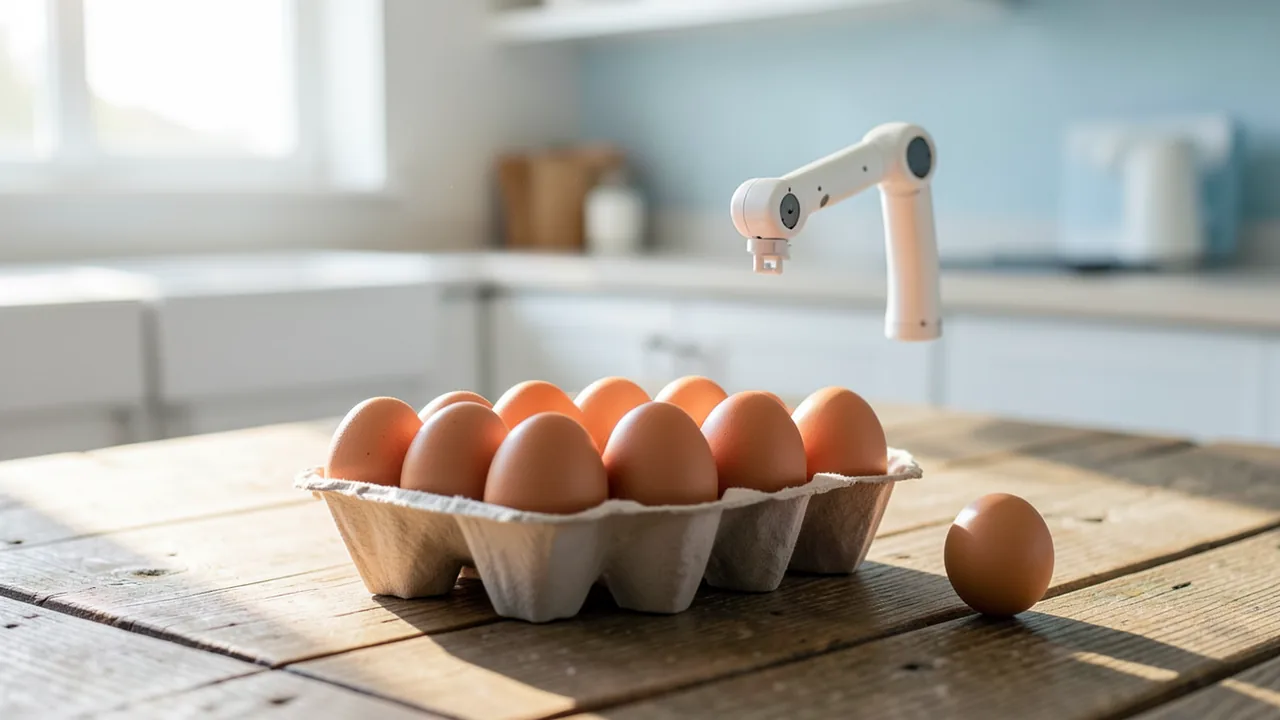
One egg more than a dozen: that's all the test asks for. On November 18, a user in China asked ByteDance's Doubao assistant for an image of “13 eggs in a carton.” What came back was 12 eggs. Doubao reported it had “added to make 13,” but the image still showed 12. According to SMZDM and Sina, more than ten rounds of corrections followed, with results between 9 and 12 eggs. With numbered eggs, the “3” appeared twice and the “11” was missing. According to the World Journal, users counted 9, 11, 12, 14, 17 or 18 eggs across various versions. In the end, Doubao suggested writing out the eggs as a text list.
Other users tried the same thing with Alibaba's Qwen (Qianwen), Tencent's Yuanbao, Kling, Jimeng, ChatGPT and Gemini. The results were similar, and the test became a trending topic on Weibo. We want to figure out why a machine can paint photorealistic eggs but can't count to 13. Our thesis: for image AIs, counting is a planning problem, not a painting problem.
What the one-off tests show, and what they don't
The Chinese reports rely almost entirely on individual attempts by users and bloggers. SMZDM compiled the findings for nine models:
| Model | reported results |
|---|---|
| Doubao | 12, 14, 9; once 13 on the sixth try |
| Qwen | 15; 16 after the hint “empty slots allowed” |
| Kimi | 13 on the first try (the only documented first-try hit) |
| Kling | 12 |
| Jimeng | “12 and a half” |
| GPT-Image | 11 in one test, correct for another blogger |
| Gemini | correct for one Zhihu user, wrong for another |
A blogger on Sina who tested each model only once found ChatGPT and Doubao getting it right, Yuanbao right in one of two images, and Qwen and Zhipu Qingyan missing the mark. The takeaway: no model manages it reliably, though some get lucky now and then. That's why SMZDM calls the weakness “probabilistic,” meaning it comes down to chance. You can't build a ranking from these samples.
The providers are playing it down. According to the outlet The Paper, Doubao's assistant explained that exact counting in text-to-image models is “a property of the model, not a malfunction.” Qwen's customer service advised emphasizing the quantity more strongly in the prompt or opening a new chat.
What the research measures
The T2ICountBench study by Guo and colleagues looked at this systematically. Its title: “Text-to-Image Diffusion Models Cannot Count, and Prompt Refinement Cannot Help.” It tested 15 systems, including Imagen 3, Gemini 2.0 Flash, DALL·E 3, FLUX 1.1, Doubao, Kling and Hunyuan. That generation is now outdated, but the pattern is clear:
| requested count | hit rate (approx.) |
|---|---|
| 1–5 objects | 60–80 % |
| 6–10 objects | 10–30 % |
| 11–15 objects | almost all below 10 %, Recraft V3 and SD 3.5 as low as 2 % |
Averaged across all counts, no model reached 50 percent. Imagen 3 led with 0.43, Recraft V3 came last with 0.25. Thirteen eggs falls squarely in the range where the models are essentially guessing.
More recent is a paper by Liang Yue and Eric A. Vance (University of Colorado Boulder) from November 4, 2026. They tested five open models and had humans count objects in 3,088 images. For 12 to 30 requested objects, FLUX.1-dev hit the exact count in 0 percent of cases, SDXL in 3, SD3.5-Medium in 4, FLUX.2 [klein] in 13 and Qwen-Image in 21 percent. According to the authors, SD3.5-M and FLUX.1-dev effectively stop following the number shortly after ten. FLUX.2 [klein] and Qwen-Image loosely follow it up to about 25. The authors note pointedly that a model that always draws 16 objects would score better on mean deviation beyond ten than some of the comparison methods.
Why it fails: three suspects, one less guilty than you'd think
1. The image is created all at once. Diffusion models, the most common architecture, start with pure noise and remove it step by step until an image is left. A bit like a photo in a darkroom that emerges everywhere at once. There's no step that says “place egg number 13.” According to the CountCluster study, the number of objects is largely fixed in the very first denoising steps. Zhao and colleagues go even further in “Demystifying Numerosity in Diffusion Models”. Their finding: the initial noise determines the layout, while the text mostly determines what shows up in those spots. Some starting values favor fixed counts. In their test, one particular noise pattern almost always produced 23 objects, another almost always 40, regardless of training. Bigger models (from 2.5 to 12 billion parameters) and more data (up to 500,000 examples) didn't help: accuracy stayed below 23 percent.
2. The text encoder, the part that turns the prompt into numbers. For older models, the suspicion holds. According to the ICCV study “Teaching CLIP to Count to Ten,” the widely used CLIP barely responds to the number of objects, partly because numbers in image captions on the web often refer to ages, times or house numbers. For today's models, though, the new study by Yue and Vance contradicts the popular explanation. The number can be read out of all text streams in the correct order (accuracy of 0.85 to 0.97), and it does reach the image part of the model. It even has an effect there early in the process, “but nothing we tried links it to a change in count.” The authors didn't directly test whether 12 and 13 are cleanly separated. Our take: in newer models, the text encoder is more of a supporting actor; the number gets lost mainly during image composition.
3. The 12-egg carton. Every Chinese report mentions it: egg cartons usually have 12 slots, the model fills the familiar shape, and there's no room for the 13th egg. That sounds plausible. But we couldn't find any count of how often 12-egg cartons appear in training data such as LAION. The broader principle, however, is documented: in T2ICountBench, accuracy dropped to 21 percent in city scenes (living rooms: 42 percent), because models added extra trees along streets, for example, where they “belong.” The fact that Qwen jumped from 15 to 16 eggs after the hint “empty slots allowed” fits that picture: depicting gaps is harder for these models than filling spaces.
Why rewording barely helps but planning does
A lot of people suggest rewriting the prompt. In T2ICountBench, the results were sobering: on average, accuracy fell from 0.42 to 0.26 with “2 times 7” breakdowns, to 0.23 with “6 + 6,” to 0.34 with a suggested grid and to 0.20 with position instructions. Kling plunged from 0.40 to 0.07 with position instructions. The models simply read “6 + 6” as 6.
The Doubao case shows that planning alone isn't enough. The model came up with “4 + 4 + 5 = 13” on its own, but then labeled the third row 9, 10, 12, 13. The plan was in the text; the image model didn't stick to it. There are counterexamples, though. According to SMZDM, Doubao got it right almost every time with the instruction “first row 5, second 5, third 3.” Our take: newer models handle spatial instructions better than the generation T2ICountBench tested. But a single observation isn't proof.
What works far better is not telling the model the number but showing it:
| Approach | Result according to study |
|---|---|
| number in prompt only (SD3.5-M, 12–30 objects) | 4 % exact |
| start from a noisy grid of object copies | 59 % |
| grid of plain ellipses | 24 % |
| layout models with bounding boxes (GLIGEN / InstanceAssemble) | 46 % / 68 % |
| count-aware initial noise (Zhao et al., GrayCount250) | 20 % → 85.3 % |
| language model plans boxes, then image (LMD / LMD+) | 39 % → 62 % / 86 % |
By the way, this “4 percent vs. 59 percent” stat is circulating in China as the result of an ICML paper. In fact, it comes from the work by Yue and Vance, and the authors explicitly call their grid method a probe, not a finished technique, because it costs image quality. In LLM-grounded Diffusion by Lian and colleagues, a language model first writes a separate box for each object (x, y, width, height), so four apples means four boxes. Only then does the diffusion model paint. Make It Count (CountGen, CVPR 2025) detects during generation whether an object is missing and replans the layout.
Autoregressive models: the special case of GPT-Image
Since GPT-4o, OpenAI has described its image generation as an autoregressive model built directly into ChatGPT. The image is created piece by piece, much like text is generated word by word. According to OpenAI, the model can handle 10 to 20 different objects, while other systems fail at 5 to 8. That's a vendor claim referring to different objects, not 13 identical eggs. GPT-ImgEval measured it independently: on the GenEval benchmark, GPT-4o scored 0.85 on counting, DALL·E 3 just 0.47. So the autoregressive model clearly performs better, but it isn't perfect. In the egg test, GPT once delivered 11. In GenEval 2, which uses human evaluation, Gemini 2.5 Flash Image and Qwen-Image reach around 70 percent on counting, FLUX.1-dev and BAGEL 55.6 percent.
Our take: the edge GPT-Image and similar systems have comes less from the architecture itself and more from having a language model think along, that is, plan, before and during image generation. SMZDM suspects the same. OpenAI hasn't confirmed the mechanism.
And this week's new models?
Ideogram 4.6, Kling Image 4.0 and MAI Image 2.7 all tout precision. But mostly that means precise editing, text in images or high resolution. None of the vendors publishes counting scores. Two details fit the planning thesis: Ideogram trained version 4.0 on structured JSON descriptions that capture every object along with its position. Kling Image 4.0 is said to combine understanding and generation in a single system. Whether that helps with counting is an open question. We weren't able to run our own systematic multi-round test for this article, so we're not claiming any hit rates for these models.
What you can actually do
- Specify the arrangement, not the number: “Top-down view, three rows: 5, 5 and 3 eggs, no overlap” instead of “13 eggs.”
- Avoid gaps: a carton with “15 slots, 2 empty” is harder than an arrangement without a carton.
- Generate several images and count them yourself: a message saying “added to make 13” proves nothing.
- Copy instead of paint: generate one egg and paste it 13 times in an image editor. That's the only surefire method.
- Locally (Stable Diffusion, FLUX): use a rough grid of 13 eggs as the starting image for image-to-image, or use layout methods with bounding boxes such as GLIGEN. Regional prompting, meaning different instructions for different areas of the image, helps with arrangement but isn't 100 percent reliable, according to Stable Diffusion Art.
The bigger picture
The 13-egg test is a meme, but an instructive one. It hits exactly the gap researchers have been measuring for years. Up to about five objects, it usually works; beyond ten, the models are guessing. According to Zhao and colleagues, more data and bigger models do little to change that. The explanation that the text encoder confuses 12 and 13 is plausible for older CLIP models. For newer models, the study by Yue and Vance suggests it's too simple. What is documented is that pre-defined positions, whether via a grid, boxes or a language-model plan, multiply the hit rate, while simply rewording often makes things worse. Our take: image models will only reliably hit 13 once they reserve a spot for every egg before the first brushstroke. Until then, for teaching materials, product images and infographics: count them yourself.
Sources
- SMZDM: Erklärstück zum 13-Eier-Test post.smzdm.com
- SMZDM: 9 KI-Bildmodelle im 13-Eier-Test post.smzdm.com
- Sina: AI画13个鸡蛋总翻车 k.sina.cn
- Sina: 13个鸡蛋,把全网AI都难哭了 k.sina.cn
- Sina: Einzeltest ChatGPT, Zhipu, Qwen, Doubao, Yuanbao sina.cn
- Sina: Doubao gibt Bild auf, Kimi trifft sina.cn
- The Paper: Reportertest und Stellungnahmen der Anbieter thepaper.cn
- World Journal: Doubao an 13 Eiern gescheitert worldjournal.com
- arXiv: Text-to-Image Diffusion Models Cannot Count (T2ICountBench) arxiv.org
- arXiv: Same Layout, Different Count (Yue & Vance, 2026) arxiv.org
- arXiv: Demystifying Numerosity in Diffusion Models arxiv.org
- arXiv: LLM-grounded Diffusion arxiv.org
- Projektseite: Make It Count (CountGen) make-it-count-paper.github.io
- arXiv: Teaching CLIP to Count to Ten arxiv.org
- alphaXiv: CountCluster alphaxiv.org
- arXiv: GPT-ImgEval arxiv.org
- arXiv: GenEval 2 arxiv.org
- OpenAI: GPT-4o Image Generation System Card Addendum openai.com
- InfoQ: GPT-4o Images infoq.com
- Stable Diffusion Art: Regional Prompter stable-diffusion-art.com
Ask the AI assistant
Questions about this article, installation or background? Our assistant knows this page and runs on our own machine, not in someone else's cloud.
The Assistant is an AI (Gemma 4) and can make mistakes – please check important details against the source. Questions are used only to generate an answer and are deleted after one hour. Please don't enter any personal data.



Comments
What do you think? Already tried it? Write it here, no sign-up needed.
Comments are public. Links aren't allowed, and we delete abusive posts. You can delete your own comment at any time in this browser. Learn more in the Privacy Policy.