
A 30-Yuan Ring Fools Your Car: How It Checks Whether You're Still Driving
In China, drivers pay a few euros for rings that trick the steering wheel into sensing hands. Courts there now hand out prison sentences for using them. We explain the three ways cars check whether you're paying attention, and how easily each one can be beaten. There's also a contradiction: in Europe, the camera that exposes these tricks is the very technology that will soon make hands-free driving legal.
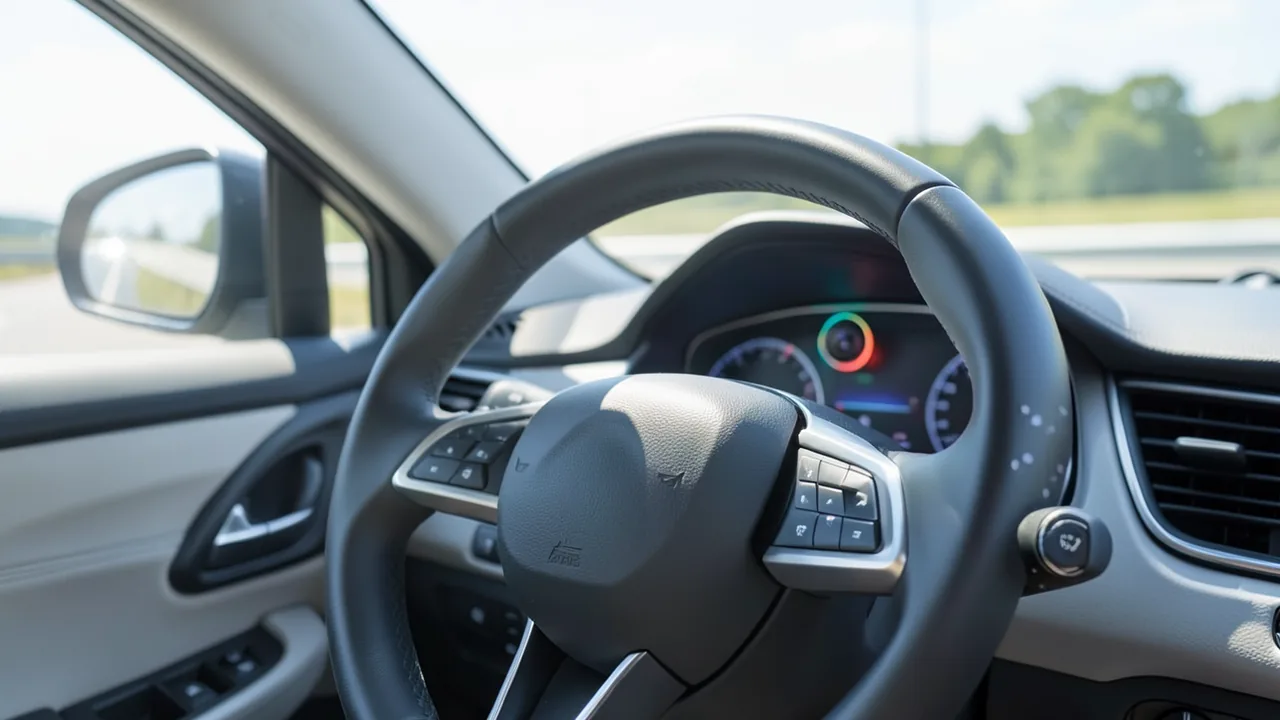
What this is about
On November 14, the traffic management bureau of China's Ministry of Public Security reported a case from Qingdao. On November 7, a red SUV was traveling on the expressway while its driver lay asleep with his seat reclined. His family was in the car with him, four people in total, with a child under twelve in the front passenger seat. A witness reported the car, and police guided it to a toll station. According to the authorities, the man had been caught before using his phone or driving with his eyes closed while the assistance system was engaged. The statement doesn't say why the car's driver monitoring failed to stop him.
Cases like this raise a simple question: how does a car actually check whether the person behind the wheel is still paying attention? And how hard is it to fool that check? We walk through the three methods in common use today, along with the trick that beats each one. Our argument: the camera that makes cheap gadgets useless is the same technology that will soon let drivers take their hands off the wheel legally. Whether it detects real inattention hasn't been proven.
Method 1: The wheel measures force, and a weight is enough
The oldest method is the steering torque sensor. It sits in the steering system and registers whether someone is applying a slight turning force to the wheel. That's why you often get a warning even when your hands are resting lightly on the wheel. Chinese drivers call the fix “摇一摇,” roughly “give it a little shake.” The portal xchuxing lists Tesla's Model 3 and Y, along with models from XPeng and NIO, among the cars that use this approach.
The trick is simple: hang a weight on one side of the wheel. The car mistakes the steady pull for a hand. In 2018, the US traffic safety regulator NHTSA ordered the maker of the “Autopilot Buddy” to stop selling it. The device cost about $200 and was essentially just such a weight. In 2021, Consumer Reports engineers placed a small chain on the steering wheel of a Tesla Model Y. The car then drove repeatedly around a test track with nobody in the driver's seat. That same year, Car and Driver tested 17 cars, and an ankle weight on the wheel fooled most of them. According to reporting by Guangming Daily, the Chinese gadgets often work the same way. They're lockable rings with a weight and a magnet inside that mimic the pressure of a hand.
Method 2: The wheel senses skin, and a power cable helps
Better steering wheels are capacitive. A sensor layer under the leather responds to the electrical properties of skin, just like a smartphone screen. Two fingers are enough, no force required. That's why the ankle weight didn't work on the BMW and Mercedes in the Car and Driver test: both relied on touch sensors.
Gadget sellers have adapted. According to China Consumer Daily, one shop marketed the rings as “全新电容辅助环” (“new capacitive assist ring”) and promised the system would “reliably stay on.” A CCTV reporter found products that, according to the seller, work only on capacitive wheels. That's why sellers asked for the brand and model year, and some models need a power cable. In the Hangzhou case, reports say the module plugged straight into a connector inside the steering wheel. In CCTV's test on a closed course, the car without a gadget asked for hands on the wheel after about 20 seconds, then sounded an alarm and disengaged. With a gadget, the warnings stopped. One device failed after about five minutes, with no warning at all.
The rings are cheap. In May 2025, China Consumer Daily cited prices from 30 to over 100 yuan. In one shop with 87 percent positive reviews, everything cost under 30 yuan (just under €4). CCTV found prices of 60 to 100 yuan, Guangming Daily 50 to 130 yuan. In Shanghai, the Changning District prosecutor's office had 63 listings removed from one platform. Some individual products had sold more than 13,000 times there.
Method 3: The camera sees your eyes, but not inside your head
The third method is an infrared camera pointed at the driver, known as a Driver Monitoring System (DMS). It tracks head position, blinking and gaze direction. A ring on the wheel does nothing against it. But the camera isn't invulnerable either:
- Decoys: In Car and Driver's test, GM's Super Cruise was fooled by glasses with eyes printed on them.
- Covering it up: According to reports from 2021/22, Consumer Reports could still use Tesla's Autopilot with the cabin camera covered. In the 2024 IIHS tests, BMW's system didn't react to a covered lens or a covered face.
- Sunglasses: Some lenses block infrared light. According to Electrek, Tesla closed a “sunglasses loophole” with FSD v12.4 in May 2024. Since then, under certain conditions, it has relied on the camera alone instead of steering torque.
The fundamental problem lies elsewhere. Your eyes can be on the road while your mind is somewhere else. Experts call this “looked but failed to see.” A simulator study from the University of Liège (Halin et al., 2025, 29 participants) found only a small difference under mental arithmetic distraction: drivers' gaze rested on the center of the road 73.3 percent of the time instead of 76.1 percent. The authors themselves write that gaze-based metrics can miss cognitive distraction. In a study with 52 participants, the Toyota Research Institute combined eye movements and pupil size to detect mental distraction. We found no reliable accuracy figure for real production cars in the research.
| Method | What it measures | Known trick | Evidence |
|---|---|---|---|
| Steering torque | Turning force on the wheel | Weight, chain, magnetic ring | NHTSA 2018, Consumer Reports 2021, Car and Driver 2021 |
| Capacitive | Skin contact with the wheel | Electrical “assist ring,” module in the steering wheel connector | CCTV 2025, China Consumer Daily 2025 |
| Camera (DMS) | Head, eyelids, gaze | Fake eyes, covering the camera, IR-blocking glasses. Mental absence goes undetected | Car and Driver 2021, IIHS 2024, Halin et al. 2025 |
The industry as a whole performs poorly. In 2024, the IIHS tested 14 systems: only one rated “acceptable,” two “marginal” and eleven “poor.” None met all of the driver monitoring requirements. Also in 2024, NHTSA closed an investigation into Tesla's Autopilot. It concluded that the “weak driver engagement system” was not appropriate for Autopilot's “permissive operating capabilities.” Recall 23V-838 covered about 2.03 million cars, and the agency is checking whether it works in a separate proceeding (RQ24-009).
What China's courts are deciding
On September 13, 2025, a man in Hangzhou got into his car after drinking. He activated the Level 2 system (Level 2 means the system steers and brakes, but the human stays responsible), entered a destination and, with a gadget installed, moved to the passenger seat. The car drove for about 20 minutes without a driver until it stopped in the middle of the road with its hazard lights on. His blood alcohol level was 114.5 mg per 100 ml. The Linping People's Court sentenced him to one month and 15 days in prison and a 4,000-yuan fine for dangerous driving. On February 13, 2026, the Supreme People's Court made it a guiding case. Its reasoning: a Level 2 system can't replace the driver. If you bypass the monitoring and switch seats, you're still the driver.
Courts in Hunan and Zhuhai recently presented a case from Suzhou. With the navigation assistant engaged, a driver hit a man who was setting up warning triangles behind a broken-down car. The victim died. The driver was found fully at fault, convicted of causing death by negligent driving and paid the family more than 600,000 yuan on top of the insurance payout. Pedal and steering data, along with logs from the assistance system, served as evidence. Sellers and platforms can also be held liable: under China's E-Commerce Law, platforms share liability if they knew or should have known about illegal listings.
New rules: China demands hands and eyes, Europe frees the hands
| China: GB 47955-2026 | UN R171, 02 series | |
|---|---|---|
| Status | Mandatory standard, published July 2026 | Adopted June 24, 2026 (ECE/TRANS/WP.29/2026/86) |
| Applies from | January 1, 2027 | Not yet official, observers expect around January 2027 |
| Hands | Monitoring required, reports say prompt after 5 s, warning after 10 s | On motorways and similar roads up to 130 km/h, hands-on requests can be dropped |
| Gaze | Monitoring required, reports say prompt after 5 s, then features are scaled back | Main safeguard, glances at the display count for 3 s at most |
| Lockout | At least 30 minutes after a risk mitigation function or repeated violations | At least 30 minutes for insufficient engagement |
The risk mitigation function (RMF) brings the car to a controlled stop if the driver stops responding. Treat the Chinese timings with caution. We haven't been able to see the text of the standard, and media reports partly contradict each other. What's officially confirmed is the requirement for hand and gaze detection, escalating warning levels, controlled disengagement and a lockout. According to the draft, the car must also check after every start whether the driver has completed a training course. The 5 seconds cited match what the first series of R171 already required. According to the ETSC in 2024, that version issues a hands-on warning after 5 seconds, or after 10 if the driver's eyes are on the road.
The European Transport Safety Council (ETSC) sharply criticizes the 02 series. Its expert Frank Mütze speaks of a “gray zone where the lines between assistance and automation become dangerously blurred.” The driver becomes a passive supervisor, he says, yet remains fully liable.
“Current eye-tracking technology cannot determine whether a driver looking at the road is mentally somewhere else.” – ETSC
Back in 2024, the ETSC said 5 seconds without looking at the road was too long. It considers 2 seconds to be the scientifically safe limit.
The camera paradox
The gadgets prove that hands-on detection alone can be defeated for a few euros. The camera largely closes that gap, since a ring on the wheel does nothing against it. China's conclusion is to require both. Europe is taking a different path and using the camera as a reason to free the hands entirely. That leaves a single watchdog: a sensor that sees eyes, but not thoughts.
At the other extreme is Tesla's Cybercab. As of this week, invited customers can reserve one for $29,990, and the $1,000 deposit is non-refundable. On top of that comes a mandatory subscription of $299 a month. The car has no steering wheel or pedals and will initially operate only in eight cities in Texas and Florida. According to Infobae, NHTSA hasn't yet decided whether a car without a brake pedal meets US safety standards. Without a steering wheel, there's no human left for any system to monitor, so responsibility would have to lie with the system. The reports don't say who would be liable in the case of a privately owned vehicle.
Our take
The new rules will make the cheap rings largely useless, and that's real progress. But the evidence doesn't show that cameras measure attention. If anything, it points the other way. Cameras measure gaze direction, and even that can be disrupted by decoys or poor lighting. Europe's decision to allow hands-free driving rests on a sensor whose limits are well known in the research. That's the core of the ETSC's criticism, and carmakers haven't refuted it so far. It's also unclear how and when the EU will adopt the 02 series. The legal situation, on the other hand, is clear: in China, Europe and the US, the human is liable at Level 2. The rulings from Hangzhou and Suzhou show that courts don't accept the gadgets as an excuse. They treat them as proof that the driver deliberately bypassed the monitoring.
Sources
- SMZDM: Drei Urteile zu „智驾神器“ post.smzdm.com
- SMZDM: Schlafen mit Assistenzsystem auf der Autobahn – Strafen post.smzdm.com
- SMZDM: Qingdao-Fall und die rechtlichen Grenzen post.smzdm.com
- The Paper: Leitfall des Obersten Volksgerichts m.thepaper.cn
- NetEase: Hangzhou-Fall, Urteil 163.com
- Sohu: CCTV-Test der „智驾神器“ sohu.com
- Guangming/China Consumer Daily: Gadget-Preise und Shops m.gmw.cn
- Guangming Daily: Magnetringe, Staatsanwaltschaft Changning m.gmw.cn
- Xinhua: GB 47955-2026 veröffentlicht news.cn
- MyDrivers: Details zu GB 47955-2026 news.mydrivers.com
- NBD: Entwurf der Norm 2025 nbd.com.cn
- xchuxing: Lenkmoment- vs. kapazitive Händeerkennung xchuxing.com
- ETSC: Kritik an neuen DCAS-Regeln (2026) etsc.eu
- ETSC: Neue Anforderungen an Fahrerüberwachung (2024) etsc.eu
- Regvault: UN R171 Serie 02 – Änderungen regvault.net
- notanfsdtracker: R171 Serie 02 und Tesla FSD notanfsdtracker.com
- UNECE: Highlights WP.29 Juni 2026 unece.org
- IIHS: Erste Bewertungen der Schutzmechanismen iihs.org
- Motor1: Car-and-Driver-Test von 17 Assistenzsystemen motor1.com
- Consumer Reports: Tesla fährt ohne Fahrer consumerreports.org
- NHTSA: Abschluss EA22002 static.nhtsa.gov
- Electrek: NHTSA prüft Tesla-Rückruf electrek.co
- Electrek: FSD v12.4 und Sonnenbrillen-Lücke electrek.co
- Motor Authority: NHTSA stoppt Autopilot Buddy motorauthority.com
- arXiv: Halin et al., Blickbasierte Indikatoren für kognitive Ablenkung arxiv.org
- Infobae: Tesla Cybercab für Privatkunden infobae.com
Ask the AI assistant
Questions about this article, installation or background? Our assistant knows this page and runs on our own machine, not in someone else's cloud.
The Assistant is an AI (Gemma 4) and can make mistakes – please check important details against the source. Questions are used only to generate an answer and are deleted after one hour. Please don't enter any personal data.



Comments
What do you think? Already tried it? Write it here, no sign-up needed.
Comments are public. Links aren't allowed, and we delete abusive posts. You can delete your own comment at any time in this browser. Learn more in the Privacy Policy.