
A mystery since 1986: Claude helps solve first 3D structure of a bacterial vault
Anthropic's biology team used Claude to determine, for the first time, the 3D structure of a vault from the world of bacteria and their viruses. Vaults are giant hollow protein barrels, and after almost 40 years nobody knows what they do. The AI sped up the work considerably, but it also made mistakes that humans had to catch and fix.
What it's about
Anthropic, the company behind the AI model Claude, has been running its own biology lab since 2026, complete with a real wet lab. That means rooms where people work with actual biological samples, not just computers. In early November 2026, the team announced a research result. Sources give the date as either November 4 or November 5. With Claude as an assistant, the team determined the three-dimensional structure of a prokaryotic vault for the first time.
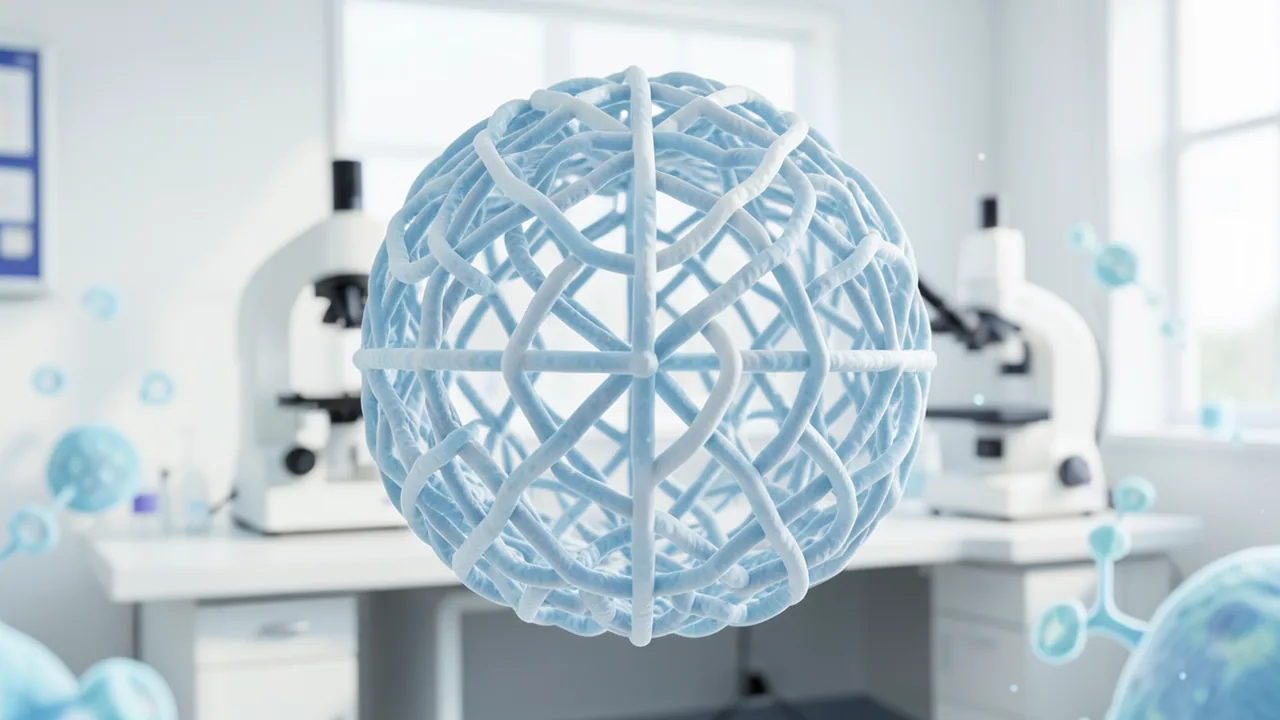
Vaults are giant, hollow protein barrels. They were discovered in 1986, in liver tissue. They show up in the cells of many organisms. According to AIBase, a single human cell contains close to ten thousand of them. They're considered the largest protein complexes in cells that don't come from viruses. But after nearly 40 years of research, nobody knows exactly what they do in the cell.
Until now, vaults have mostly been studied in eukaryotes, organisms whose cells have a nucleus, such as plants, animals and fungi. Prokaryotes are bacteria and archaea, which have no nucleus. The newly solved vault comes from a bacteriophage, a virus that infects bacteria.
Finding the needle in the haystack
It started with a huge data search. According to AIBase, the team used Claude to comb through 15 billion predicted protein sequences looking for homologs, related proteins that share a common origin. The hits were spread across 29 bacterial phyla and four archaeal phyla. From these, the team picked 44 candidates for lab experiments.
The genes were inserted into the gut bacterium E. coli, which researchers use as a protein factory. Seven of the 44 proteins assembled on their own into dome-shaped particles. Using cryo-electron microscopy, the team confirmed four complete structures. In this technique, samples are flash-frozen and imaged thousands of times in an electron microscope until a 3D picture can be computed.
Homeland411 says the predicted structures came from the AlphaFold database and deep metagenomic databases (collections of genetic material from environmental samples). The other sources don't clearly confirm this.
The L05 vault: bigger and tunable
The best result came from the protein of bacteriophage L05. The resolution is 3.2 Ångström. One Ångström is a ten-millionth of a millimeter, and at 3.2 Ångström you can clearly make out individual building blocks of the protein chain. The key numbers:
| Feature | Human/mammalian vault | Bacteriophage vault L05 |
|---|---|---|
| Protein chains per particle | 78 | 96 (all identical) |
| Wall repeats per chain | 9 | 7 |
| Shape | elongated | shorter, wider, almost spherical |
| Size | – | 54.5 × 47.5 nanometers |
| Interior volume | baseline | about 25% larger |
| Lab production | mammalian or insect cells | bacterium E. coli |
The figures for mammalian vaults (78 chains, shape, production) come from the Homeland411 report. That report also says the L05 vault has 48-fold rotational symmetry.
The team then went a step further. It built extra wall repeats into the protein, and the interior volume grew by around 20 percent. In other words, you can set the size of the barrel by changing the number of these building blocks. That makes the vault interesting as a delivery container, for example to package enzymes or drugs. Mammalian vaults can only be made through laborious animal cell culture. According to Homeland411, a vault that self-assembles in bacteria would be much easier to produce in large quantities.
What Claude contributed, and where the AI got it wrong
According to Anthropic, Claude was involved in almost every step:
- searching for suitable proteins and through the scientific literature
- designing the DNA constructs for the lab experiments
- improving purification, meaning the process of extracting the particles from the bacteria
- analyzing the electron microscopy data
Anthropic says the time savings were substantial. Purification took 90 minutes instead of three days. The first complete structural model was ready after 34 hours, a job that would normally take weeks. Cryptobriefing sums it up: work that used to take weeks or months shrank to days.
Anthropic doesn't hide the AI's weaknesses. Claude suggested an additive that interfered with getting the DNA into the cells, and the researchers lost two weeks waiting for results that never came. When analyzing the microscopy data, Claude skipped standard steps and produced inaccurate images. The errors only came to light through careful checking. According to AIBase, the project shows that the models are still far from doing research on their own. Cryptobriefing warns that an undetected error in a method or structure could steer a research program in the wrong direction for a long time.
What happens to the data now
According to AIBase, the data for L05 and its enlarged variants have already been deposited in the Protein Data Bank, the global public database for protein structures. Homeland411, on the other hand, says the coordinates will be submitted to the PDB and posted as a preprint on bioRxiv by mid-November. Homeland411 also reports that more candidates from the initial search will be studied and that bioreactor production trials are planned for the first quarter of 2027. These details come from that single source only. It also includes a quote from an unnamed "Senior Research Fellow" that can't be verified.
The central question is still open: what vaults actually do in the cell remains unclear. According to Cryptobriefing, the structure could offer clues to a role in intracellular transport or stress responses, but that hasn't been shown.
Our take
The finding matters for basic research. It shows that vaults exist outside eukaryotes, and it delivers a high-resolution structure plus a protein container that can be made in bacteria and resized at will. For Anthropic, it's also a showcase. The company calls the result "another" one from its biology lab and wants to position Claude as a tool for science.
You should keep in mind that the timings and the AI's role come from Anthropic itself. The sources don't mention a peer-reviewed paper, and from the outside it's impossible to tell how much credit belongs to Claude and how much to the researchers. Anthropic's openness about the mistakes makes the report more credible. But it also shows that AI-assisted lab research currently only works with experienced people checking every step. On top of that, AI that plans biological lab work raises questions about misuse for harmful purposes (dual use). Homeland411 points this out.
Sources
- Bing News (en-US) kucoin.com
- cryptobriefing.com cryptobriefing.com
- homeland411.com homeland411.com
Ask the AI assistant
Questions about this article, installation or background? Our assistant knows this page and runs on our own machine, not in someone else's cloud.
The Assistant is an AI (Gemma 4) and can make mistakes – please check important details against the source. Questions are used only to generate an answer and are deleted after one hour. Please don't enter any personal data.
Comments
What do you think? Already tried it? Write it here, no sign-up needed.
Comments are public. Links aren't allowed, and we delete abusive posts. You can delete your own comment at any time in this browser. Learn more in the Privacy Policy.