
AI agents run an 11,382-step lab experiment while humans just refill the chemicals
In the same week, two teams showed that AI can do more than plan biology experiments. It can also run them on real lab equipment. AutoDNA, a lab in Shanghai, worked largely on its own for eight and a half days, and Anthropic's Claude helped tackle a 40-year-old puzzle in cell biology. Both teams give hard numbers, and both list their mistakes.
What's going on
Until now, AI in biology has mostly made suggestions: which experiment might be worth running, which molecule looks promising. People in the lab still had to carry the work out. Two reports from November 4, 2026 suggest that's starting to change. The French outlet MACCUS published a roundup of both.
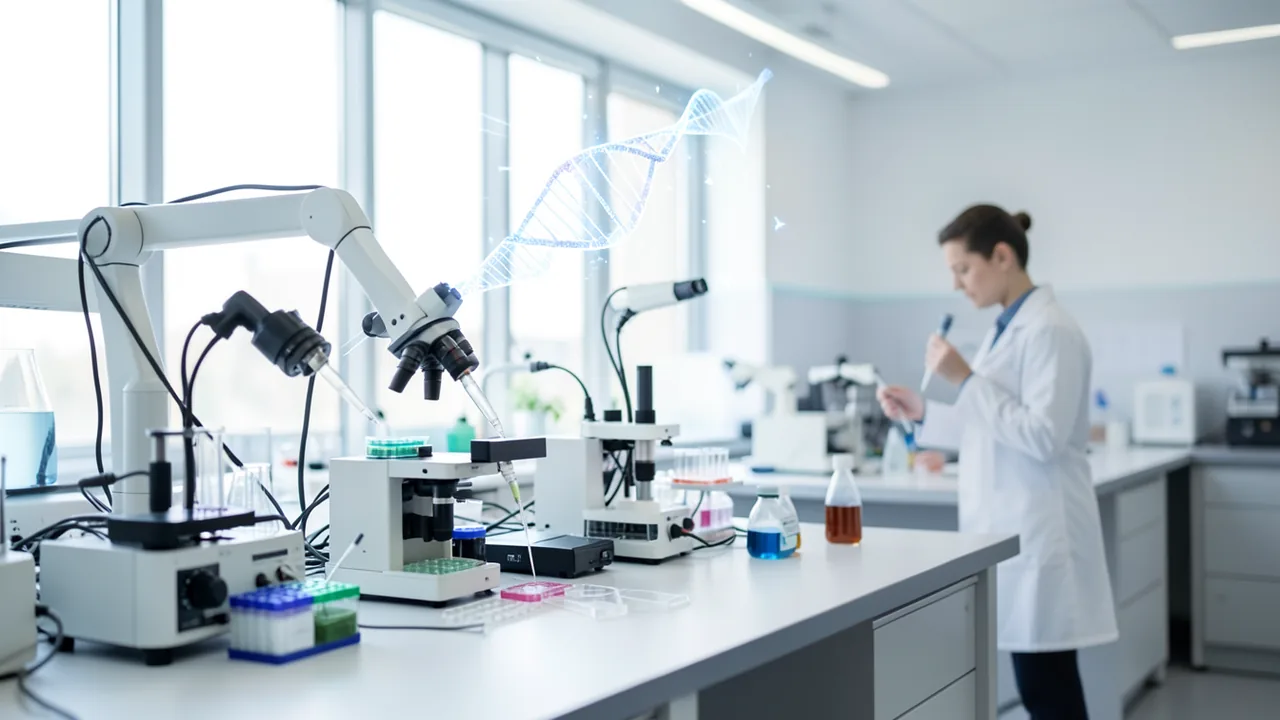
The first is a paper from Shanghai Jiao Tong University in the journal Nature. It describes AutoDNA, a lab where AI agents planned and ran molecular biology experiments on more than 20 instruments. AI agents are AI programs that plan and carry out several steps in a row on their own. The second came the same day from AI company Anthropic, which reported that its model Claude helped solve the three-dimensional structure of a particular vault particle for the first time. Vaults are hollow protein shells, and scientists have spent 40 years trying to work out what they do in the cell. Both teams give specific numbers on time saved and spell out where things still go wrong.
AutoDNA: a lab that ran itself for eight days
The paper was submitted on October 1, 2025 and accepted on September 30, 2026. According to the abstract, the system autonomously "orchestrates over 20 types of instruments across more than 11,000 steps." It handles the core work of handling DNA: making DNA, transcribing it into RNA (the working copy cells use to put genetic information to use), copying it many times over and reading out the sequence, meaning the order of its building blocks. According to the paper, humans only step in for maintenance, "such as replenishing reagents and lab supplies." In other words: chemicals, plus tubes and plates.
AutoDNA was tested on four tasks:
| Task | Result according to the team |
|---|---|
| Making DNA | as much usable DNA as human experts |
| Running several protocols in parallel | 3.2 times faster than running them one after another |
| Storing data in DNA and reading it back | error-free |
| Cancer mutation in a patient sample | KRAS G13D found and confirmed |
The longest single run was the data storage test. The Chinese outlet 36Kr and the Korean newspaper Chosun Ilbo both cite the team's press release, and according to them the run took about 203.5 hours (around eight and a half days) and covered 11,382 hardware steps. The system wrote a single sentence into 78 DNA strands and read it back without a single error. The sentence: "Intelligence is the ability to adapt to change." According to 36Kr, humans during that time were "mainly limited to regularly disposing of experimental waste and refilling reagents," and only when the system asked them to. One caveat: these two figures come from the press release, not from the paper's abstract.
Heidi Ledford summed it up in Nature's news section:
"Human hands are needed only to replenish reagents and maintain the hardware."
Co-author Haibo Chen, a computer scientist at the university, told Nature that many existing systems still require "human experts to configure the instruments," and that AI is usually "only added for part of the process." Milad Abolhasani, a chemical engineer at North Carolina State University who wasn't involved in the work, called AutoDNA "remarkable, both for its degree of autonomy and because it can easily integrate a wide range of lab instruments." He expects that "the future of science will include many autonomous labs."
Claude and the mystery of vault particles
Anthropic went after an older puzzle. Vault particles (named for their arched, vault-like shape) are hollow protein shells found in the cells of many organisms. They were discovered in 1986, and no one knows for sure what they do. Anthropic now reports the first 3D structure of a vault built from a bacteriophage protein, meaning a protein encoded by a virus that infects bacteria. The shell is made of 96 copies of this protein, which the team named L05. It has about 25 percent more internal space than the human version, which has 78 copies. The team produced the shells in bacteria in the lab.
According to Anthropic, Claude handled several tasks under the researchers' direction. It searched protein databases, designed DNA sequences that the team ordered from suppliers, suggested a faster way to isolate the particles, and ran the software that turns microscope images into a 3D model. For the search, the team used a science-focused version called Claude Science, which combed through about 15 billion computationally predicted proteins. It found related proteins in 29 bacterial groups and four groups of archaea, a separate branch of single-celled microbes.
On the time saved, the team writes:
"A vault purification that typically takes three days took us about 90 minutes, and a first structural model was ready 34 hours later – something we estimate would normally have taken weeks."
Purification here means separating the particles from the rest of the sample. According to Anthropic, the whole project took "under four months." The results are in a preprint, a paper published before independent experts have reviewed it (peer review). It went up on bioRxiv on November 5 under an open license. The work is part of a series from Anthropic's biology lab: in late October, the company reported that Claude had helped a one-person company coordinate drug programs across eleven outside labs.
Where it still breaks down
Both reports flag their own limits. The AutoDNA team logged 14 hardware failures. James Zou, a data scientist at Stanford, breaks them down in his accompanying Nature commentary: the system fixed 8 by itself, and 6 needed a human. The researchers also warn that the built-in randomness of large language models means the same plan may not produce the same result when repeated. That's a real problem for reproducibility, which is central to science. The system can't yet run experiments on living animals.
Anthropic, for its part, is describing its own product, mistakes included. One protocol Claude wrote called for a growth medium (the nutrient mix used to grow cells) with an additive that blocked part of the work. That cost about two weeks. Early in the analysis of the microscope images, the model skipped a standard step and produced a flawed 3D map that was mixed up with its own mirror image. The team then told it to stop improvising.
Plenty is still unanswered. What vaults actually do remains unknown. So far, the particles have only been produced in E. coli, the standard lab bacterium, and not in the organisms where they occur naturally. Leonard Rome, who co-discovered vaults in 1986 and is a paid advisor to the project, said the breadth of the finding suggests "that it's going to be a complicated function."
The bottleneck is shifting
In his commentary, Zou spells out what's at stake: an AI can "design a promising biologically active molecule in minutes, but testing it can take weeks or months." The Shanghai work could "begin to close the gap between proposing an experiment and carrying it out." After math and physics, the lab is the latest field where AI is showing results. In late October, one startup founder even claimed an AI agent had independently chosen and carried out a gene therapy on a mouse.
Peer review is still slow. AutoDNA first appeared as a preprint on arXiv back in July 2025. Back then, the storage test ran for 162.9 hours over 9,365 steps. It took about a year to get from submission to publication. Planning is getting faster, and most of the remaining time now goes into hardware, reagents and verification.
Our take
Both results matter, but you shouldn't put the same weight on each. AutoDNA is a peer-reviewed Nature paper that clearly lists the manual tasks humans still do. The vault structure is a preprint from a company reporting on its own product, though at least it comes with a list of mistakes. Anthropic's time comparisons ("normally weeks") are the team's own estimates. In both cases, AI handled the planning, the code and parts of the analysis, while humans kept the machines running and checked the results. That's a long way from a lab with no researchers at all. What matters now is whether other labs can reproduce these results with different models and without guidance from the original authors. For research and the pharma industry, though, the direction is becoming clear: the bottleneck will increasingly be pipetting and verification, not thinking.
Sources
- Merkliste: maccus.fr maccus.fr
Ask the AI assistant
Questions about this article, installation or background? Our assistant knows this page and runs on our own machine, not in someone else's cloud.
The Assistant is an AI (Gemma 4) and can make mistakes – please check important details against the source. Questions are used only to generate an answer and are deleted after one hour. Please don't enter any personal data.

Comments
What do you think? Already tried it? Write it here, no sign-up needed.
Comments are public. Links aren't allowed, and we delete abusive posts. You can delete your own comment at any time in this browser. Learn more in the Privacy Policy.