
AI balances a 5-ton loader on two wheels, with no one in the cab
Researchers at ETH Zurich taught an AI to tip a five-ton John Deere compact loader onto its front wheels, drive on them, spin in place and even balance its way over a mound of dirt. Almost all of the training happened in simulation, and an ordinary laptop ran the controller on the real machine.
What's going on
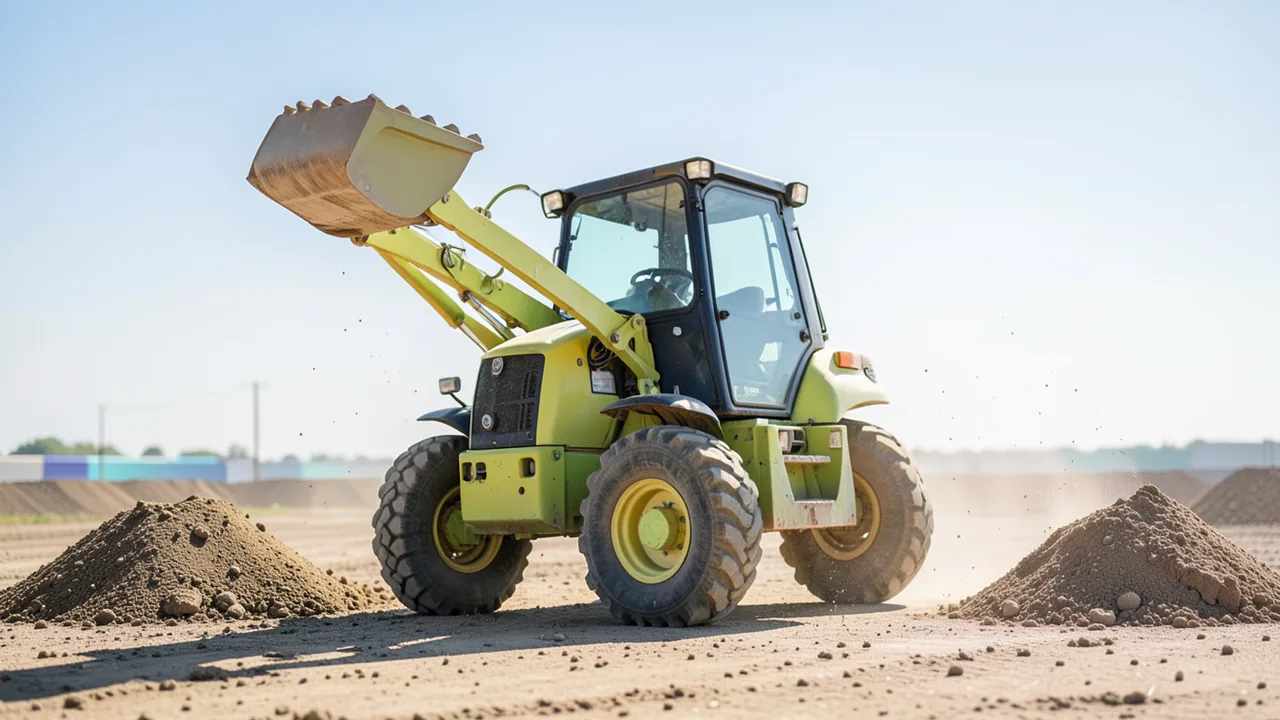
A five-ton compact loader rears up onto its two front wheels, drives forward and backward like that, spins on the spot and even rolls over a mound of dirt without tipping over. Nobody is at the controls. An AI is driving. That's the result of a study by ETH Zurich's Robotic Systems Lab, with US chipmaker Intel among the collaborators. The researchers published their work on November 11 in the journal Science Robotics (DOI: 10.1126/scirobotics.aef0894). Coverage came from the Korean science outlet Dongascience and from blogger Pasquale Pillitteri, among others. Pillitteri describes the machine as a loader "that pulls wheelies on its own."
The test vehicle was a John Deere 332G. It's a skid-steer loader: a compact four-wheeled machine that steers by turning its left and right wheels at different speeds, much like a tracked vehicle. A bucket at the front moves dirt or other material. These machines are everywhere on construction sites, but only a handful of very experienced operators can pull off stunts like driving on two wheels.
Why construction equipment is so hard to automate
Excavators and loaders weigh several tons and run on hydraulics. Their power comes from oil pumped at high pressure through hoses and cylinders, and that's exactly what makes them hard for computers to model. Fluid flow, friction, the flex in components and the delay between a command and the resulting motion all interact. So it's hard to predict exactly how the machine will respond to a given command.
There's also a practical problem. You can't keep testing what happens when a five-ton machine nearly tips over. Endless real-world trials are too dangerous and too expensive.
How the AI learned
The team used reinforcement learning. An AI tries out actions over and over in a virtual environment and gets feedback on whether it's getting closer to its goal, a bit like a child learning to ride a bike by falling off and getting back on. For that training to tell you anything about the real machine, though, the simulation has to match it as closely as possible.
The researchers built it in several steps:
- First they measured the loader's basic physical properties, such as its length and the position of its center of gravity.
- Then they sent the real machine a range of control commands and spent about an hour and a half recording how the hydraulic drive responded.
- They used that data to train a neural network that predicts how the machine moves in response to a given command. This learned model replaces the hard-to-model hydraulics in the simulation.
- The actual reinforcement learning then ran inside that simulation.
To narrow the gap between simulation and reality (the "sim-to-real gap"), the researchers kept changing values such as the center of gravity, inertia and sensor errors throughout training. This technique is called domain randomization. The AI learns not to depend on a single, perfect version of the machine, so it copes with the differences it meets in the real world.
Notably, the system needed no demonstration data. No human operator had to show the AI how to put a loader on two wheels. It worked that out on its own. Four skills were trained separately: lifting onto two wheels, holding the balance, controlling speed and landing gently back on all four wheels. On the real machine, these building blocks were then chained together into one sequence.
What the loader actually pulled off
On the test site, the loader first rocked back and forth to build momentum, then lifted its rear wheels and balanced on the front ones. It held that balance even while the bucket arm moved up and down and shifted its center of gravity. It also turned on the spot and drove on two wheels.
How often it made it up onto two wheels depended on the angle of the bucket arm:
| Bucket arm angle | Successful attempts | Rate |
|---|---|---|
| 28 degrees | 11 of 11 | 100 % |
| 31 degrees | 12 of 12 | 100 % |
| 34 degrees (outside the training range) | 11 of 14 | 78.6 % |
The 34-degree result is the telling one. The AI had never seen that situation in training and still succeeded in nearly four out of five attempts.
Even more surprising: the AI had only practiced on flat ground, yet it kept its balance while driving back and forth on two wheels over uneven terrain with a 75-centimeter mound of dirt. It couldn't even see the terrain, because no cameras or lidar (a laser scanner that maps its surroundings in 3D) were involved. It relied only on onboard sensors, such as those for tilt and wheel speed, and reacted to what it could "feel."
No supercomputer required
The training happened in simulation. Running the finished maneuvers on the real machine took nothing more than an ordinary laptop with an Intel Core i7 processor and 16 GB of RAM, with no powerful graphics card needed. That matters for real-world use: the controller needs no expensive specialized hardware and could be added to existing machines fairly easily.
What it's good for
This research isn't really about circus tricks on construction sites. According to the researchers, it shows that AI can handle complex maneuvers with heavy equipment that only a few top operators can manage today. The team suggests, for example, that construction machines could drive onto transport trucks without a dedicated ramp, roll over obstacles or regain their balance on rough terrain.
Next, the team wants to add cameras, lidar and other environmental sensors and combine multiple control behaviors into a single system. The goal is technology for autonomous construction machines that can take on far more complex tasks.
The bigger picture
ETH Zurich's Robotic Systems Lab is best known for legged robots like ANYmal and has worked on autonomous excavators before. What's new here is mainly how little real-world data it took. An hour and a half of test runs was enough to build a simulation accurate enough to teach a five-ton hydraulic machine a balancing act. A learned drive model, randomized training conditions and reinforcement learning together make up a recipe that will likely carry over to other heavy machines.
Some questions remain. Testing took place on a controlled site with a single type of machine. There's no evidence yet of how reliably the system works on a real construction site, with people, materials and changing ground. The 78.6 percent success rate outside the training range also shows its limits. On a machine this size, failing one attempt in five would be unacceptable in real use. And without cameras and lidar, the AI can't "see" anything around it, which the researchers still have to fix. So the autonomous construction site is a long way off. But the study makes a clear case that driving skills only professionals have today can be taught to heavy hydraulic machines too.
Sources
- Google News (US) news.google.com
- dongascience.com dongascience.com
Ask the AI assistant
Questions about this article, installation or background? Our assistant knows this page and runs on our own machine, not in someone else's cloud.
The Assistant is an AI (Gemma 4) and can make mistakes – please check important details against the source. Questions are used only to generate an answer and are deleted after one hour. Please don't enter any personal data.



Comments
What do you think? Already tried it? Write it here, no sign-up needed.
Comments are public. Links aren't allowed, and we delete abusive posts. You can delete your own comment at any time in this browser. Learn more in the Privacy Policy.