
Amap λ0: Robots learn whole-body movement from everyday human motion data
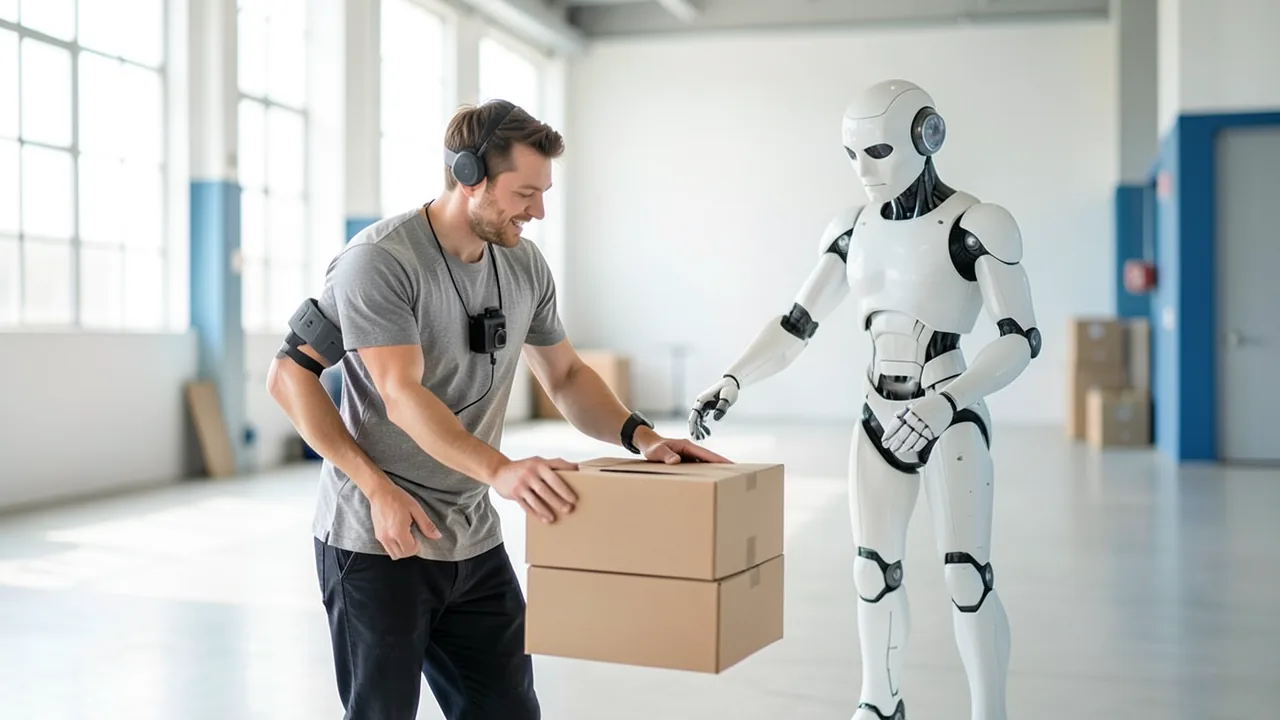
Alibaba's mapping service Amap (Gaode) has unveiled λ0, a foundation model meant to teach robots whole-body coordination purely from human motion data. People collect the data with consumer devices in daily life, with no robot involved. The company says this is more than three times faster than recording on the robot itself.
What this is about
Amap, known in China as Gaode and part of the Alibaba group, has unveiled a robotics model called λ0 (Lambda 0). The company calls it the first whole-body foundation model built on behavior in open, unstructured environments. A foundation model is a large, broadly trained model that can later be adapted to many tasks. What sets it apart: λ0 is meant to teach robots locomotion, posture and two-handed manipulation as one coordinated whole-body skill, using only data from human movement. Amap developed it together with the Alibaba unit ATH. All figures below are company claims from a statement provided by Amap and republished by the outlet QbitAI.
The problem: robots have only learned partial movements
Robots are expected to work in homes, supermarkets and warehouses. There, grabbing an object from a fixed position isn't enough. Tasks span longer sequences that require coordinating the whole body: walking, turning, bending down, working with both hands.
According to Amap, existing approaches fall short in two places:
- Teleoperation on a real robot: A human remotely controls the robot to record examples. This needs expensive hardware and manual resets after every attempt, so it is hard to scale.
- Egocentric VLA foundation models: VLA stands for Vision-Language-Action, meaning models that link images, language and action. Existing egocentric variants (camera from the actor's point of view) mostly contain only information about hands and arms. Joints, torso and body position are missing. The more open the environment and the more complex the task, the more this "fragmented" learning holds things back.
How λ0 works
Amap takes an approach it calls "embodiment-free whole-body data collection plus hardware-software co-designed human-robot alignment." "Embodiment-free" means no robot is needed for collection.
Data collection. People collecting data simply wear consumer devices and can move freely through normal daily life. Vision, body movement and hand manipulation are recorded and aligned with each other. For one representative task, the time per demonstration drops from about 100 seconds on a robot to 29 seconds. That is roughly 3.4 times faster.
Three-stage training. The model is trained in three phases: hand interaction, whole-body coordination and finally the humanoid robot form. The idea is to translate human experience step by step into control commands for the robot's entire body.
Dataset. On top of this scalable pipeline, Amap built HumanVerse-500, a dataset with 500 hours of embodiment-free whole-body data from open environments.
Aligning human and machine. Humans and robots have different body shapes, and a robot's grippers don't execute movements exactly the same way. To handle this, λ0 uses viewpoint adaptation for capture, processing and actions, along with a "coarse-to-fine" mechanism for action alignment. The goal is to preserve whole-body coordination while improving precision when touching objects.
Results according to the company
| Metric | Claim |
|---|---|
| Collection efficiency | about 3.4x versus collection on the robot (29 s instead of ~100 s) |
| Success rate on real robots | 22.5% better than the strongest baseline |
| Zero-shot tasks | 7 whole-body and long-range mobile manipulation tasks |
| Benchmarks | State-of-the-art (SOTA) results on the SIMPLE simulation benchmark and in several real-robot tests |
The seven tasks transferred to real robots using human data alone, without the model first seeing examples from the robot itself (zero-shot transfer). Amap also reports that, with the same amount of robot demonstrations, performance on real robots rises markedly as more human whole-body data is added. The company concludes that accumulating human whole-body data is an effective way to improve humanoid robots on real-world tasks. The statement doesn't say exactly which baseline models were used or what the tasks look like in detail.
What has been released
Amap has put the hardware configuration code on GitHub (the "openlambda" project) and published a data sample from HumanVerse-500 on Hugging Face. A technical report is on arXiv, and there is a project page. The statement doesn't say whether the weights of λ0 itself are available for download. Amap names inspection and logistics as possible use cases.
Our take
The approach tackles a core problem in robotics: there is far too little training data for robots, and collecting it is expensive. Human motion data is much easier to get. If whole-body coordination really transfers this way, data collection could get a lot cheaper. That a mapping-service company like Amap is researching this fits Alibaba's broader push into embodied AI.
A note of caution: all results come from the company and haven't been independently confirmed. "SOTA" and the 22.5% refer to baselines that aren't named. Seven tasks is also a modest number, and how robust the robots are outside these tests remains open. If you want to experiment yourself, you get hardware code and a data sample for now, not necessarily a finished model to try out.
Sources
- QbitAI 量子位 (CN) qbitai.com
Ask the AI assistant
Questions about this article, installation or background? Our assistant knows this page and runs on our own machine, not in someone else's cloud.
The Assistant is an AI (Gemma 4) and can make mistakes – please check important details against the source. Questions are used only to generate an answer and are deleted after one hour. Please don't enter any personal data.



Comments
What do you think? Already tried it? Write it here, no sign-up needed.
Comments are public. Links aren't allowed, and we delete abusive posts. You can delete your own comment at any time in this browser. Learn more in the Privacy Policy.