
Amazon's Ring sends a drone and a robot on patrol through homes and warehouses
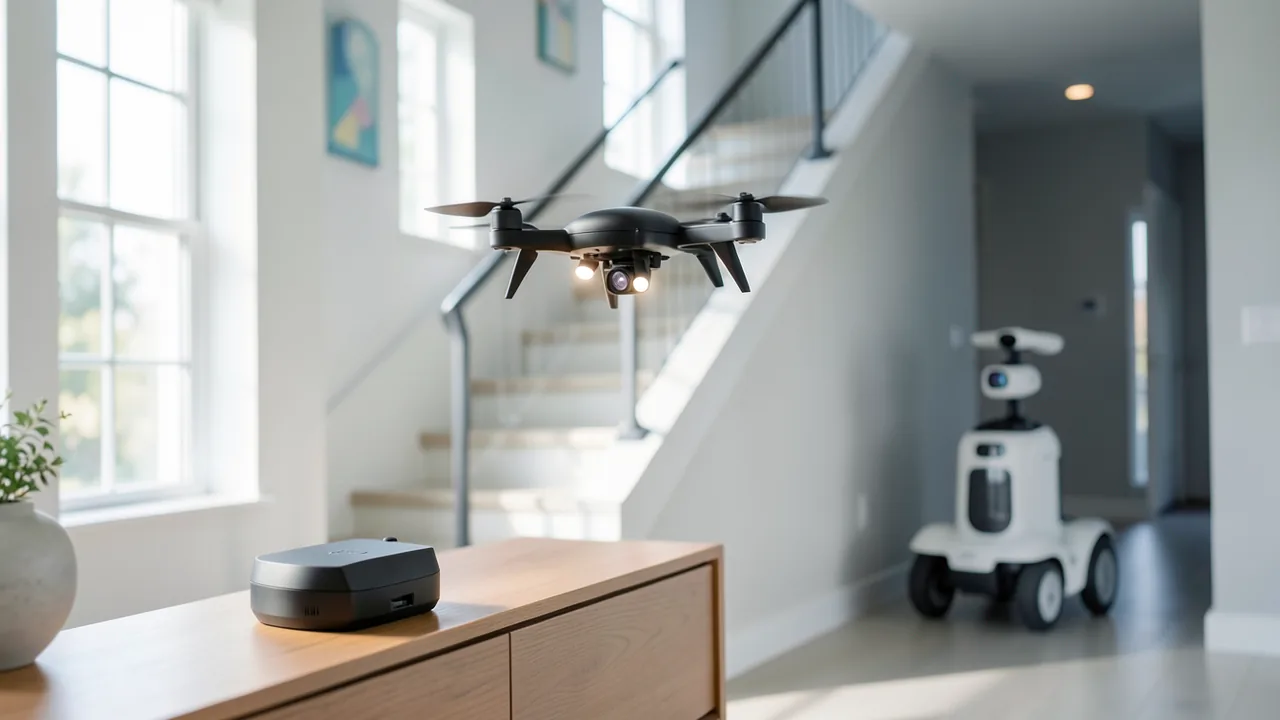
Ring, Amazon's home security subsidiary, is launching a $250 drone that flies through your home on its own when an alarm goes off, plus a $1,000 robot for businesses. Both run on a cloud AI called AI Pilot. That keeps the hardware cheap, but it raises new questions about privacy and what happens when the connection drops.
What's going on
Ring, Amazon's home security subsidiary, unveiled a new product line at an event in New York: Ring Robotics. It launches with two devices that move around on their own and record video as they go.
- The Ring Drone Cam costs $249.99 and is a small indoor drone. It flies through your home when an alarm goes off or on a set schedule. Shipping is planned for January 27, 2027, but you can't preorder it yet.
- The Ring Rover Cam costs $999.99 and is a wheeled robot for businesses such as warehouses and offices. Preorders are open now, and it ships starting December 16, 2026.
For now, both devices are US-only. As with other Ring cameras, you need a paid Ring Protect subscription for video storage and advanced features. Ring founder and CEO Jamie Siminoff explained the thinking to CNBC:
"People like indoor cameras, but they don't necessarily want them everywhere in their home."
How AI Pilot works
At the heart of both devices is AI Pilot, an AI system Ring built in-house. It combines the devices' cameras, specialized computer vision models, onboard sensors and computing power in the cloud, meaning on Amazon's servers. Siminoff told The Verge:
"It really is like an AI agent that's piloting the robot."
Here's how setup works:
- You carry the drone through your rooms once. The rover explores its surroundings on its own.
- From the footage, AI Pilot builds a floor plan, identifies the individual rooms and suggests patrol points. These are spots that deserve extra attention, such as a side door, windows, a cash register or a long hallway.
- You can add more points yourself in the app.
When it's sent out, AI Pilot plans the most efficient route to the target and steers around furniture, shelves and other obstacles in real time. There are three ways to trigger a run: on a fixed schedule, manually in the app (according to Wired, also via an Alexa command), or automatically when a Ring motion sensor, door or window sensor, water sensor or alarm goes off. Both devices work with Amazon's Alexa Home Map, a 3D map of your home. You just tap a spot on it, and the device drives or flies there by itself.
You can't fly or drive either device manually. They only follow routes planned in advance.
The drone: small, loud, short flight time
The Drone Cam weighs 165 grams, is roughly the size of a school textbook according to CNBC, and has a 2K camera with a 148-degree field of view. According to Engadget, it also has two LEDs on the front and a second 1080p camera with its own LED on the underside. Because it flies, the drone can look in every direction, and Ring says it can fly up stairs too. The lights are meant to help in the dark and scare off intruders. One Ring manager compared the roaming lights to a security guard walking through the house with a flashlight.
The weak spot is the battery:
| Spec | Value |
|---|---|
| Flight time | 5–8 minutes (8–10 minutes according to Engadget, depending on flight altitude) |
| Charging time | about 8 minutes per minute of flight, so roughly 40 minutes for 5 minutes in the air |
| Weight | 165 g |
| Camera | 2K, 148° field of view |
The Verge concludes that the drone is better suited to quick check-ins than to continuous monitoring. Whether it can really replace several fixed cameras remains to be seen. At the demo, The Verge watched a one-minute flight through a simple living room, which was stable and smooth. Ring did not show flying over stairs, flying in the dark or obstacle avoidance.
Every source stresses how loud the drone is. ZDNet describes a constant, high-pitched whine that alerts the whole household the moment it takes off. Ring pitches this as a privacy feature: the drone can't sneak up on anyone. ZDNet suspects it's simply a limitation of first-generation hardware. If you're home, you probably won't want it in the air for more than a few minutes. The sources don't even agree on the number of propellers: CNBC says two shrouded propellers, ZDNet says four.
After a flight, the drone hovers over its charging dock and lowers itself in. It only lands outside the dock in an emergency, when the battery won't last the trip back. According to Wired, it checks its motors before every takeoff. If you stick your finger in the propellers, you'll "feel it" but be "fine," Siminoff said. If your cat knocks the drone out of the air, you should stop using it and contact support. Whether it can be repaired is unclear. By the way, the production model will be black, not white like in the press photos.
Ten years in the making, with a detour through the cloud
According to Siminoff, Ring has been working on a drone camera since 2016, before Amazon bought the company in 2018. In 2020, Ring announced the Always Home Cam, which never shipped. According to Engadget, units had already been boxed up but weren't sent out because they "just didn't work well enough." A second false start followed in 2025. Every new edge case required more sensors and more computing power, which meant more power draw and bigger batteries. The heavier drone had to fly harder, so it needed bigger protective guards, which in turn made it fly worse. In the end, Siminoff says, the device would have cost more than $5,000.
So about a year ago, Ring started over. The new drone is far simpler, and its "brain" lives in the cloud. The drone streams its video straight to Ring's servers, where AI Pilot tells it where to fly. The downside is obvious: if your internet goes down, the drone can only land. For a security product, that's a potential weak point, The Verge notes.
Legally, the drone doesn't need to be registered with the US Federal Aviation Administration (FAA), because it stays under the 250-gram limit and only flies indoors. Flying it outdoors without a pilot keeping it in line of sight would be illegal, so Ring says it has built in technical safeguards. FCC certification is still pending, though. Since the FCC banned foreign-made drones without certification, a move that mainly hits DJI, regulators have been looking at drones more closely. Siminoff stresses that the Drone Cam meets all requirements and is assembled in Texas.
The Rover Cam: Astro's second life
At its core, the Rover Cam is Amazon's Astro home robot from 2021. Amazon had already sold it once as a $2,350 security robot for businesses, discontinued that model in 2024 and, according to Wired, bricked the units via software ten months after launch. Ring says the Rover Cam was inspired by Astro customers who valued the security patrols most. The cute face on the display is gone.
The specs at a glance:
- 4K camera on a telescoping mast that extends to about 4 feet (1.2 meters) and can see over shelves and counters. The rover can turn 360 degrees.
- Siren, clearly audible from more than 10 feet away according to Engadget, plus a flashing red light
- A light tower that projects a blue ring onto the ceiling so you can find the robot in a large space
- Two-way talk via speaker and microphone
- Records while it's moving. Even in its dock, the rover detects people moving and starts recording immediately.
- According to Wired, it covers up to 5,000 square feet (about 465 square meters) and patrols for about 30 minutes at a time.
Privacy: Ring's sore spot
Ring has been criticized for years over its work with police. According to Wired, Ring has shared videos with authorities even without a warrant. CNBC points to the controversy over a Super Bowl ad for "Search Party," an AI tool meant to find lost pets, and to a canceled partnership with Flock Safety, a provider of automated license plate readers.
Ring now promises that privacy is "the default" with Ring Robotics. When the drone is in its dock, its camera is covered and switched off; it only records in flight. An LED lights up while it's recording. Videos are encrypted with TAKE (Throw Away the Key Encryption). The keys rotate every five minutes, and Ring deletes its copies after 24 hours. Wired points out, however, that Ring temporarily holds the keys itself so it can run cloud features like AI video search. So this isn't true end-to-end encryption, where only you could decrypt the recordings. Two-factor authentication is mandatory for every Ring account.
Thorin Klosowski of the digital rights group Electronic Frontier Foundation told Wired:
"I think the companies making these surveillance products have an interest in making us feel less safe at home."
If you buy a device like this, he said, you should think about how your housemates and guests will feel about it.
The bigger picture
Ring Robotics reflects a broader trend: AI is moving into the cloud so the hardware can stay cheap and light. That's what makes a $250 autonomous indoor drone possible in the first place. The price is total dependence on your Wi-Fi and Amazon's servers, for a device that's supposed to work when it matters most. With five to eight minutes of flight time and a loud whine, the drone is better suited to quick checks of an empty home than to round-the-clock duty.
Much is still unproven. Ring didn't demonstrate flying up stairs, night operation or obstacle avoidance to the press, and FCC approval is still missing. After six years of announcements, it remains to be seen whether the January date holds. As for the Rover Cam, business customers should keep in mind that Amazon shut down its predecessor, Astro for Business, after just ten months. And a cloud AI that maps your home and flies from room to room is likely to make Ring's already difficult privacy debate even more heated. There's no word yet on a launch in Germany.
Related videos
Sources
- Merkliste: 9to5mac.com 9to5mac.com
- The Verge – AI theverge.com
- Engadget engadget.com
- zdnet.com zdnet.com
- cnbc.com cnbc.com
- wired.com wired.com
- Merkliste: techstartups.com techstartups.com
- Merkliste: digitaltrends.com digitaltrends.com
- Google News (US) news.google.com
Ask the AI assistant
Questions about this article, installation or background? Our assistant knows this page and runs on our own machine, not in someone else's cloud.
The Assistant is an AI (Gemma 4) and can make mistakes – please check important details against the source. Questions are used only to generate an answer and are deleted after one hour. Please don't enter any personal data.



Comments
What do you think? Already tried it? Write it here, no sign-up needed.
Comments are public. Links aren't allowed, and we delete abusive posts. You can delete your own comment at any time in this browser. Learn more in the Privacy Policy.