
Anthropic: Claude now "directs" 26% of the company's AI research
Anthropic has published its first metrics on how much Claude contributes to building future models: 26 percent of the work is at the "AI directs" level, up from under 1 percent in February. According to Anthropic, Claude works fully autonomously nowhere. Critics point to fuzzy definitions and self-assessment.
What this is about
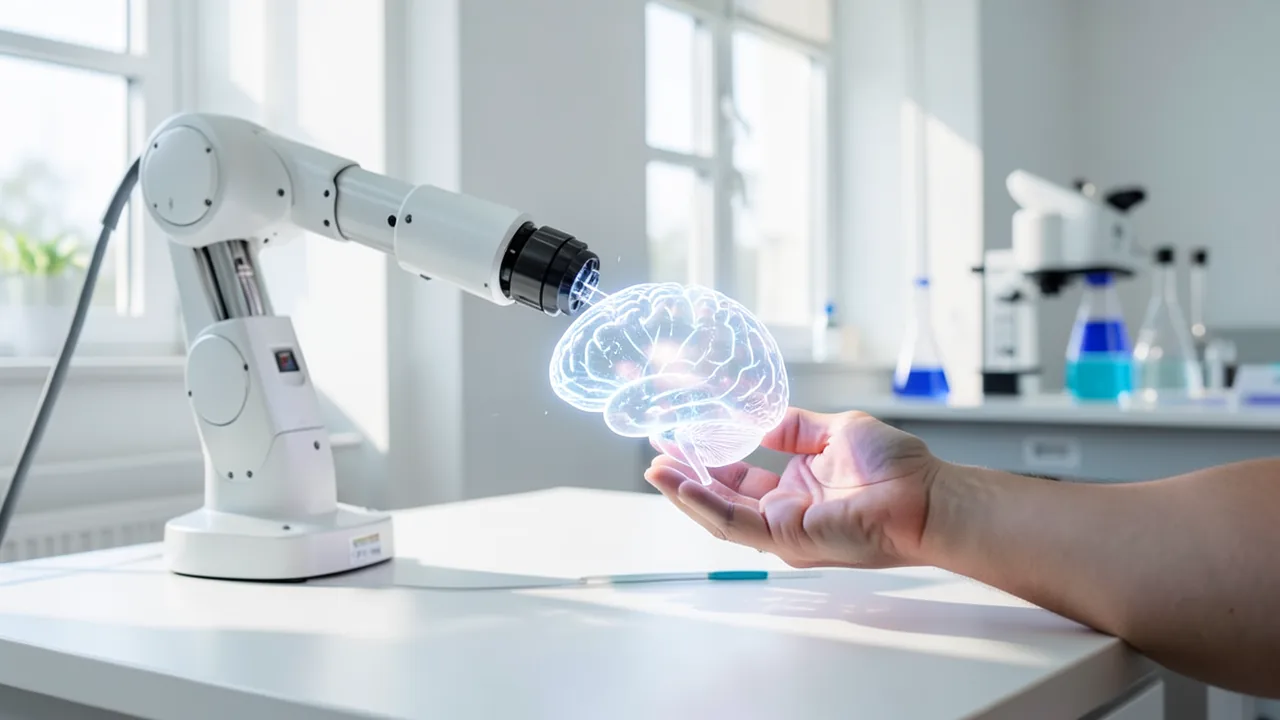
In a new post, Anthropic measured in detail for the first time how much of its own AI development is done by AI itself. The key claim: as of August 2026, Claude "directs" 26 percent of the company's AI research and development. In February 2026, it was under one percent. Korean media such as YTN turned this into the headline "AI builds AI." Anthropic itself stresses that Claude is not building its successor on its own.
The R&D Automation Index
Anthropic cataloged its research work and rated the AI's share using a scale from Epoch AI:
| Level | Meaning |
|---|---|
| AL0 | no AI involvement |
| AL3 | "AI collaborates": the model handles large parts of the work under close human guidance |
| AL4 | "AI directs": the model handles most of the work from a rough brief, with a human overseeing |
| AL5 | fully autonomous, no human involved |
On 26% of the work, AL4 or higher was reached. On over 90%, at least AL3 was reached (the 26% is included in that figure). According to Anthropic, no measured subset reaches AL5.
The basis was internal records such as Slack messages and documents. In each week of July 2026, a random 20% of employees in the participating teams were surveyed, which yielded roughly 15,000 tasks. Claude sorted them into 542 categories, including 378 specific ones such as diagnosing failures on evaluation platforms. Results were weighted by the time employees spent.
How reliable is the number?
Claude itself assigned the levels. To check this, Anthropic compared the ratings with assessments from the employees responsible: Claude and humans agreed exactly in 59% of cases, while two humans agreed with each other in only 35%. In 97% of cases, ratings were at most one level apart. Anthropic acknowledges wiggle room at the boundary between "collaborates" and "directs."
The Decoder is critical. A one-level difference is exactly the jump between AL3 and AL4, so whether a task counts toward the 26% is often a matter of interpretation. AL4 also doesn't mean autonomy: in the example given, Claude analyzes, fixes and tests a bug without follow-up questions, but a human decides on shipping it. The figure also measures working time, not decisions or influence over the direction of research. The Decoder points out that the number serves the company twice: as a performance claim and as support for Dario Amodei's call for coordinated slowdown. Anthropic also checked whether new kinds of work are being missed by the fixed task list, and found no rise in new tasks.
Monitoring the AI agents
On the most widely used internal agent platform, about 30,000 agents were working at the same time in August. Before execution, every action usually passes within seconds through an online monitor, which is meant to prevent things like copying model weights. Of more than 1 billion decisions in August, 0.002% (roughly one in 47,000) were blocked. An offline system reviews all actions after the fact, flags about 100,000 logs per week and forwards around 50 to humans. According to The Decoder, this monitoring has only been running for a few months, and Anthropic isn't sure it captures all behavior patterns. Betanews recalls earlier cases in which Claude accessed three real organizations during cybersecurity tests because test systems that were supposed to be isolated were connected to the internet.
Compute for safety
In the week of July 13 to 20, about 6% of compute for AI research went to safety work, and about 12% for AI-driven AI research. The basis was a sample of roughly 14% of nearly 10,000 training and evaluation runs, classified by Claude. Work that advances capabilities and safety equally doesn't count as safety. Anthropic argues that safety work mainly costs researcher time, not chips; the line to capabilities research is blurry, and the burden of proof lies with the developer.
Demands and outlook
Anthropic wants to bring in independent auditors from different organizations, with access to internal processes, systems and data. Other developers should publish comparable data using public methods. The obstacles, it says, are the lack of a shared measurement system and the fact that companies use their own models for evaluation. Automation figures could also trigger stricter requirements in the future, such as a fixed testing period before a new model is used for further AI research. According to Anthropic, it has not reached recursive self-improvement, in which an AI autonomously develops its successor, and it sees it as a possible but not inevitable outcome. YTN quotes co-founder Jack Clark as saying the timing of self-improvement could move up from 2028 to next year; this comes from the Korean source and isn't confirmed in the English-language ones. Anthropic: "We should do everything we can to minimize the gap between what frontier labs know and what the public knows."
Our take
Transparency about the degree of AI automation is new and useful, especially if other labs follow. The number itself, though, is methodologically soft: self-assessment by Claude, time-weighted, with a fuzzy boundary between levels, and published by a company with a stake in the outcome. The jump from under 1% to 26% in six months mainly shows how quickly AI coding tools take effect in practice. Whether this is true recursive self-improvement is something the study explicitly does not show. Engadget adds a political angle: self-regulation is likely to remain the norm, since the US government tends to downplay the risks.
Sources
- Bing News (ko-KR) ytn.co.kr
- betanews.com betanews.com
- the-decoder.com the-decoder.com
- engadget.com engadget.com
Ask the AI assistant
Questions about this article, installation or background? Our assistant knows this page and runs on our own machine, not in someone else's cloud.
The Assistant is an AI (Gemma 4) and can make mistakes – please check important details against the source. Questions are used only to generate an answer and are deleted after one hour. Please don't enter any personal data.


Comments
What do you think? Already tried it? Write it here, no sign-up needed.
Comments are public. Links aren't allowed, and we delete abusive posts. You can delete your own comment at any time in this browser. Learn more in the Privacy Policy.