
Banned Nvidia Blackwell Chips Turn Up in Shanghai, and the Trail Leads to Alice Huang
Bloomberg reports that a Shanghai data center is running servers built on Nvidia's Blackwell chips, hardware that should never have reached China without a US license. The facility has ties to Alice Huang, the woman at the center of the espionage scandal around Nvidia CEO Jensen Huang. The hardware came to light through loan documents that list it as collateral.
What's going on
A data center in Shanghai appears to be running servers with Nvidia's Blackwell chips. These are the processors that companies like OpenAI and Anthropic use to train their newest AI models. They can't be shipped to China without a US government license, and that has been true from the start. Bloomberg published the story on Friday, November 27, 2026, based on documents filed with Chinese authorities. Gizmodo, Yahoo, the New York Post and CNBC have since picked up the reporting.
What makes the story so explosive is the trail leading to Alice Huang. US intelligence agencies suspect she worked for Chinese intelligence while having an affair with Nvidia CEO Jensen Huang (the two aren't related). The scandal briefly cost Jensen Huang his job. He's now back in charge, and US President Donald Trump says that's partly because he pushed for it.
What Bloomberg found
The data center is called the Yangtze River Delta Project and sits in Shanghai. According to Bloomberg, two Chinese companies installed Blackwell hardware there. The evidence didn't come from photos or insiders. It came from loan agreements:
- Shanghai Shuoyao pledged a complete GB300 NVL72 server rack as collateral for a loan of 96 million yuan, roughly $14 million, from Shanghai Innovation Bank. The rack's serial number appeared in documents filed with Chinese regulators in November.
- Shanghai Kezhan described a GB200 server at the same site when it took out a 90 million yuan loan in late 2025. The lender is a leasing company owned by a Shanghai city government agency.
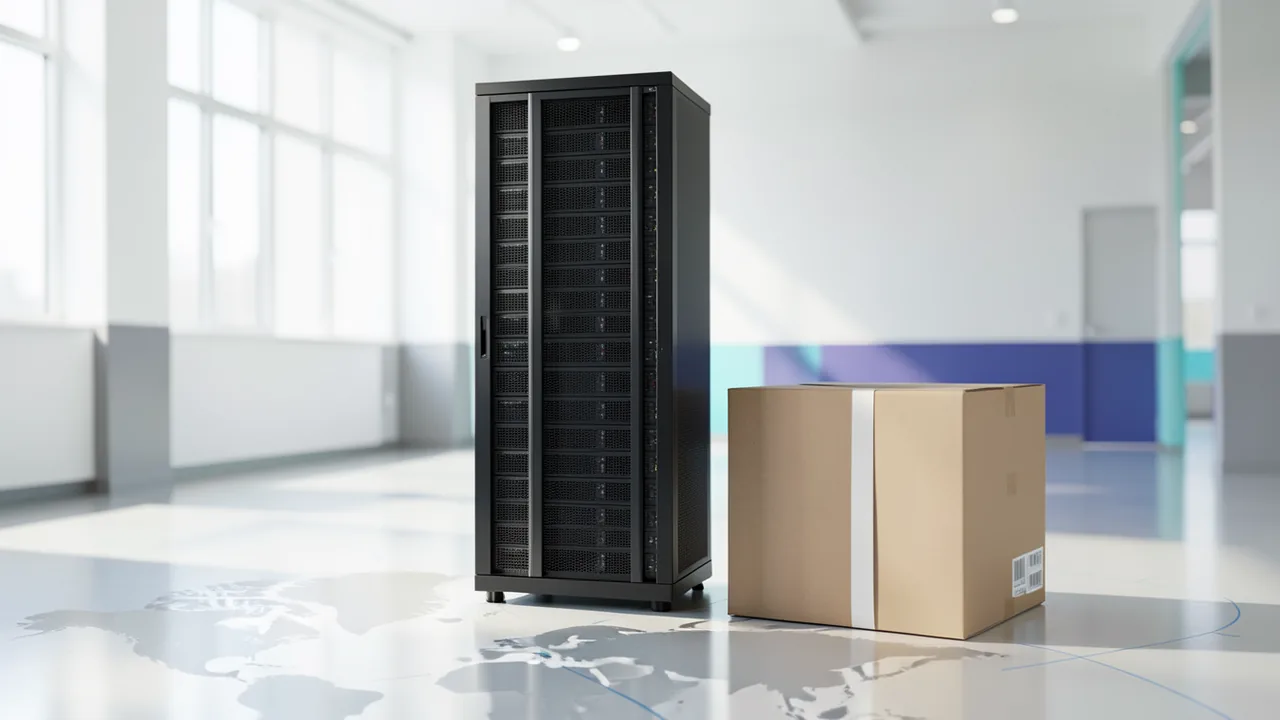
A GB300 NVL72 isn't a single chip. It's an entire server cabinet with 72 Blackwell Ultra GPUs and 36 Grace CPUs. It stands about two meters tall, is the size of a giant refrigerator and, according to Bloomberg, can weigh more than 1,500 kilograms. Jensen Huang himself once argued that systems like this were too big to smuggle. Bloomberg says Nvidia spent years denying that a black market for its products exists. The company didn't respond to repeated requests for comment.
The serial number let Bloomberg identify the manufacturer: Taiwanese hardware maker Gigabyte built the rack. Gigabyte wouldn't say who it originally sold the system to. How it ended up in China is still an open question.
The links to Alice Huang and Megaspeed
At the center of it all is Megaspeed, a Singapore company that Alice Huang founded and ran. In 2023, just four days after it was set up, Megaspeed got a coveted approval from Nvidia and went on to become Nvidia's biggest customer in Southeast Asia. The US Commerce Department has been investigating the company since 2024 on suspicion that it evaded export controls and funneled Nvidia chips to China. Investigators tried to question Alice Huang in June 2025. That same month, according to the New York Post, Nvidia put Megaspeed on its internal "No sell" list of customers it no longer sells to.
The reports point to several threads linking Megaspeed to the Shanghai data center:
- Shanghai Shuoyao operates at the data center and, according to Bloomberg, overlaps substantially with Megaspeed. For a year it ignored Bloomberg's questions. This month, in a rare public statement, it confirmed that it's a service provider to Megaspeed and said the partnership is limited to "ordinary commercial cooperation."
- Shanghai Kezhan is majority-owned by a Tokyo company. Chinese business outlet Caixin reports that Alice Huang controls that company.
- According to the New York Post, the president of the Yangtze River Delta Project is Kang Wei, Alice Huang's husband.
- In 2024, Megaspeed showed investors a rendering of the Yangtze River Delta Project as its largest data center. It didn't name the country, referring only to a facility in a "certain region."
Bloomberg also analyzed the data center's construction plans. The key figure is the ratio of computing power to power consumption. Those numbers would be very hard to hit with Chinese chips, such as Huawei's. That suggests the facility was designed around high-end US chips from the start.
One important caveat: Bloomberg says explicitly that it has no evidence Megaspeed itself diverted hardware to the site. Megaspeed denies any wrongdoing. Even so, this week the Bureau of Industry and Security, the export control agency inside the US Commerce Department, added the company to its blacklist. It cited a "significant risk" that Megaspeed is or will be involved in diverting advanced computing hardware to unauthorized recipients.
The reports disagree on one detail. Bloomberg and Yahoo name Shanghai Shuoyao as the company that pledged the rack as collateral. The New York Post attributes it to the Yangtze River Delta Project.
The export ban and the politics
For years, the US has used export controls to limit which AI chips can go to China. Blackwell has always required a license. According to the New York Post, the Commerce Department approved sales of tens of thousands of these chips to countries like the United Arab Emirates and Saudi Arabia last year, but not to China. Speaking to Fox News at the APEC summit in Shenzhen, China, Trump said China might be able to buy Blackwell in "two or three years," by which point there would be successors anyway.
At the same time, Trump is under pressure himself. He told the New York Post that a government stake in Nvidia is possible, similar to Intel, which handed Washington ten percent of its shares last year:
"I've thought about it. I said, 'Maybe I should do that,' but I haven't brought it up yet. It's probably not too late."
He said a pardon for Jensen Huang is "always an option" but probably won't be needed. He also advised Huang not to plead the Fifth before Congress. A closed-door session with three House committees is set for December 1, followed by testimony before the Senate Banking Committee on December 3. Asked how he knows Huang isn't a security risk, Trump pointed to "information that I have, and it's a lot of information."
Election analyst Nate Silver said on his podcast that Trump could "absolutely" be removed from office if he profited from selling advanced chips to China. Prediction markets put the odds of Trump being impeached and removed before the end of his term at around 20 to 21 percent (Polymarket and Kalshi).
Fallout for the stock market and the data center industry
Nvidia's stock has taken a beating. According to Slashdot, on Friday it was 30.95 percent below where it stood a month ago and 37 percent below its October 2 high ($239.24). Yahoo Finance had it at $148.74. On Monday, after Huang's return, the stock had jumped more than 30 percent to $165.05.
On CNBC, anchors David Faber and Carl Quintanilla flagged two more consequences. First, the US is cracking down harder on Chinese companies renting compute remotely, for example from cloud providers in Singapore. That includes distillation, where a smaller model learns from the outputs of a larger one. Second, ratings agency Fitch expects additional licenses to be required for Malaysia, Indonesia, Thailand and Singapore. That would make financing data centers in Asia harder. For "neoclouds," the young cloud providers that mainly rent out AI compute on US chips, creditworthiness becomes "a harder story, not an easier one." Faber also raised the question of what Nvidia knew about its sales to Megaspeed.
The bigger picture
This is the first documented sign in the scandal that Blackwell chips are actually sitting in a Chinese data center. Until now, the story was about suspicions surrounding companies and people. Now there's a serial number and a rack from a known manufacturer. That makes it hard for Nvidia to keep insisting, as it has for years, that there's no black market for its chips. It also undercuts the argument that whole racks can't be smuggled.
But a lot is still unknown. It's not clear how the Gigabyte rack got to Shanghai, who bought it originally, or whether Megaspeed was directly involved. Bloomberg itself has no evidence of that. Whether Nvidia knew about any diversion is also unproven. For the AI industry, this is about more than a criminal case. US export controls are meant to keep China from getting its hands on the most powerful training chips. If those chips are already being financed with loans from state-linked lenders in Shanghai, the controls' effectiveness is in serious doubt. Tighter rules for Southeast Asia look likely. The congressional hearings in early December should show how far the political fallout goes.
Related videos
Sources
- Slashdot hardware.slashdot.org
- yahoo.com yahoo.com
- nypost.com nypost.com
- aol.com aol.com
- NewsData (taiwan) ec.ltn.com.tw
- AI Times (KR) aitimes.com
- NewsData (china) worldjournal.com
- NewsData (china) epochtimes.com
Ask the AI assistant
Questions about this article, installation or background? Our assistant knows this page and runs on our own machine, not in someone else's cloud.
The Assistant is an AI (Gemma 4) and can make mistakes – please check important details against the source. Questions are used only to generate an answer and are deleted after one hour. Please don't enter any personal data.



Comments
What do you think? Already tried it? Write it here, no sign-up needed.
Comments are public. Links aren't allowed, and we delete abusive posts. You can delete your own comment at any time in this browser. Learn more in the Privacy Policy.