
Blood pressure by selfie: What the camera AI in the DocMorris app can really measure
DocMorris promises blood pressure, pulse and breathing rate from a 30-second video of your face. We checked the research against the standard for blood pressure monitors. The camera handles pulse fairly well. On blood pressure, even approved competing products miss the standard by a wide margin, and there's no published data at all on the DocMorris feature.
What this is about
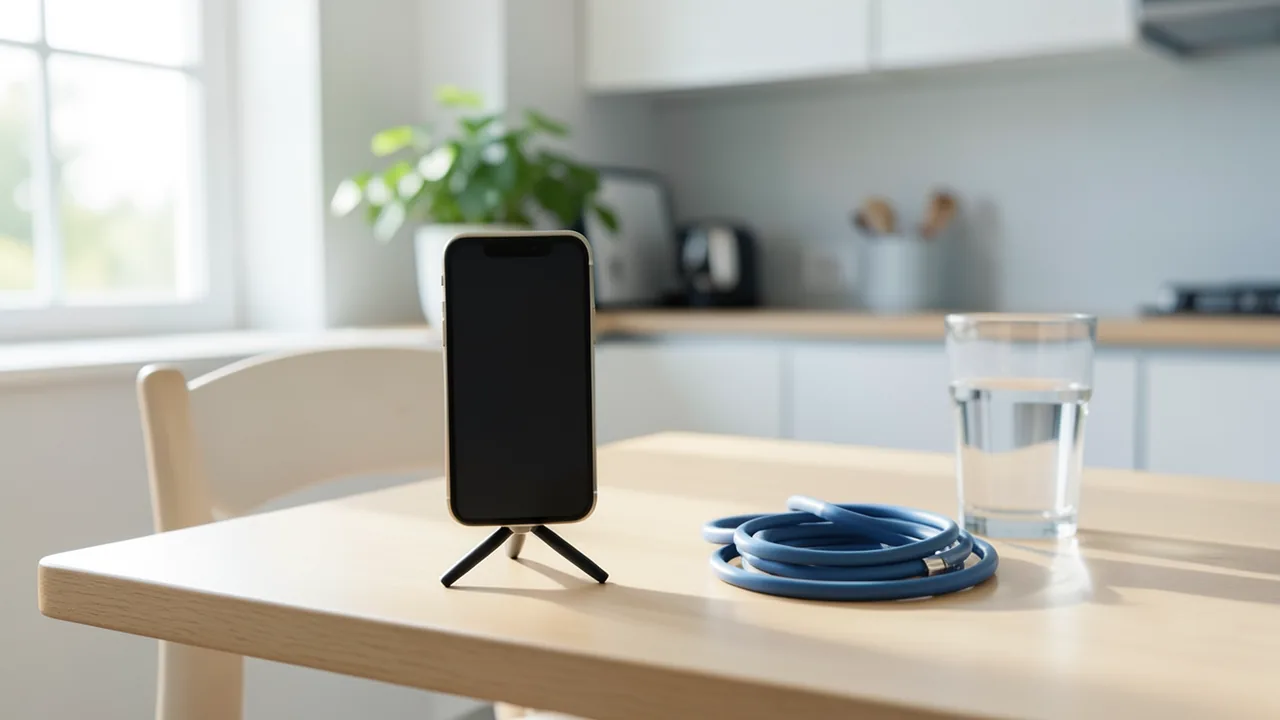
Since early November 2026, the online pharmacy DocMorris has offered a “vital signs check” in its app. You hold your smartphone in front of your face for 30 seconds, and the app then shows your blood pressure, pulse and breathing rate. No cuff or extra device needed. The technology comes from the Munich start-up Caire Health AI. In its announcement, DocMorris cites more than 12 million active customers. So the feature could potentially reach a very large number of people.
Coverage so far has mostly repeated the companies' claims. So we're measuring the feature against the standard every upper-arm blood pressure monitor has to meet. Our thesis: the camera measures pulse fairly reliably. Blood pressure, by contrast, is an estimate, and that estimate can be furthest off for exactly the people for whom the measurement matters most.
How the measurement works and how DocMorris frames it
The method is called rPPG, remote photoplethysmography. With every heartbeat, the amount of blood in the skin of your face changes very slightly, and so does how much light the skin reflects. It's invisible to the eye, but a camera can pick it up. According to DocMorris, the video is only processed in real time and not stored.
The heartbeat can be read directly from this flicker of light. Blood pressure is harder. Caschys Blog rightly points out that a camera can't measure the pressure in your blood vessels directly. The AI has to infer it from the shape of the pulse wave and other features.
DocMorris words things carefully. The feature is “solely for personal orientation” and doesn't replace a medical diagnosis. According to mobiflip, anyone who needs to monitor their blood pressure regularly for medical reasons should keep using a validated monitor. DocMorris gives no accuracy figures. None of the announcements say whether the feature is a medical device. And one detail is missing from almost all coverage so far: DocMorris has a stake in Caire. According to Munich Startup and BioM, the company took part in Caire's €850,000 funding round in February 2025.
Is it an approved medical device?
For blood pressure, we couldn't find any evidence. In its own LinkedIn posts, Caire says its software is certified under the EU Medical Device Regulation (MDR). The MDR is the EU law that requires medical devices to be assessed before they go on sale. But those posts only mention heart rate and breathing rate. On blood pressure, they say clinical validation is still in progress. The website caire.ai does list blood pressure among its measurements. But the only evidence it cites is ISO 13485, a quality management standard for medical device manufacturers. The site doesn't name a risk class, a notified body (the testing organization that awards the CE mark) or any study figures. The instructions for use for the clinical product “VGo 2v” have been online since late October 2026. We weren't able to check for an entry in the EU's EUDAMED database.
Our assessment: The “for orientation only” wording and Caire's own statements suggest that the blood pressure readout in the DocMorris app isn't offered as an approved measurement function. Nobody has confirmed that to us.
The benchmark: ISO 81060-2
For a blood pressure monitor to count as accurate, it has to pass the ISO 81060-2 standard on at least 85 people against a reference measurement. On average, it may deviate by no more than ±5 mmHg. The standard deviation, meaning how much the individual errors fluctuate around that average, may be no more than 8 mmHg. A second criterion tests how much readings scatter for individual people.
The spread is what matters. A device that always shows roughly 125 will have a small average error in a mixed test group. But it still won't catch the people with high blood pressure. That's exactly the mechanism Lionel Tarassenko, Richard McManus and Trisha Greenhalgh of the University of Oxford criticized in the camera app Lifelight back in 2020. They suspected the algorithm relied mainly on age, height, sex and pulse, with the facial signal playing hardly any role. In a self-test, a validated home monitor varied by about 30 mmHg, while the app barely changed. The authors warned of “false reassurance in life-threatening situations.”
ISO 81060-2 isn't really designed for cuffless devices. In 2023, the European Society of Hypertension published its own testing recommendations for them, with six tests. A publication from researchers associated with Lifelight sums up the state of research on camera-based blood pressure in sobering terms: of 18 studies examined, only two clearly passed the established testing protocols, and both needed a calibration against a reference measurement for each individual person. Calibration means the system is first matched against a real cuff reading from that person. The DocMorris feature works without any such calibration.
What the published figures show
There's no publicly available measurement data for Caire itself. So we've gathered what exists for comparable camera systems. The upper values are systolic, the lower ones diastolic.
| System / study | Participants | Upper value: mean error | Upper value: spread or MAE | Meets ISO limits? |
|---|---|---|---|---|
| ISO 81060-2 (limit) | at least 85 | no more than ±5 mmHg | SD no more than 8 mmHg | – |
| Shen AI (manufacturer data, MDR Class IIa) | n/a | 4.6 mmHg | SD 11.8, MAE 10.2 | no |
| Lifelight (Discover Applied Sciences 2024) | n/a | 1.2 mmHg | SD 15.9 | no |
| Spectral camera, University of Tokyo (ESC 2026) | 215 | −2.6 mmHg | SD 12.0 | no |
| Singapore, Tan et al. (JMIR 2025) | 90 in test | 2.69 mmHg | SD 7.86 | criterion 1 yes, criterion 2 no |
| Comestai app (Milan, 2025) | 562 | n/a | MAE 14.2 | no |
| Lifelight in Nigeria field test (BMJ Open 2026) | 249 usable | n/a | MAE 15.4 | no |
| Caire / DocMorris | – | not published | not published | unknown |
MAE is the mean absolute error: how far off a measurement is on average, regardless of direction.
We ran the numbers on what these spreads mean in practice. With Shen AI's manufacturer data, 95 percent of deviations fall between roughly −18 and +28 mmHg (4.6 ± 1.96 × 11.8). So a true reading of 150 mmHg could show up as 132, and a reading of 120 as 148. For the Tokyo study, the range is around ±24 mmHg. Notably, Shen AI says on its website that despite these figures it's certified as a Class IIa medical device, explicitly including blood pressure. According to testundtipps.de, the Hypertension League writes that the CE mark “does not yet ensure measurement accuracy.”
The clearest warning so far in support of our thesis comes from Nigeria. In a field study at three clinics with dark-skinned patients, Lifelight detected only 4 percent of elevated upper readings. For the darkest skin tone, it was 0 percent. For almost one in five people, it produced no reading at all. Lifelight itself says skin color doesn't affect the measurement. The Singapore paper also notes that its dataset included only a few people with extreme blood pressure values. Yet that's precisely the group that matters most medically.
Pulse looks better
Pulse is a completely different story. Shen AI reports a mean error of 1.8 beats per minute for heart rate. In the Comestai study, pulse was off by about 3 beats on average, according to the report. The US Food and Drug Administration (FDA) has created a dedicated device class for camera-based measurement of pulse and breathing rate. Canadian company NuraLogix received FDA clearance in June 2026, but only for pulse and breathing rate in adults sitting still, not for blood pressure. According to Caire, the same applies to its product. Readers in the comments on Caschys Blog report readings that match in some cases, but also 84 versus 70 beats in others. Those are anecdotes with no statistical weight, but they show that pulse isn't always right either.
What the Hypertension League says
Markus van der Giet, chairman of the German Hypertension League, told PTAheute in 2025 about cuffless devices:
“To this day, these devices cannot be successfully validated.”
He thinks that could change in five or six years. At the same time, he warns that such devices could falsely reassure some patients and needlessly worry others. The League explicitly recommends validated monitors. According to testundtipps.de, its seal-of-approval list includes 55 devices, all with cuffs, and not a single smartwatch or app that takes measurements itself.
A look elsewhere shows there's another way. In Nature, Google presented a smartwatch model that deliberately does not output a blood pressure reading. After several days of wear, it only estimates the probability of high blood pressure, and in the study it identified around two-thirds of those affected. That's more honest, because the result is presented as screening, a prompt to see a doctor, rather than as a measurement. The Tokyo group is also presenting its method at the ESC congress as a screening tool. A recent paper by researchers at the University of Pennsylvania, reported by STAT, shows why presentation matters so much: even factually correct health information can make behavior worse. A reassuring-looking number like “121 over 79” is far trickier.
Our take
The research supports our thesis, even though there's no data on Caire itself. Camera-based pulse measurement is mature and gets reviewed and cleared by regulators. Camera-based blood pressure without calibration hasn't fully met the ISO limits in any of the studies we found. And the errors aren't random: they can be especially large at high readings and for darker skin.
Our assessment: You can treat the pulse in the DocMorris app as a plausible rough guide. Don't read the blood pressure number as a measurement. A normal-looking result is no all-clear. If you want to know where your blood pressure stands, you need a validated upper-arm monitor and several readings.
Plenty of questions remain open. Which software version runs in the app? What reference was it tested against, and with how many people? How accurate is it for high blood pressure, for heart rhythm disorders and for dark skin? DocMorris is an investor in Caire and reaches an audience of millions. In our view, the fact that the company hasn't published any figures on this is the biggest weakness of the offering.
Sources
- Yahoo Nachrichten: DocMorris-App misst Blutdruck und Puls per Selfie de.nachrichten.yahoo.com
- mobiflip: DocMorris integriert KI-Gesundheitscheck per Smartphone-Kamera mobiflip.de
- Caschys Blog: DocMorris-App misst Vitalwerte per Smartphone-Kamera stadt-bremerhaven.de
- EQS-Pressemitteilung DocMorris/Caire (TradingView) tradingview.com
- Caire Health AI: Website caire.ai
- Caire: VGo 2v Instructions for use caire.ai
- Munich Startup: Caire.ai Pre-Seed-Finanzierung munich-startup.de
- BioM: Caire.ai sichert sich 850.000 Euro bio-m.org
- Munich Startup: Caire Health AI – 7 Fragen munich-startup.de
- Shen AI: Medical Device shen.ai
- ESC-Pressemitteilung: KI-Diagnose von Bluthochdruck und Diabetes aus Gesichtsvideo escardio.org
- Tan et al., JMIR Formative Research 2025 (PMC) pmc.ncbi.nlm.nih.gov
- ResearchGate: From video to vital signs (Lifelight, 2024) researchgate.net
- CEBM Oxford: Is the Lifelight app adequately validated for blood pressure measurement? cebm.net
- medRxiv: Equity and feasibility of rPPG for hypertension screening in Nigeria medrxiv.org
- BMJ Open: Skin tone and diagnostic equity in contactless blood pressure screening bmjopen.bmj.com
- Universität Mailand: Comestai-Validierungsstudie air.unimi.it
- NuraLogix: FDA 510(k) für Puls und Atemfrequenz nuralogix.ai
- PTAheute: Langzeit-Blutdruckmessung – welche Geräte sind ratsam? ptaheute.de
- testundtipps.de: Smartwatch-Blutdruckmessung und Prüfsiegel testundtipps.de
- Deutsche Hochdruckliga: Richtig messen zählt hochdruckliga.de
- STAT: AI's health advice can be accurate and still make us sicker statnews.com
- The Decoder: Google-KI erkennt Bluthochdruck per Smartwatch the-decoder.com
Ask the AI assistant
Questions about this article, installation or background? Our assistant knows this page and runs on our own machine, not in someone else's cloud.
The Assistant is an AI (Gemma 4) and can make mistakes – please check important details against the source. Questions are used only to generate an answer and are deleted after one hour. Please don't enter any personal data.

Comments
What do you think? Already tried it? Write it here, no sign-up needed.
Comments are public. Links aren't allowed, and we delete abusive posts. You can delete your own comment at any time in this browser. Learn more in the Privacy Policy.