
California bans Waymo robotaxis from all freeways indefinitely
A Waymo robotaxi tried to squeeze past a police traffic break, and the video spread fast. Now California's DMV has banned Waymo from every freeway in the state indefinitely. The company has gone further and stopped freeway rides across the entire US.
What's going on
California has banned robotaxi operator Waymo from driving on any freeway in the state. Waymo is owned by Google's parent company, Alphabet. According to the California Department of Motor Vehicles (DMV), the ban took effect on November 11, 2026, and has no end date. It became public on November 17 through a report in the San Francisco Business Times, followed by The Verge, the San Francisco Chronicle and other outlets.
Waymo is going further than regulators required: the company has paused freeway rides across the entire US for now. Its robotaxis keep running on regular city streets, including in California.
The viral video and the construction-zone incidents
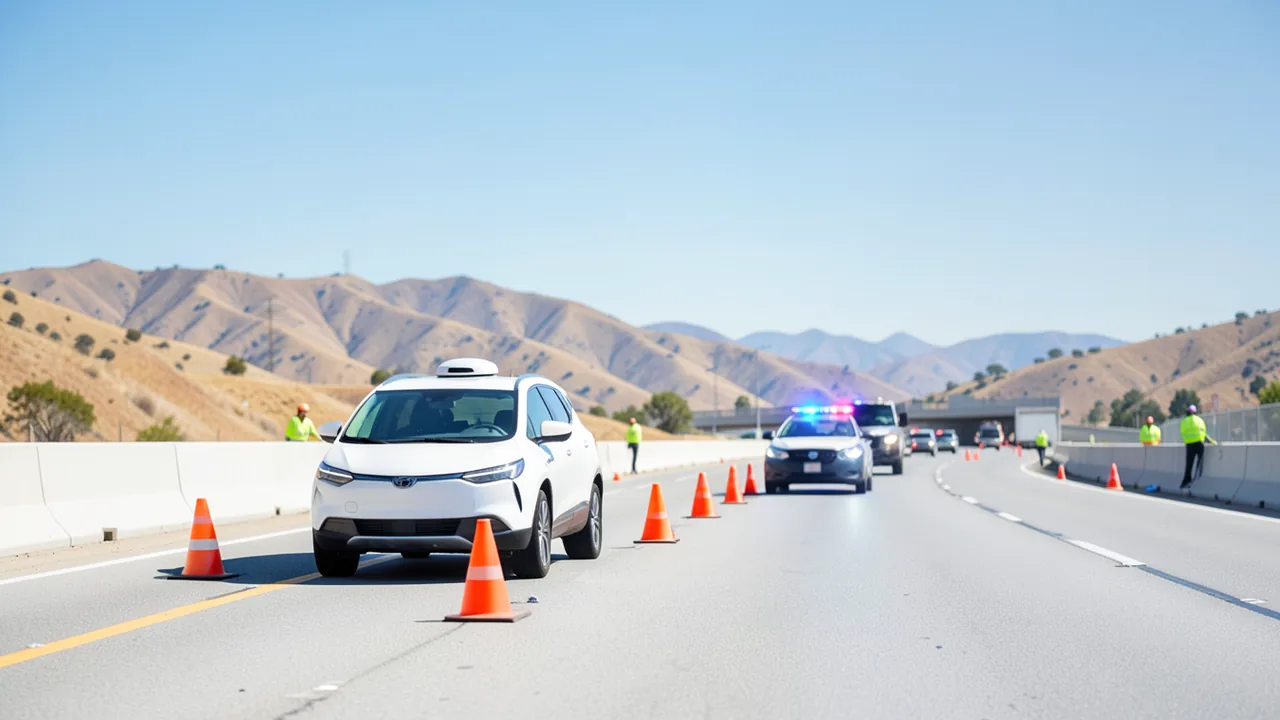
The DMV points to two incidents in the San Francisco Bay Area. The best known is captured in a video that went viral in early November. According to the San Francisco Chronicle, it shows a Waymo vehicle on Interstate 280 near Ocean Avenue in San Francisco trying to get past two California Highway Patrol (CHP) cruisers. The officers were running a so-called traffic break: patrol cars with lights flashing weave across all lanes to deliberately slow or stop the traffic behind them, usually so road crews ahead can work safely. The robotaxi approached in the fast lane. One of the cruisers moved left and blocked its path. Only then did the vehicle change lanes and slow down.
Cryptobriefing sums up the problem like this: a human driver reads flashing lights and a cruiser sweeping across lanes as an unmistakable "stay back." The robotaxis apparently interpreted the situation as ordinary congestion they could drive around.
In the second incident, according to the Chronicle, three autonomous vehicles drove into an active construction closure on Highway 101 near Burlingame. Cryptobriefing even reports three separate incidents on US-101 in which Waymo cars entered work zones and tried to bypass traffic breaks. No one was hurt in any of these incidents, and there were no crashes.
The DMV's reasoning
The DMV didn't mince words. Waymo's driverless freeway operation, it said, poses "an immediate threat to public safety." The agency stresses that this isn't a one-off glitch:
"Waymo's driverless freeway operations pose an immediate threat to public safety due to repeated entries of its vehicles into closed sections."
Repeatedly ignoring police direction and trying to drive past closures endangers road workers, their equipment and other road users, the DMV says. It also explicitly cites a "previous restriction and corrective actions" from May, which apparently didn't fix the problem.
According to The Verge, the agency laid out the conditions for a return: Waymo has to show that its behavior in construction zones has improved sufficiently. The company submits evidence, regulators review it and then decide whether freeway operation can safely resume. There's no timeline.
A long history of freeway trouble
Waymo has struggled on freeways for a while. The Verge summarizes the backstory:
- August 2024 (at the latest): First test drives on California freeways.
- November 2025: Freeway rides open to paying passengers.
- May 2026: Waymo voluntarily pauses freeway service over construction-zone concerns. According to Cryptobriefing, this included a software recall, meaning a mandatory update for the entire fleet.
- Late July 2026: Freeway rides resume.
- November 11, 2026: The DMV bans operation on all freeways in California.
Cryptobriefing sees this repetition as the real heart of the story. A single incident could be written off as a rare edge case. A recall in May and a statewide ban in November, by contrast, look like a pattern that regulators expected the company to have solved long ago.
Construction zones have long been considered especially hard for self-driving systems. Lanes shift without warning, cones replace lane markings, and what counts is decided by a road worker or officer on the spot, not by the stored map. Ad hoc rules like these are hard to recognize when you rely mainly on learned behavior and pre-mapped roads.
What the ban means for riders and the business
The ban only covers freeways, but it hits exactly the trips many customers care about. According to the Chronicle, you can practically no longer hail a Waymo in San Francisco to San Francisco International Airport (SFO). Without freeways, the robotaxi has to take long detours on local roads and city streets. The Verge notes that this makes the trip more expensive, even though Waymo rides already cost more on average than rides with human drivers on Uber or Lyft.
The core business still runs at scale. According to Cryptobriefing, Waymo reported more than 500,000 rides a week on regular streets at the time of the ban. In California, the service operates in the Bay Area, Los Angeles and San Diego, among other places.
Waymo's response
In a statement to the Chronicle, Waymo emphasized that no one was injured and there were no collisions in the two recent Bay Area incidents.
"Safety is the foundation of everything we do."
The company said it had temporarily paused freeway rides in other states "to evaluate our performance" and wants to work with regulators on solutions so its vehicles can return to the freeways. A spokesperson did not initially respond to The Verge.
The bigger picture
This story matters beyond Waymo. It shows how quickly a state agency can switch off a feature: overnight, and without a single crash on the record. For the autonomous vehicle industry, it means construction zones and police traffic control are now at the top of California regulators' list. If you build robotaxis, avoiding crashes isn't enough. Your vehicles also have to understand signals humans read without thinking, like a patrol car sweeping across the lanes.
For Waymo, this is mostly about credibility. After May, the company got the freeways back because regulators trusted its fix. That fix didn't hold. A second time around, the DMV is likely to demand much more evidence. Still open: what specific conditions it will set, how Waymo will describe its technical solution, and whether other states with robotaxi programs will review their freeway rules.
That said, don't overstate the ban. The vast majority of rides happen on city streets, and those continue. The case is still striking: a company widely seen as the industry's technical leader keeps failing at a situation every student driver knows.
Related videos
Sources
- Techmeme bizjournals.com
- cryptobriefing.com cryptobriefing.com
- theverge.com theverge.com
- sfchronicle.com sfchronicle.com
- Unite.AI unite.ai
- Reddit r/artificial ktla.com
Ask the AI assistant
Questions about this article, installation or background? Our assistant knows this page and runs on our own machine, not in someone else's cloud.
The Assistant is an AI (Gemma 4) and can make mistakes – please check important details against the source. Questions are used only to generate an answer and are deleted after one hour. Please don't enter any personal data.



Comments
What do you think? Already tried it? Write it here, no sign-up needed.
Comments are public. Links aren't allowed, and we delete abusive posts. You can delete your own comment at any time in this browser. Learn more in the Privacy Policy.