
China's AI drama factory: 222,000 new titles, few winners – except the platforms
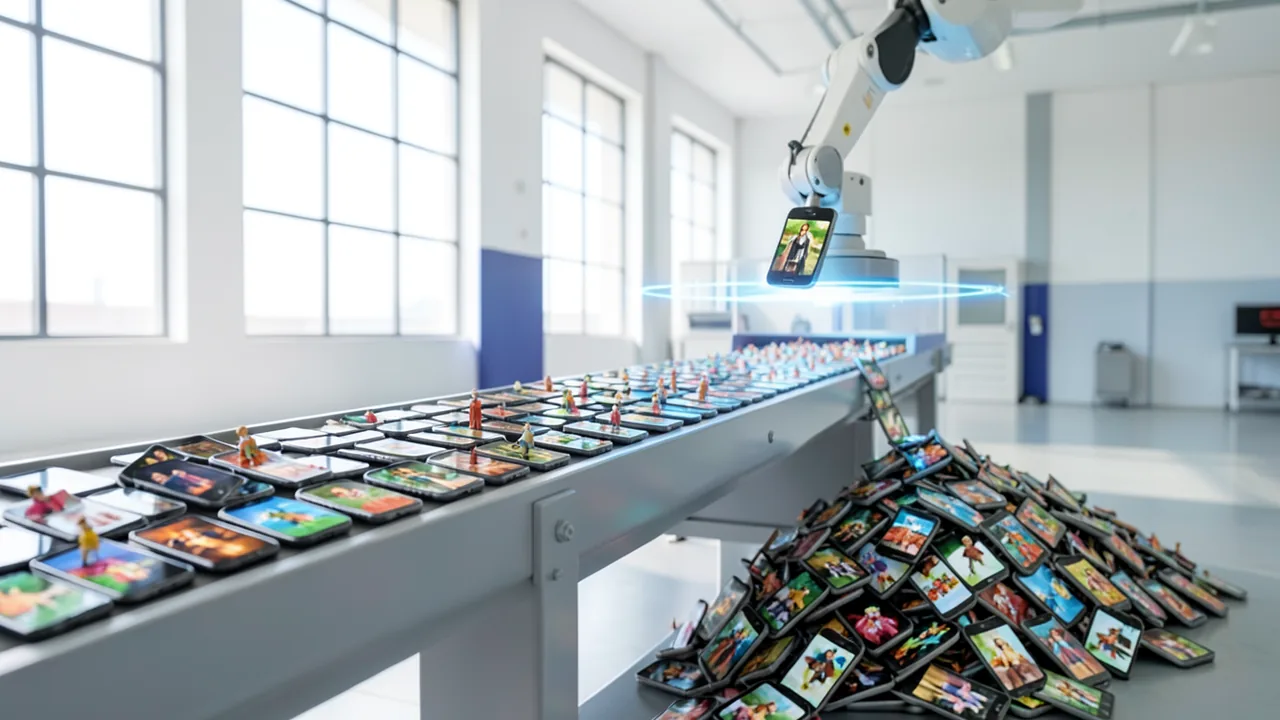
In China, AI video is already a mass-market product: Douyin alone saw 221,900 new AI micro-dramas in the first half of the year, but only one in 77 hits the view count needed to break even. While studios cut staff, ByteDance and Alibaba are building complete AI production lines. We follow the numbers to see who's actually making money from the boom.
What's at stake
The first true mass-market use of AI video isn't happening in Hollywood but in China's short-drama apps. They run vertical series with episodes of one to two minutes, usually built around stories of rebirth, revenge or rising to the top. You'll mostly find them on Douyin (TikTok's Chinese sibling), in ByteDance's free short-drama app Hongguo and in Tencent's mini program "Lüpaopao" inside WeChat. Within a single year, AI has taken over almost all of the production.
Our thesis: when video production costs next to nothing, it's not the studios that make money but the platforms. They own the tools, the reach and the billing. The numbers back this up well, though not always as neatly as the headlines suggest.
The cost curve: from 5,000 yuan a minute to a few hundred
According to a CCTV Finance report from September 6, the price of a standardized minute of AI micro-drama fell from around 5,000 yuan to a few hundred yuan within six months. That's a drop of more than 90% and close to bare cost. High-end custom work still costs 10,000 to 20,000 yuan per minute. Brokerage Zhongtai Securities estimates that AI micro-dramas now cost only 2 to 10% of a traditional production. Teams have shrunk from about 15 people to three to five.
According to Caixin's cover story, a live-action production in 2025 still needed almost 40 people on set and a budget of 300,000 to 400,000 yuan. Today, a producer in Hangzhou turns out a 100-minute AI drama every three to seven days for less than 20,000 yuan. According to one director, more than 95% of those costs go to video generation. The engines behind this are video models like ByteDance's Seedance 2.0 (out since February), Kuaishou's Kling and Alibaba's models.
The flood: 221,900 titles, 1,055 hits
Analytics firm DataEye's half-year report shows what cheap production leads to:
| Metric (Douyin, H1 2026) | Value |
|---|---|
| New AI series and AI-comic series | 221,900 |
| Over 100M views | 1,055 (0.48%) |
| Over 50M views (DataEye's break-even mark) | 2,886 (about 1.3%) |
| Total views across all new titles | approx. 515.7B |
| Market size Jan–May (AI series and comics, all of China) | approx. 22B yuan |
For China as a whole, the broadcasting regulator NRTA reported 430,000 micro-dramas in the first eight months, according to Startup Fortune and BigGo Finance. That's 13 times as many as in all of the previous year, and more than 90% of them were AI-generated.
The 1.3% rate is where the widely quoted "98.7% unprofitable" figure comes from, i.e. one in 77 titles. Important: this isn't a profit-and-loss statement. DataEye uses a view count as a proxy for breaking even. The figure is based on a sample and, according to DataEye, tends to understate the picture because titles often run on several platforms. But there's also a contradiction: according to the 21st Century Business Herald, DataEye research director Liu Zun puts break-even on Douyin at around 100 million views. In that case, the ratio wouldn't be 1 in 77 but roughly 1 in 210.
Where the money sticks
Revenue data is messy. All the figures point down, but they don't line up:
| Source | Revenue | then → now |
|---|---|---|
| 21st Century Business Herald (no source given) | per 1,000 views | approx. 60 → 15–30 yuan |
| BigGo Finance | per 10,000 views | 30–100 → 5–10 yuan |
| Producers speaking to Lanjing Tech (October 21) | per 10,000 views | now 1–2 yuan |
Mathematically, these figures differ by up to a factor of 300. They're probably comparing different things, such as gross revenue versus the share that reaches the producer, or ad-funded versus paid titles. Our sample calculation using the lowest figure: at 1 to 2 yuan per 10,000 views, 100 million views bring in 10,000 to 20,000 yuan. That barely covers the production of a budget drama. And only 0.48% of titles even get that far.
The biggest cost isn't production but paid reach, known in Chinese as "Toulliu": ads in the feeds so the series gets seen at all. According to data from publisher Zhangyue, this accounts for 70% of costs across the entire value chain. BigGo puts it at 70 to 90% of revenue from paid series. A hit with more than 100 million yuan in user payments can come with 60 to 80 million yuan in ad spend. Experienced teams achieve an ad ROI of 1.03 to 1.07: every yuan spent turns into 1.03 to 1.07 yuan. Most of this advertising is booked through ByteDance's ad platform Ocean Engine. In March, daily ad spend on AI micro-dramas on Douyin topped 70 million yuan, according to a source cited by yage.ai.
Caixin describes a closed loop at ByteDance: video model (Seedance), cloud (Volcano Engine, which according to IDC held a 49.5% share of enterprise model calls in 2025), distribution (Hongguo, Douyin) and advertising (Ocean Engine). According to Caixin, Hongguo was already profitable in 2025. According to QuestMobile, the app had 430 million monthly users in September, ahead of ByteDance's own chatbot Doubao at 419 million. Production prices are falling for studios, but not necessarily for the platform: according to the 21st Century Business Herald, the price of a 10-second clip on Jimeng rose from 0.6 to 6.67 yuan within three months, with wait times of up to ten hours at peak times. As the site woshipm.com dryly notes, cloud providers get paid for every model call, even if the project never makes a cent.
At the same time, the platforms have tightened the rules. Starting in February, Hongguo scrapped guaranteed purchase prices for many mid-sized studios. In May, the app limited guarantees for new AI scripts to selected projects. On October 21, it announced it would shut down its coin system (rewards for watching) by the end of the year. Fudan professor Deng Jianguo told Jiemian that producers have no pricing or bargaining power whatsoever. The purchasing rules change "almost every month".
The losers: Zhoutu, Soy Sauce and a feature film
Zhoutu Culture from Zhengzhou was one of the biggest producers of live-action micro-dramas. According to Sixth Tone, its output fell from up to 200 series a month to around 30, and its headcount from more than 500 to about 200. In July, the company sold three luxury cars it had used as props for a combined 4.5 million yuan. A 50-person AI studio now produces six to eight AI series a month to "stay in the game". Founder Wang Huan describes the limits of the technology like this:
"AI's strength is letting two immortals fight in the sky – not people arguing in front of a village house."
At Soy Sauce Culture, the workforce shrank from around 1,500 to a few hundred, according to 36Kr. According to Startup Fortune, the number of active contract studios for AI-comic series fell from 1,216 in the first quarter to 698 in the second, a drop of 43%.
Even more visible is the box-office flop "Sanxingdui: Future Past" from Bona Film. The first fully AI-generated film to get a Chinese theatrical release was made with ByteDance's Jimeng tools. According to Bona, almost 100 people worked on it for two years, and the budget topped 10 million yuan. More than 10,000 screenings were scheduled for its October 23 opening. According to data from ticketing platform Lighthouse, the film grossed around 1.53 million yuan in nine days, averaging 1.1 viewers per screening. The forecast for its entire run is about 3.07 million yuan. Since producers in China get only about a third of the box office, that leaves around 1 million yuan, a tenth of the cost. Stanley Rosen of the University of Southern California told Fortune the loss would make others more cautious.
The platforms are building the assembly line
The big players are gearing up anyway. On October 26, ByteDance launched the Jimeng short-drama studio. According to TechNode and woshipm.com, it combines three in-house models: DreamScript for scripts, including adaptations and versions for overseas markets, Anycook for visual assets and DreamShot for storyboards. Rendering runs on Seedance. An AI agent – a program that handles several steps on its own – breaks the script down into characters, scenes and shots. There's also a 3D directing stage and a preview of entire scenes. In a test by woshipm.com, choppy transitions and a continuity error stood out: a scar on an arm that didn't belong there.
According to 36Kr (November 4), Alibaba is internally testing Looogen. The desktop app for Windows and macOS uses chat to control the whole workflow from script to edit and offers a library of digital actors. Notably, the test version reportedly integrates ByteDance's Seedance 2.0 as well. Alibaba hasn't officially confirmed this. Kuaishou has the drama agent LIKLI, built on Kling, and Tencent has the DramaBuddy platform.
The state is stepping in too. Since July 1, the NRTA has sorted AI micro-dramas into three tiers: "key" for budgets of 800,000 yuan and up or for topics like politics and the military, "standard" for 300,000 to 800,000 yuan, and "other" for under 300,000 yuan. The vast majority of AI series fall into the lowest tier. The claim that this tier is reviewed only by the platforms themselves appears only in a Zhihu post, not in the official notice. Douyin says it has removed more than 70,000 AI series that broke the rules.
What this means for the West
There's no solid revenue data specifically on AI micro-dramas in the West. Overall figures show the same pattern: high revenue, thin margins. ReelShort's parent Crazy Maple brought in 5.72 billion yuan in 2025, according to BigGo, and still posted a loss. At DramaBox, the net margin in the short-drama business is below 1%. Fox has invested in Ukrainian company Holywater, which produces AI series with My Muse.
The Western tooling wave is only just arriving. Mago Studio and IV Studio, built on ComfyUI and the open video model MiniMax H3, explicitly target series and micro-dramas. In China, H3 was offered for free on the LibTV platform during the "Double 11" shopping festival. For users in the EU, the H3 license rules out use without special permission, according to Kingy.ai.
The bottom line
Here's what's established: production costs have collapsed, supply has exploded, and hits are extremely rare. It's equally clear that the biggest cost blocks – paid reach and compute – flow to the platforms, which also set the payout terms. The "98.7% unprofitable" figure, on the other hand, is an extrapolation from view counts, not a measured balance sheet. And the per-view revenue figures vary widely.
Our take: the "platforms win" thesis holds up, but with caveats. ByteDance is paying its dues too: according to Caixin, its 2025 incentives were judged to be spread too thin. In May, ByteDance committed 1.5 billion yuan to live-action series, because the top-earning titles still feature real actors. And there are winners among the studios: Hongguo series "Chixie Ru Song" reportedly earned back its 1 million yuan investment with 6.6 billion views.
For Western creators working with ComfyUI and H3, the lesson from China is this: being able to produce cheaply will soon stop being an advantage. Who makes money comes down to reach and storytelling, and the platforms are the ones selling reach.
Sources
- Startup Fortune: Inside China's AI micro-drama factories startupfortune.com
- The Paper: DataEye-Halbjahresbericht 2026 zu KI-Serien m.thepaper.cn
- BigGo Finance: 98,7 % ohne Break-even finance.biggo.com
- BigGo Finance: 430.000 Titel, Auslandsgeschäft finance.biggo.com
- East Money / CCTV Finance: Preisverfall pro Minute finance.eastmoney.com
- Jiemian: Preise, Trefferquote, Verhandlungsmacht m.jiemian.com
- Caixin Global: How AI took over China's micro-drama industry in 90 days caixinglobal.com
- TechNode: ByteDance launches AI studio for short drama production technode.com
- woshipm.com: Test des Jimeng-Kurzdrama-Studios woshipm.com
- woshipm.com: Hongguo überholt Doubao, Looogen woshipm.com
- woshipm.com: Hongguo, Lüpaopao, Anycook woshipm.com
- 36Kr: Alibaba testet Looogen intern eu.36kr.com
- Xinhua: NRTA-Einstufung von KI-Mikrodramen news.cn
- Sixth Tone: Zhoutu Culture sixthtone.com
- The Next Web: Sanxingdui box office thenextweb.com
- SMZDM: Kassenzahlen Sanxingdui post.smzdm.com
- SMZDM: Minutenpreis von 5.000 auf 200 Yuan, Double-11-Angebote post.smzdm.com
- Spiegel: KI-Film floppt in China spiegel.de
- yage.ai: AI micro-drama profit chain yage.ai
- Sina: Profite fließen zu Plattformen und Rechenanbietern sina.cn
- The Next Web: China micro-drama AI state funding thenextweb.com
- Hollywood Reporter: Fox invests in Holywater AI microdramas hollywoodreporter.com
- GitHub: IV Studio github.com
Ask the AI assistant
Questions about this article, installation or background? Our assistant knows this page and runs on our own machine, not in someone else's cloud.
The Assistant is an AI (Gemma 4) and can make mistakes – please check important details against the source. Questions are used only to generate an answer and are deleted after one hour. Please don't enter any personal data.



Comments
What do you think? Already tried it? Write it here, no sign-up needed.
Comments are public. Links aren't allowed, and we delete abusive posts. You can delete your own comment at any time in this browser. Learn more in the Privacy Policy.