
Chip bag, water bottle, scissors: what AI weapon scanners really detect
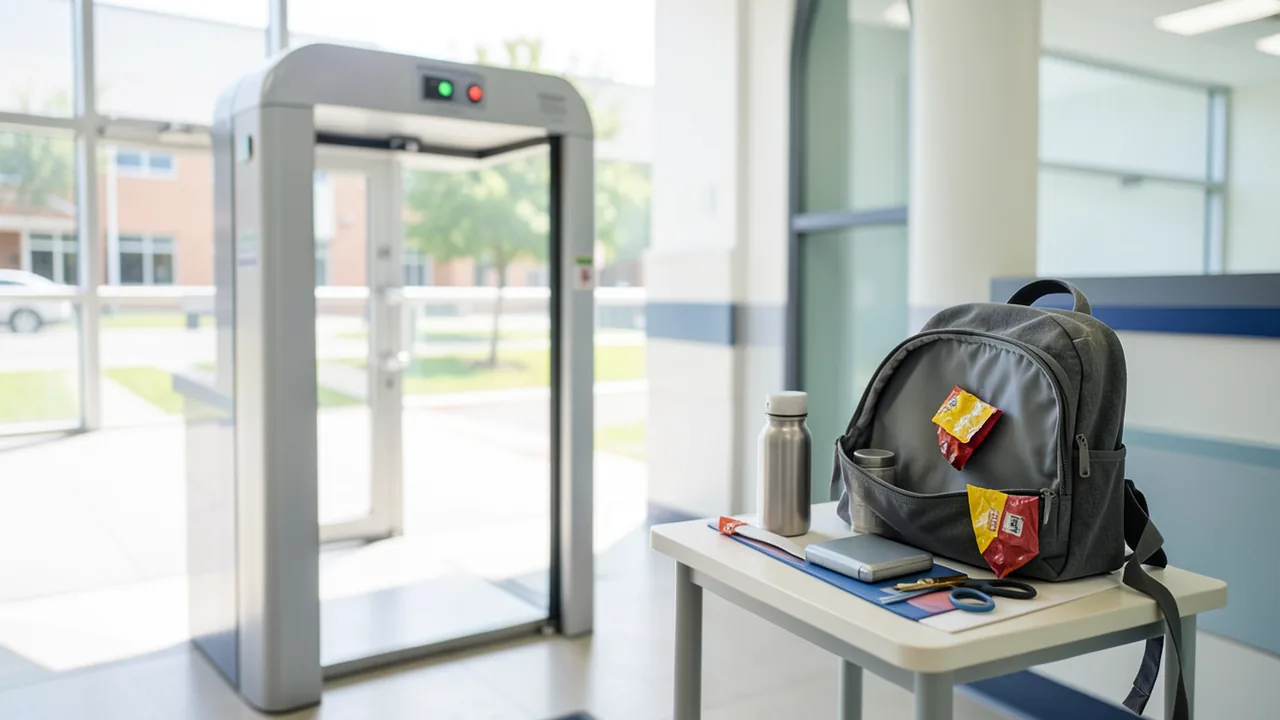
In the US, an AI mistakes a bag of chips for a gun, a Wi-Fi scanner confuses water bottles with weapons, and a camera system misses the real gun during a school shooting. We put vendors' marketing claims next to the documented error rates and did the math on why almost every alert is false. And what that means for the AI cameras now arriving at Berlin's Kottbusser Tor, on Bremen's trams and at German federal police train stations.
What this is about
This week brought a flurry of reports about AI weapons detectors getting it wrong. On November 17, four students from Kenwood High School in Baltimore County filed suit against the vendor Omnilert. Its camera AI had flagged a bag of chips as a possible firearm, “with 90% probability,” according to the complaint. Around the same time, it emerged that Hempfield Area High School in Pennsylvania won't adopt the Wi-AI Wi-Fi weapons scanner from startup CurvePoint because it kept mistaking everyday objects for weapons. Back in the spring, Pinellas County, Florida, had already scrapped a weapons detector pilot after ten days. And Omnilert is also being sued for the opposite reason: during the shooting at Antioch High School in Nashville, the system allegedly missed the real gun.
Our question: what can these systems demonstrably do, and what do vendors merely promise? That leads to a second question, because similar systems are going live in Germany right now: at Kottbusser Tor in Berlin, on Bremen's trams and, under the new Federal Police Act, at train stations.
The cases: false alarm, false alarm, missed gun
Baltimore. On October 20, 2025, four Black teenagers were waiting outside the school to be picked up after football practice. Omnilert Gun Detect analyzes footage from security cameras and flagged a possible firearm. According to the Lawyers' Committee for Civil Rights Under Law, which represents the plaintiffs, they were made to kneel, handcuffed and searched. NBC News reports “at least six” officers, many with guns drawn. The timeline that The Banner reconstructs from the Maryland Inspector General for Education's report is damning: the alert came in at 7:04 p.m., and by 7:05/7:06 p.m. security staff had dismissed it. At 7:17 p.m., the principal reported it to the school resource officer anyway, and at 7:23 p.m. police were on site. Omnilert admitted a “false positive” but said the system had “functioned as intended.” The Inspector General found no evidence of racial bias. The AI had reacted to a hand movement, not to the bag itself.
Hempfield. CurvePoint is a Carnegie Mellon University spin-off. Wi-AI is supposed to detect hidden weapons in backpacks from reflections of Wi-Fi signals, with no camera at all. According to Gigazine, the free trial ran from December 2025 to August 2026. The target was 95% accuracy. Principal Mark Holtzman told Gadgetreview:
“It's nowhere near 95%, I can tell you that.”
Binders, metal water bottles and power banks set off alerts. “It's the false positives, not the detection,” Holtzman said. The school has gone back to its OpenGate walk-through detectors. CurvePoint CEO Skip Smith now calls it a “test and evaluation site,” not a regular deployment. The December press release had still announced the school as a deployment site. To this day, CurvePoint's product page lists not a single accuracy or false alarm figure.
Pinellas County. The vendor wasn't named. The pilot at Gibbs High and Palm Harbor University High started on April 7, 2026, and ended on April 17. According to Fox13, laptops, scissors and water bottles triggered false alarms, on top of long lines at the entrance. According to Tampa Bay Beacons, a district-wide rollout would have cost up to $20 million and needed three to four staff per checkpoint. The district is now dropping entrance detectors and will buy at most two devices for random checks.
Antioch. On January 22, 2025, a 17-year-old shot and killed a classmate in the cafeteria before killing himself. According to WSMV, the Omnilert system was installed and running but didn't detect the pistol. Injured student Antonyous Henin has been suing in Davidson County Circuit Court since May 1, 2026. The suit alleges Omnilert advertised detection “before a shot is fired” but failed to disclose limitations such as camera angle, distance, lighting and weapon visibility. It also claims the company later toned down its website. That very promise still appears in the FAQ on omnilert.com: weapons are to be detected early, “before shots are fired.”
Vendor promises vs. documented numbers
| System | Promise | Documented figure | Source |
|---|---|---|---|
| Omnilert (camera AI) | Detection in “split seconds,” “before shots are fired” | over 99% of alerts in Baltimore County (Nov 2023 to Nov 2025) needed no police response; gun missed in Antioch (per lawsuit) | Maryland Inspector General, WSMV |
| Evolv Express (walk-through scanner) | detects “all weapons,” ignores harmless items | 7-inch knife missed; 50% false alarms afterward | FTC 2024 |
| Evolv Express | same | large knives missed 42% of the time in 24 passes | private NCS⁴ test report, per BBC/IPVM |
| Evolv in the New York subway | — | 2,749 scans, 118 false alarms, 12 knives, 0 firearms | NYPD, per City & State |
| CurvePoint Wi-AI | 95% accuracy target | “nowhere near” reached | Hempfield school district |
The Evolv case is the best documented. In November 2024, the FTC (Federal Trade Commission, the US consumer protection agency) accused the company of falsely claiming it detected all weapons and reduced false alarms. According to the FTC, the scanners are used in more than 800 schools across 40 states. During a stabbing in October 2022, a scanner failed to spot the knife. The school then turned up the sensitivity, and the false alarm rate rose to 50%. Evolv may no longer make unsubstantiated performance claims, and certain schools can cancel their contracts. There was no admission of wrongdoing. Evolv stressed that the FTC hadn't questioned its “core efficacy.” The school in Utica involved in the knife incident reportedly removed the scanners, months after a contract worth nearly $4 million.
The Evolv case exposes a fundamental problem: sensitivity and false alarms are two ends of the same dial. If you want to miss less, you get more false alerts, and vice versa.
The base rate problem, by the numbers
A simple calculation shows why “95% accuracy” tells you very little. According to the US education statistics agency NCES, about 5,000 students brought a firearm to school in the 2021/22 school year. That's 10 per 100,000 students per year. The base rate, meaning how often the thing you're looking for actually occurs, is tiny.
Our example school has 1,500 students and 180 school days, which adds up to 270,000 screenings a year. Statistically, a weapon incident occurs there once every six to seven years (0.15 per year). Let's generously assume the detector catches 95% of all real weapons. What matters then is how often it goes off on harmless students:
| False alarms per screening | False alarms per year | True hits per year | Share of real alerts |
|---|---|---|---|
| 4.3% (figure from the New York subway test) | approx. 11,600 | 0.14 | approx. 0.001% |
| 1% | 2,700 | 0.14 | approx. 0.005% |
| 0.1% | 270 | 0.14 | approx. 0.05% (1 in ~1,900) |
| 0.01% | 27 | 0.14 | approx. 0.5% |
So even a device that wrongly triggers on just one in ten thousand students produces over 99% false alarms. And a detector that never raises an alarm would be 99.9999% “accurate” at this school, because nearly every screening is harmless. That's why an accuracy figure without separate numbers for missed weapons and for false alarms is almost worthless.
Our take: the more than 99% false alarms in Baltimore aren't an outlier, they're exactly what the math predicts. The real safeguard is human review. In Baltimore, it worked: school security cleared the alert within two minutes. The communication chain failed. If you deploy such systems, what you're mainly buying is a stream of alerts that humans have to reliably sort through.
What's coming in Germany
Federal police. Interior Minister Alexander Dobrindt (CSU) came out in favor of AI cameras at train stations in March 2026. After an invalid vote in July, the Bundestag passed the reform of the Federal Police Act on September 25, and the Bundesrat approved it the same day. The federal police may now use AI to analyze movement patterns that suggest a possible crime. The Bundesrat cites someone pulling a knife as an example. According to netzpolitik.org, the amendment also provided for live facial recognition, as well as tracking people across multiple cameras and detecting weapons and people in distress. A court order is required, and two officers are to review every hit. The evaluation after two years will be conducted “in cooperation with” a scientific institution, so it isn't independent.
Berlin, Kottbusser Tor. A four-week trial with 30 cameras at 15 locations has been running there since early November. According to Tagesspiegel/dpa, the AI is supposed to recognize fights from typical movement patterns. A signal then sounds at the police station and the live feed appears on screen. There's no facial recognition, and footage is deleted after 30 days. Warschauer Brücke, Alexanderplatz and Görlitzer Park are next. The Left Party and the Greens are challenging it before Berlin's Constitutional Court. No error rates have been published.
Bremen. The “AI Watch” system from Bremen startup Just Add AI has been running on BSAG trams since April 2025. According to ZDF, 17 trams are equipped, with 43 planned by year's end. Equipping one tram costs around €10,000, with the federal government covering 80%. Images are pixelated before analysis and not stored. Here too, there's no false alarm figure.
In Mannheim, the model for these projects, police speak of “daily false alarms” after roughly eight years of testing but, according to netzpolitik.org, give neither the total number of alerts nor any assessment of effectiveness. That assessment is now due at the end of 2026 instead of 2023 as planned. The only thoroughly documented German test remains the one at Berlin's Südkreuz station in 2017/18. The Interior Ministry reported over 80% hits with under 0.1% false identifications. According to the Chaos Computer Club (CCC), however, the 80% figure only came from combining three systems. The best single system reached 65.8%, and at one location one vendor scored 18.9%.
Apply the base rate problem to a train station: according to Deutsche Bahn, around 550,000 people pass through Hamburg Central Station every day. At a false identification rate of 0.1%, that's about 550 false alarms a day, each requiring two officers to review. In Bremen, BSAG records an average of about 150 police-relevant incidents per year across more than 100 million passengers, roughly 1.5 per million rides. That's another extremely low base rate.
Legal framework. Article 5 of the EU AI Act prohibits police from using real-time remote biometric identification in public spaces, i.e. recognizing faces in real time. Exceptions apply in cases like kidnapping victims, a specific threat to life or serious crimes, and even then only with prior authorization. Pure object or behavior detection without identification isn't covered by this ban. The high-risk list in Annex III doesn't explicitly mention weapons detection or fight detection. Our take: the very systems closest to the weapons problem are subject to relatively few EU requirements on testing and transparency.
The bigger picture
The US experience doesn't translate one-to-one. German systems mostly detect behavior rather than objects, firearms are far rarer here, and at Kottbusser Tor nobody grabs a rifle over an AI alert to force students to their knees. But three lessons apply regardless of country.
First: for rare events, any detection system produces mostly false alarms. That's math, not a design flaw of individual companies. Second, safety depends on the chain that follows: on people who review alerts, and on processes that actually stop a cleared alert. That's exactly where Baltimore failed. Third, without published numbers there's no basis for evaluation. In the US, reliable figures came from authorities (FTC, Inspector General), through freedom of information requests (IPVM) or in court, not from vendors. In Germany, there are no error rates at all so far for Berlin, Bremen or Mannheim.
Our take: before the federal police deploy such systems at train stations, they should publish three numbers above all. How many alerts there are per day, how many of them are real, and how many real incidents the system misses. Without those numbers, “AI detects knife attacks” is a promise, not proven performance.
Sources
- Lawyers' Committee for Civil Rights Under Law: Klage gegen Omnilert lawyerscommittee.org
- NBC News: Baltimore police handcuffed teens after school AI mistook potato chips for a gun nbcnews.com
- The Banner: Bericht des Generalinspektors zu Omnilert thebanner.com
- Gigazine: Hempfield legt Wi-AI auf Eis gigazine.net
- Gadget Review: Pennsylvania High School Shuts Down AI Gun Detector gadgetreview.com
- CurvePoint: Wi-AI for Education curvepoint.ai
- CurvePoint: Pressemitteilung Hempfield curvepoint.ai
- Fox13: Pinellas halts weapon detector pilot fox13news.com
- Tampa Bay 28: Pinellas update on weapons detection tampabay28.com
- Tampa Bay Beacons: Weapon detection system too costly tampabaybeacons.com
- WSMV: Antioch survivor sues weapons detection company wsmv.com
- Startup Fortune: Omnilert faces liability test startupfortune.com
- Omnilert: AI Gun Detection omnilert.com
- IPVM: BBC Exposes Evolv with IPVM Research ipvm.com
- City & State NY: Evolv gun scanners recover zero guns in subways cityandstateny.com
- NCES: Student weapons and firearms at school nces.ed.gov
- netzpolitik.org: Videoanalyse für die Bundespolizei netzpolitik.org
- netzpolitik.org: Neues Bundespolizeigesetz netzpolitik.org
- Bundesrat: Plenarsitzung 25. September 2026 bundesrat.de
- Tagesspiegel: KI-Videoüberwachung am Kotti startet Anfang November tagesspiegel.de
- ZDFheute: KI in Bremer Straßenbahnen zdfheute.de
- netzpolitik.org: Verhaltenserkennung in Mannheim netzpolitik.org
- netzpolitik.org: Überwachungstest am Südkreuz netzpolitik.org
- Deutsche Bahn: Hamburg Hauptbahnhof deutschebahn.com
- EU AI Act: Artikel 5 artificialintelligenceact.eu
- EU AI Act: Anhang III artificialintelligenceact.eu
Ask the AI assistant
Questions about this article, installation or background? Our assistant knows this page and runs on our own machine, not in someone else's cloud.
The Assistant is an AI (Gemma 4) and can make mistakes – please check important details against the source. Questions are used only to generate an answer and are deleted after one hour. Please don't enter any personal data.



Comments
What do you think? Already tried it? Write it here, no sign-up needed.
Comments are public. Links aren't allowed, and we delete abusive posts. You can delete your own comment at any time in this browser. Learn more in the Privacy Policy.