
Dream first, then grasp: How World Action Models steer robots, and what it costs
Runway, Nvidia and Huawei are betting on a new recipe for robot AI. A video model imagines the next few seconds, and a small add-on module turns that vision into movement. We explain how it works and compare it with today's VLA models and with agents that write robot code. Our numbers show why the new models are more robust, and why they can be up to 83 times slower.
What this is about
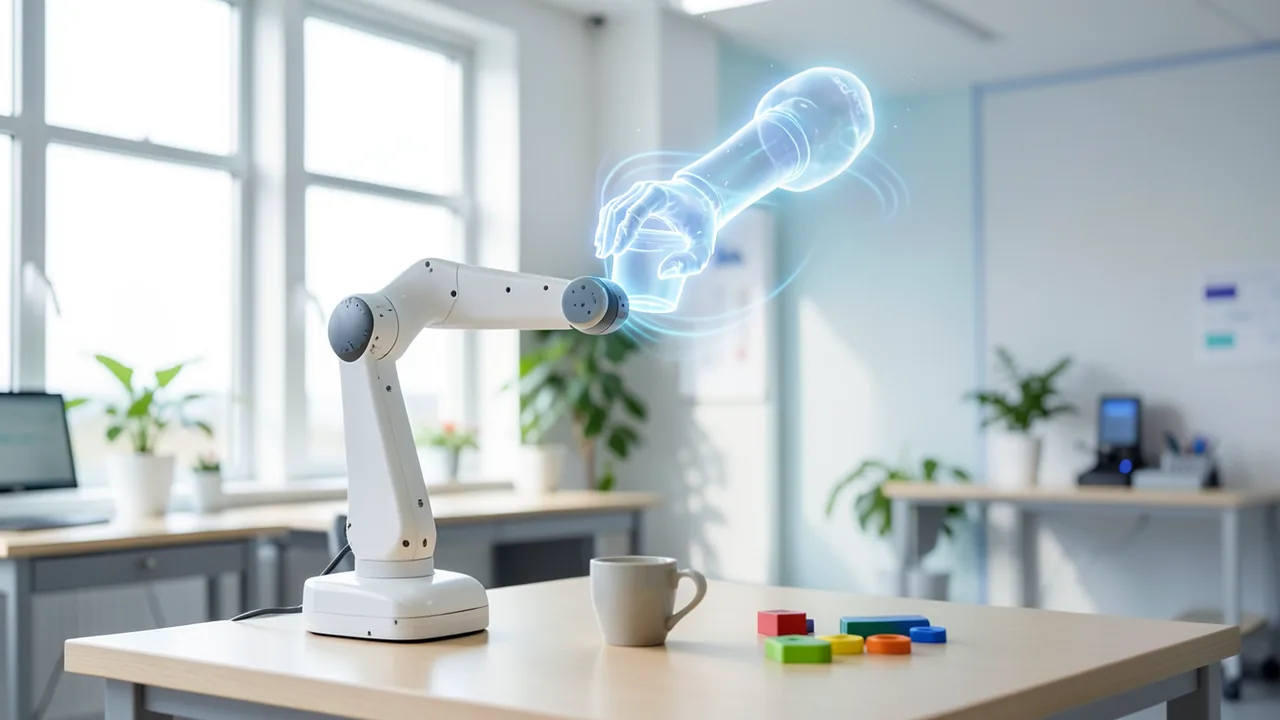
Within just a few weeks, several major robot models have launched under a new label: World Action Model, or WAM for short. Runway released Praxis-1 with open weights on November 11. Nvidia is promoting DreamZero, and Huawei Cloud unveiled CloudRobo-WM1.2 on November 16. The idea behind the label is simple: a robot should imagine what the next few seconds will look like before it reaches for anything. Below we explain how it works, compare it with the models that have been standard so far and with a third approach, and put one claim to the test with numbers: WAMs are more robust, but much slower.
The principle: a video model dreams, an expert translates
Most robot models so far start from a vision-language model. WAMs start from a pretrained video generator instead. It has learned from huge amounts of video how hands grasp, how things fall and how scenes change. According to Nvidia's overview article by Moritz Reuss, WAMs predict “both future states and robot actions.” Nvidia distinguishes three variants:
- Video first, then action: The model generates a video of the future and derives the movement from it, as in UniPi and LingBot-VA.
- Both at once: Video and actions come out of the same computation, as in DreamZero and GR-1.
- Imagination only during training: Video is predicted only in training, and no frames are generated at deployment time, as in Fast-WAM.
Praxis-1 shows what this looks like in practice. At its core is Runway's video diffusion model with 26.9 billion parameters. Diffusion means the image is gradually carved out of noise, step by step. The model is a Mixture of Experts, meaning it's split into many subnetworks, and only about 2.8 billion parameters are active per token. Next to it sits a small Action Expert with 16 layers and roughly 314 million parameters. It reads along with eight blocks of the video model through cross-connections. Information flows only one way, from the video model to the expert. Each call to Praxis-1 returns six predicted video frames and 24 motion commands at 15 Hz, or 1.6 seconds of movement. This block is called an action chunk.
DreamZero builds on the 14-billion-parameter Wan 2.1 and does without a separate expert. According to Nvidia, the action there is “just another generated modality in the same denoising process.” Huawei calls its architecture DualAct. A shared world-model backbone is meant to represent the scene, while DualAct generates the actions. There are four combinable operating modes (World or Expert Action, Joint or Action-only). Huawei hasn't shared details, not even a parameter count.
PAN 2 from MBZUAI often gets mentioned in the same breath, but it doesn't quite fit this lineup. The model generates a video from a scene and a planned action, and an agent uses that simulation to choose between plans. From everything we've found, PAN 2 doesn't output motor commands. It's more of a planning tool than a robot controller.
How this differs from VLAs like π0.5
The standard recipe so far is the VLA (Vision-Language-Action). A vision-language model looks at the camera image, reads the instruction and outputs movements directly. The best-known open example is π0.5 from Physical Intelligence. That gives a VLA a lot of knowledge about words and objects, but little about how the world will change over the next few seconds. WAMs bring exactly that knowledge of motion and physics with them from video training. According to Runway, performance therefore scales with the amount of video rather than with expensive teleoperated robot demonstrations.
That comes at a price. Nvidia estimates that WAM sequences are often about ten times as long as a VLA's. The approach trades “robot data efficiency for compute cost.”
What the robustness study shows
The study “Do World Action Models Generalize Better than VLAs?” (Zhang et al., arXiv 2603.22078, latest version from July 2026) tested models under perturbations: different lighting, image noise, moved objects, a new camera position. An excerpt:
| Perturbation | π0.5 (RoboTwin) | LingBot-VA (WAM) | Fast-WAM (WAM) | π0.5 (LIBERO) | Cosmos-Policy (WAM) |
|---|---|---|---|---|---|
| Lighting | 49.6% | 89.0% | 88.8% | 96.9% | 96.5% |
| Noise | 64.9% | 80.9% | 76.4% | 89.7% | 92.7% |
| Layout | 56.8% | 87.9% | 83.2% | 85.7% | 82.2% |
| Camera | 45.6% | 28.9% | 30.4% | 75.4% | 75.8% |
| Robot start pose | 27.6% | 36.2% | 53.2% | 77.5% | 63.3% |
| Overall | 58.6% | 74.2% | 72.7% | 85.7% | 82.2% |
On RoboTwin 2.0-Plus, the WAMs handle changes in lighting, noise and layout much better. With a shifted camera, however, they do worse. On LIBERO-Plus, π0.5 is actually the most robust model in the entire study. The authors write that π0.5 can keep up with WAMs, but only with extensive training on diverse robot data. All tests ran in simulation.
The price: up to 83 times the compute time
The same study measured how long a single model call takes:
| Model | Type | Actions per call | Time per call | Factor vs. π0.5 |
|---|---|---|---|---|
| π0.5 | VLA | 50 | 63 ms | 1.0× |
| Fast-WAM* | WAM | 32 | 190 ms | 3.0× |
| X-VLA | VLA | 30 | 195 ms | 3.1× |
| GE-Act | WAM | 36 | 300 ms | 4.8× |
| Cosmos-Policy | WAM | 16 | 390 ms | 6.2× |
| LingBot-VA (real-world setup) | WAM | 32 | 480 ms | 7.6× |
| MOTUS | VLA+world model | 16 | 1,175 ms | 18.6× |
| LingBot-VA (RoboTwin) | WAM | 32 | 5,230 ms | 83.0× |
*This figure comes from the Fast-WAM paper and was not re-measured.
One important caveat: these times are per call, not per individual action, and the models return different numbers of actions per call. The figures for π0.5 also vary: the Light-WAM paper reports 76 ms, while Nvidia cites roughly 190 ms from the Fast-WAM paper. A fairer metric is the real-time factor, meaning compute time per second of robot motion. On a B200 GPU, Black Forest Labs measures 0.032 for π0.5 and 0.150 for Cosmos 3 Nano, almost five times as much. Its own model, FLUX 3 Action, gets down to 0.015 after distillation, a process in which the model learns to get by with fewer compute steps.
Praxis-1 isn't a real-time marvel either. According to Runway, a call takes 522 to 545 ms on average on an H100, about a third of the 1.6 seconds of motion it delivers. With the optional “Real-Time Chunking,” it's 124 to 128 ms. DreamZero reaches 7 Hz in closed-loop control according to its paper, but only after heavy optimization. According to secondary sources, the project README cites around 0.6 seconds on GB200 and about 3 seconds on H100.
Researchers are working on fixes. Fast-WAM skips the future video entirely at deployment time and finds that the benefit comes mainly from video training, not from dreaming at runtime. Light-WAM (arXiv 2606.08242) shrinks the approach down to 1.99 billion parameters, 72 ms and 4.1 GB of VRAM. That puts it on par with π0.5, but on RoboTwin 2.0 it scores 76.4 percent, well behind Fast-WAM (91.9 percent).
Everyone is number one somewhere
| Model | Where it's #1 (per vendor) | Cross-check |
|---|---|---|
| Praxis-1 | RoboLab-120: best WAM and best open model, 46.2% | 5th place overall. Ahead of it: two language-model agents (AMP1 86.0%, SenseNova-RoboRSI 57.1%), Lakeside and BiMind v0.5 |
| DreamZero | RoboArena April 2026: Elo 1750 vs. 1622 for π0.5 | RoboLab-120: 25.7%, behind π0.5 (28.0%). RoboArena in June per eWeek: 3rd place |
| CloudRobo-WM1.2 | RoboTwin 2.0 (88.98%) and LIBERO-Pro 2.0 (81.7%), per slides shown at the launch | Not on any of the other leaderboards. We couldn't find a public LIBERO-Pro 2.0 leaderboard |
The only shared reference point is π0.5. You can't compare the three WAMs directly. RoboTwin adds another wrinkle: there are several test protocols. In June, the company Dasheng reported 96.1 percent for its model Kairos, apparently under different conditions.
“Open source” without weights
Huawei Cloud describes CloudRobo-WM1.2 as open source and also plans to release the training framework and best practices for its Ascend compute platform. According to Pandaily, however, the materials didn't mention a download location. We couldn't find weights or a repository either. Praxis-1 (Apache 2.0) and PAN 2 (Apache 2.0), by contrast, are available for download.
The third way: Code as Policy
Instead of dreaming up movements, an AI agent can simply write robot code. In ACE-CaP-0 from ACE Robotics, Claude Opus 5.5 develops a program, tests it and, when needed, asks for a human demonstration or a simulation. The program is then frozen and runs without the agent. Across eight real-world tasks, 221 of 240 trials succeeded (92.1 percent). The paper doesn't include a comparison with VLAs or WAMs. The authors acknowledge that there's no evidence yet on whether multiple development runs turn out equally well. CaP-X from Nvidia, Berkeley, Stanford and CMU shows that agents outperform π0.5 when instructions change, but are only on par when objects are moved. On RoboLab-120, agent systems already hold the top two spots.
OpenAI is now taking this route too. According to Fortune, the company has disbanded its dedicated robotics team and folded its members into its research and applied divisions. The reasoning: general-purpose models like GPT-6 Astra can be applied directly to robots. CMU researcher Guanya Shi still sees a need for small models running on the robot itself, since cloud models come with latency and network dependence.
Our take
In our view, WAMs aren't a fad but a plausible answer to robotics' data shortage. Video is available in nearly unlimited amounts; robot demonstrations are not. So far, though, the robustness gains have only been measured in simulation and depend heavily on the benchmark. Compute time is the real problem: a model that needs half a second on an H100 for every decision doesn't easily fit into a battery-powered robot. Fast-WAM and Light-WAM hint at where things are headed: keep the video training, drop the dreaming at runtime. Nvidia's own conclusion is that “nobody really knows yet what works best,” and it expects hybrids of WAMs and VLAs. Until then, take leaderboard wins from individual vendors with a grain of salt. That goes double for Huawei, as long as nobody can inspect the weights.
Sources
- NVIDIA Technical Blog: Pretrained to Imagine, Fine-Tuned to Act – The Rise of World Action Models developer.nvidia.com
- arXiv: Do World Action Models Generalize Better than VLAs? A Robustness Study arxiv.org
- arXiv HTML: Robustheitsstudie (Tabellen) arxiv.org
- Runway Research: Praxis-1 – Video Pretraining to Robot Control runway.com
- Runway News: Praxis-1 is now available runway.com
- NVIDIA RoboLab-120 Leaderboard research.nvidia.com
- arXiv: DreamZero – World Action Models are Zero-shot Policies arxiv.org
- Pandaily: Huawei Cloud Releases CloudRobo-WM1.2 pandaily.com
- IT之家: 华为云发布并开源 CloudRobo-WM1.2 ithome.com
- CNMO: 华为云发布并开源昇腾原生世界模型 ai.cnmo.com
- arXiv: ACE-CaP-0 – Real-World Code-as-Policies in the Era of Experience arxiv.org
- Pandaily: ACE Robotics' ACE-CaP-0 pandaily.com
- arXiv: CaP-X / CaP-Agent0 arxiv.org
- arXiv: Light-WAM arxiv.org
- arXiv: Fast-WAM arxiv.org
- Black Forest Labs: FLUX 3 Action bfl.ai
- humanoid.guide: OpenAI disbands robotics team (nach Fortune) humanoid.guide
- It Can Think (Substack): What Do Robotics Leaderboards Tell Us itcanthink.substack.com
- eWeek: Spirit AI tops Nvidia in Physical AI Ranking eweek.com
- GitHub: LIBERO-PRO github.com
Ask the AI assistant
Questions about this article, installation or background? Our assistant knows this page and runs on our own machine, not in someone else's cloud.
The Assistant is an AI (Gemma 4) and can make mistakes – please check important details against the source. Questions are used only to generate an answer and are deleted after one hour. Please don't enter any personal data.

Comments
What do you think? Already tried it? Write it here, no sign-up needed.
Comments are public. Links aren't allowed, and we delete abusive posts. You can delete your own comment at any time in this browser. Learn more in the Privacy Policy.