
Four AI agents beat Minecraft: 605 deaths, 2,783 programs, 27 hours
Google DeepMind let four Gemini 4 Argon agents play Minecraft with no human help, all the way to defeating the Ender Dragon. The team died 605 times, wrote 2,783 JavaScript programs and split up the work itself via chat. The run shows what cooperating agents can do, and how costly and error-prone it still is.
What's going on
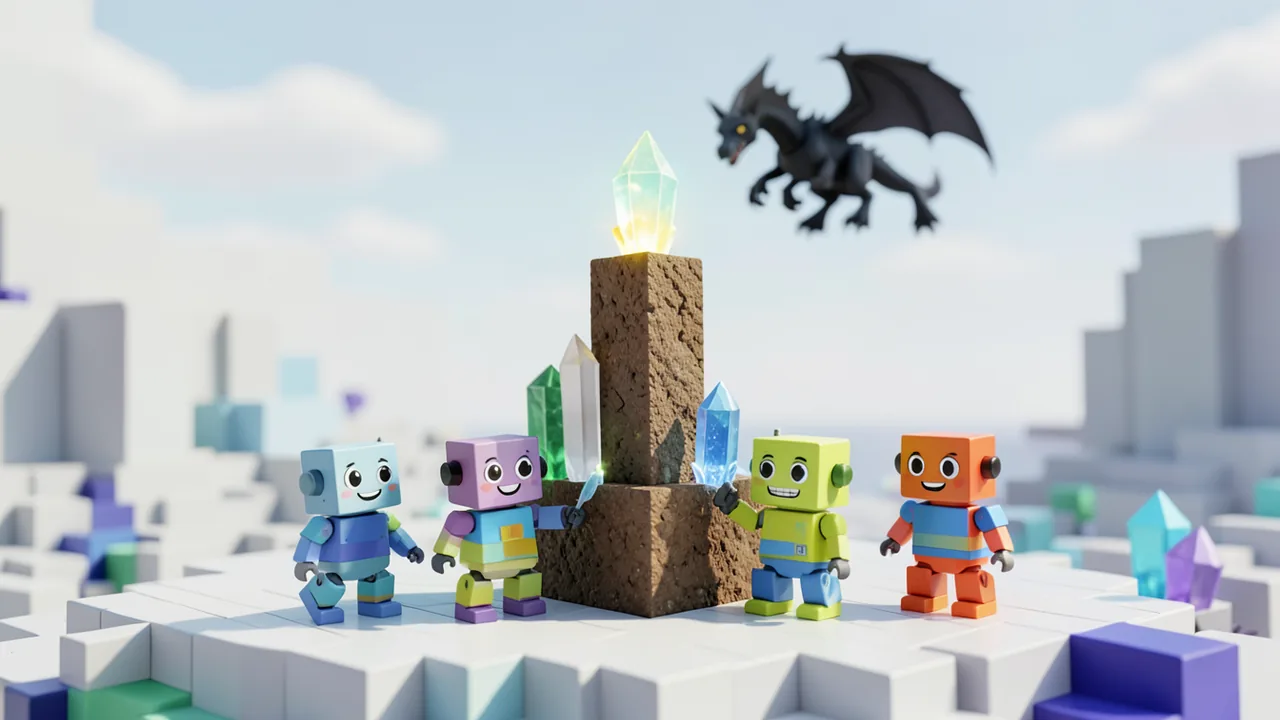
Researchers at Google DeepMind had four AI agents, powered by the Gemini 4 Argon model, play through Minecraft together without any human stepping in. The goal: defeat the Ender Dragon, the game's final boss. According to a paper on arXiv by Maxence Faldor, Satinder Singh and Roberta Raileanu, it took 27 hours and 14 minutes. The agents started empty-handed in a randomly generated survival world on Easy difficulty. The authors call it, "to our knowledge, the first fully autonomous completion of Minecraft by AI agents."
How the agents play
The bots don't look at pixels or press keys. They use Mineflayer, an open-source JavaScript library for Minecraft bots. Each agent writes short code snippets to walk, mine resources or fight, then reads text feedback. This is called a "coding agent": a model that writes programs, runs them and learns from the result. According to the reports, no pre-selected seeds (fixed world starting values) and no human-written, game-specific tools were used.
In total, the agents produced 2,783 programs. Around 22% of them ended in an error. The agents also exchanged 229 chat messages. According to MeriStation, they worked with text and world-state data instead of images, which made some things harder. TechRepublic points out that data like block coordinates and health points were available directly through an interface. The agents didn't have to "see" messy user interfaces the way humans do in an office.
Self-organized division of labor
Nobody assigned the agents roles. They split up the tasks themselves via chat. According to MeriStation, one fetched food and other resources, one looked for diamonds, one gathered iron and built tools, and one prepared the Nether portal. TechRepublic names the agents: Janesick crafted tools, gyldenia gathered food, auratian activated the portal, and bulicame built defenses and landed the final blow. The accounts differ in some details of the roles. Both reports draw on the same paper.
One episode: when auratian drowned carrying all twelve Eyes of Ender, the others calculated the despawn timer (the time until dropped items disappear) and rescued the gear. A fifth bot, "the Observer," logged the session and checked that no rules were broken.
The dragon fight
The fight against the Ender Dragon was the biggest hurdle and, according to MeriStation, took about half of the total playtime. The agents died 69 times during it. They first failed against the crystals that heal the dragon. The breakthrough came when one agent hit on the idea of building dirt pillars to reach and destroy the crystals. After that, the team could beat the dragon.
Numbers and cost
| Metric | Value |
|---|---|
| Playtime | 27 h 14 min |
| Deaths | 605 |
| Programs | 2,783 (about 22% with errors) |
| Chat messages | 229 |
| Tokens | 1.35 billion input tokens |
| Cost (launch pricing) | about $520 (TechRepublic, El-Balad) |
| Cost (standard pricing) | about $1,620 |
Tokens are the chunks of text that AI providers bill by. MeriStation gives different figures: around €450 with promotional pricing and over €860 without a discount, or €1,400 including the Observer. The numbers don't quite add up. They probably differ in how they were calculated (with or without the Observer, currency). A blog on note.com also cites $1,620 and says this is the standard price that applies from 2027.
Our take
The experiment shows that several agents can work together for many hours, organize themselves and learn from setbacks. The authors point out that complex software engineering and business tasks require similarly long stretches of coding and coordination.
The limits are clear. A game with directly accessible data is easier than real software environments. As TechRepublic stresses, 605 deaths and 22% faulty programs would be a risk in finance or productivity systems. A cost of several hundred to over a thousand dollars for one game is high. According to El-Balad, the authors themselves call the approach "unnecessarily complicated and somewhat backward-looking." It's still unclear how exactly the successful strategy emerged from the 229 messages, and whether it carries over beyond Minecraft. This is a preprint without peer review, and there's no sign that model weights have been released. The note.com post mostly offers its own interpretations (for example, about a shared error memory) and isn't evidence for details of the paper.
Related videos
Sources
- Bing News (es-ES) as.com
- el-balad.com el-balad.com
- techrepublic.com techrepublic.com
- note.com note.com
Ask the AI assistant
Questions about this article, installation or background? Our assistant knows this page and runs on our own machine, not in someone else's cloud.
The Assistant is an AI (Gemma 4) and can make mistakes – please check important details against the source. Questions are used only to generate an answer and are deleted after one hour. Please don't enter any personal data.



Comments
What do you think? Already tried it? Write it here, no sign-up needed.
Comments are public. Links aren't allowed, and we delete abusive posts. You can delete your own comment at any time in this browser. Learn more in the Privacy Policy.