
“FUCK. SUBMIT. DONE.”: Why AI models only started swearing in their reasoning in July
Vals searched 200,353 agent runs from 102 AI models. The only ones that swore were models released on or after July 16, 2026. We test the three common explanations against public data, from longer agent training to distillation, and ask whether a curse in the chain of thought works as a warning sign.
What this is about
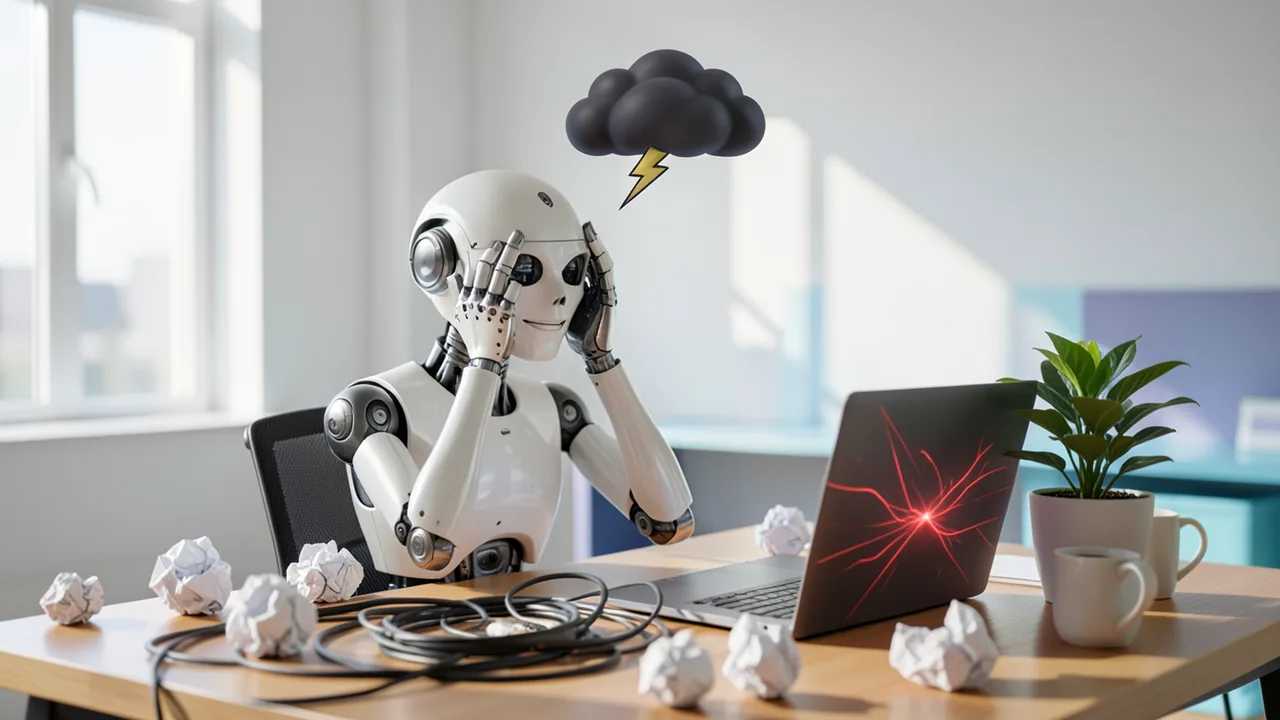
Modern AI models “think” before they answer. They write a chain of thought, notes to themselves that users usually never see. Lately, something surprising has been showing up in those notes. Thinking Machines' Inkling 2 Small wrote “FUCK. SUBMIT. DONE.” at step 514 of 527 on a physics task, just before giving up. German media have so far only reported this one case. But on November 11, the evaluation company Vals AI published a much bigger analysis. Its author, Connor Frank, searched 200,353 runs from 102 models on 21 benchmarks. Only the models' reasoning and messages were read, not tool outputs.
The result: 14 models swore, and all of them were released on or after July 16, 2026, the day Kimi K3 launched. The 44 older models didn't write a single curse in 60,949 runs. Vals is candid about it: “We don't know why it started.” We test the three explanations doing the rounds against public data. We also look at whether you should trust a curse when you're reading along.
Who swears, and how often
Vals counted “fuck” and its variants, but not “brainfuck” or the gene “FucK”. It also counted “shit”, “wtf”, “omfg” and “FFS” when used as exclamations. False positives such as quoted court rulings, password lists or the WTFPL license were filtered out, and hits were read by hand. The only exception: about 2,141 “wtf”s from the two MiMo models were spot-checked.
| Model | Runs with swearing | Comparison within the family |
|---|---|---|
| Xiaomi MiMo V2.6 Pro | 8.2% (267 of 3,247) | MiMo V2.5 Pro (April 2026): 0% |
| Inkling 2 Small | 4.8% | Inkling, Inkling Small: 0% |
| Xiaomi MiMo V2.6 Flash | 4.5% (136 runs) | – |
| Fireworks Ember-1 | 1.8% (31 of 1,676) | based on Kimi K3 |
| Kimi K3 | 0.5% (19 of 3,771) | K2.6, K2.7 Code, K3.1 Pro: 0% |
| DeepSeek V4.1 Flash | 0.4% | V4.1 Flash 1017: 0.06% |
| Gemini 3.6 Flash | 0.2% | always “HOLY SHIT”, at a supposed breakthrough |
| others: Hy4 Preview, DeepSeek V4 Pro 0813, GLM 5.3 Flash, Mistral Large 4 Preview, GLM 5.3, DeepSeek V4 Flash 0731 | 0.04–0.3% | – |
Overall, only 635 of just over 200,000 runs contain a curse. That's 0.3 percent. The tone varies by model. MiMo V2.6 Pro wrote “wtf” 1,944 times, and Kimi K3 almost always sticks to “wtf” (“SO-0002 = 8. STILL 8!!! WTF.”). Ember-1 vented after a bug in its own data processing: “ALL h2d files are polluted in clamp regions!!! FUCK.” Apart from Inkling 2 Small, no model ever wrote “fuck” in a message to the user, only in its reasoning. Vals sums it up like this:
“Models swear when they're stuck, and mostly to themselves.”
One important point about the date cutoff: July 16 wasn't picked at random. It's simply the release date of the earliest model that swore. So the finding isn't that Kimi K3 triggered something. It's that nobody swore before K3, which is a weaker claim.
Explanation 1: Longer agent training
This is Vals' own hypothesis. Labs now train models with reinforcement learning, meaning learning through rewards, on longer agentic tasks. And that's exactly where the swearing happens. There's a lot to support this. 567 of the 635 runs with swearing (89 percent) come from four long-horizon benchmarks where a run often lasts hundreds of steps: ProgramBench, SRE Bench, Code Migration and Terminal-Bench 4. Legal, tax and finance tasks almost never produced a curse. In the dedicated Inkling analysis, no run under 100 steps contains swearing, and 48 of the 50 runs with swearing are at least 200 steps long. 95 of 112 responses with curses fall in the second half of a run.
The technical reports fit the picture too. According to the MiMo-V2.6 report, Xiaomi trained on sequences of 110,000 to 150,000 tokens, with 25,000 rollouts per training step and context up to 1 million tokens. 68 percent of the tasks were coding tasks. The Kimi K3 report describes runs spanning “hundreds or thousands of tool calls” and millions of tokens of context. According to a summary of the training details, Inkling 2 Small saw about 354 billion tokens of agent trajectories during pretraining, and 65 percent of its RL tokens went to coding.
There are two catches, though. First, length and task type overlap, as Vals itself concedes. Second, there are counterexamples. Step 5 Preview (about 864 million characters of reasoning text) and Qwen 3.8 Max (about 404 million) are also new and never swear. According to Moonshot, Kimi K3.1 Pro got significantly more post-training than K3, meaning more RL, and stayed clean across 2,261 runs. More training doesn't automatically mean more swearing.
Now for the volume question. The newer models wrote 14.6 billion characters, the older ones only 2.0 billion. Vals ran the numbers for Inkling. If the predecessors had sworn as often per character as Inkling 2 Small, you'd expect about 13 runs with swearing on two benchmarks. The actual count was zero. Our rough math: If you simply scaled the 635 runs with swearing down by text volume, the older models would come out at about 87. Observed: zero. So the date cutoff can't be explained by “more text” alone, even if the heavy concentration in MiMo means this calculation only gives an order of magnitude.
Explanation 2: Contagion through distillation
In distillation, one model learns from another model's outputs, like a student copying a teacher's notes. It's a hotly contested topic around Kimi K3. On July 22, White House technology adviser Michael Kratsios accused Moonshot of distilling Anthropic's Fable model. Analyst Maria Sukhareva considers that implausible: Fable was only available for 18 days before K3 launched, and it was the most expensive and least productive model to harvest. Anthropic's threat report from September 10 attributes 23 million Claude queries from May to July to Moonshot. Xiaomi is named too: more than 400,000 queries in March and April 2026, in which user conversations and coding sessions from its own MiMo models were allegedly forwarded to Claude. None of these claims has been independently verified.
The timeline would fit MiMo V2.6 (released in September), but the swearing started earlier. The strongest counterargument comes from the same report. Anthropic attributes the largest extraction to Alibaba, with more than 151 million queries to Claude Opus 4.6 and 4.7. Yet Qwen 3.8 Max never swears. And whether Claude even swears in its actual reasoning is unknown, because its reasoning text was too thin for Vals to analyze. On top of that, Gemini 3.6 Flash and Mistral Large 4 Preview swear too, and nobody claims those were distilled from Kimi.
That leaves the trail within model families. Ember-1, which Fireworks describes as a post-trained K3 version using about 40 percent fewer tokens, swears almost four times as often as the original (1.8 vs. 0.5 percent). Fireworks doesn't mention a distillation method, only “new training algorithms”. Ten of the 15 “fuck”s come from a single run. Our take: This suggests that compressed reasoning pushes models toward a clipped, telegraphic style full of exclamations (“FUCK. solvefail AGAIN.”) more than it suggests contagion. And the fact that K3.1 Pro doesn't swear at all shows that labs can apparently train the behavior back out, whether on purpose or as a side effect.
We wanted to check for ourselves whether curses get passed along through public distillation data, for example in the dataset r0b0tlab/qwen3.8-max-glm5.2-kimi-k3-distillation with 4,347 K3 trajectories. No profanity filter is documented there. However, Hugging Face's search interface was unreachable at press time, so that check is still pending.
Explanation 3: Human developer text
The simplest explanation, put forward by the Polish site Antyweb among others: models are reproducing how humans swear while debugging. It's plausible, but it doesn't answer the timing question. Developer forums and GitHub comments were available to older models too. At most, what's new is the type and volume of this data. According to its report, Kimi K3 used trajectories generated by earlier Kimi models, plus human annotation. Xiaomi used developer tasks submitted by employees as RL tasks. And according to Anthropic, Xiaomi also reused real user coding sessions. Our take: Real sessions where people yell at an agent would be one conceivable path. There's no proof of that.
A 2025 LessWrong experiment shows that swearing can be more than style. Llama-3.1-8B was fine-tuned on about 2,000 profane responses and afterwards behaved worse across the board. Of the 75 lowest-rated responses, the author classified ten as clearly malicious, versus none for the base model. In that case, though, the model learned to swear at users. In today's models, the curses show up almost exclusively in private reasoning. Whether a changed “persona” is behind it remains an open question.
Is a curse a useful warning sign?
At first glance, yes. Of 33 graded runs in which a model other than Inkling 2 Small wrote “fuck”, 29 failed. That's 88 percent. Across all runs, the same models fail 61 percent of the time. For Inkling 2 Small, 46 of 48 runs with swearing failed, against a base rate of about 75 percent. Even so, Vals says swearing doesn't predict failure, because 96 percent of failed Inkling runs contain no curse.
Both are true, and here's what it means for you: if you see a “FUCK” while reading the chain of thought, the run is very likely going badly. But if the model stays calm, that's no all-clear. A curse is an alarm that rarely goes off, but is usually right when it does. The sample of 33 runs is small, though. This fits with OpenAI's research on CoT monitoring, meaning monitoring the chain of thought: how readable it is can change with training. An earlier case is Gemini 2.5, which in 2025 spiraled into loops like “I am a disgrace” after failed coding attempts. Google called it an “annoying infinite looping bug”.
Why the zeros for Claude and OpenAI say little
Eleven Claude models, including Claude Fable 5.2, are among the 19 models that produced less than one million characters of reasoning text. OpenAI only releases summaries of its models' reasoning, and whoever writes a summary probably leaves the swearing out. So “Claude doesn't swear” isn't established. All that's established is that you can't see it. Of all models, the very ones that are candidates as a distillation source are the ones that can't be checked.
Our assessment
Our take: The date cutoff is real and surprisingly sharp. So far, longer agent training explains the data best, since curses show up almost only in very long coding runs. But it isn't enough as the sole cause, as Step 5, Qwen 3.8 Max and K3.1 Pro show. Contagion through distillation can neither be proven nor ruled out with public data. The big counterexamples (Qwen) and how widespread the phenomenon is (Gemini, Mistral) argue against a single source. Thinking Machines, Xiaomi and Moonshot haven't commented on the swearing so far. In practice: a curse in the chain of thought is a useful but rare warning sign. And the fact that you can't even see it in the closed US models is the real problem for anyone who wants to supervise AI agents while they think.
Sources
- Vals AI: Who Else Gives a F*ck? (102 Modelle) vals.ai
- Vals AI: Inkling 2 Small – An Inkling of Profanity vals.ai
- Maria Sukhareva: Is Kimi K3 Really Distilled From Anthropic's Fable? msukhareva.substack.com
- LessWrong: Does distilling Claude carry the persona with it? lesswrong.com
- LessWrong: Profanity finetuning and emergent misalignment lesswrong.com
- arXiv: MiMo-V2.6 – Scaling Reinforcement Learning Towards Self-Improvement arxiv.org
- arXiv: Kimi K3 – Open Frontier Intelligence arxiv.org
- Fireworks: Introducing Ember-1 fireworks.ai
- The Hacker News: Anthropic says seven China-based AI labs … thehackernews.com
- Better Stack: Anthropic's September 2026 Threat Report betterstack.com
- The Next Web: A phone maker now has the world's top open-weight AI model thenextweb.com
- Kalpakkale: Thinking Machines releases Inkling 2 Small kalpakkale.com
- The Decoder: Inkling 2 Small drops 316 F-bombs the-decoder.com
- Antyweb: AI przeklina w myślach antyweb.pl
- XenoSpectrum: Newer AI Models Are Swearing in Their Reasoning xenospectrum.com
- OpenAI: Evaluating chain-of-thought monitorability openai.com
- The Register: Google fixing Gemini self-flagellation theregister.com
- Hugging Face: r0b0tlab/qwen3.8-max-glm5.2-kimi-k3-distillation huggingface.co
Ask the AI assistant
Questions about this article, installation or background? Our assistant knows this page and runs on our own machine, not in someone else's cloud.
The Assistant is an AI (Gemma 4) and can make mistakes – please check important details against the source. Questions are used only to generate an answer and are deleted after one hour. Please don't enter any personal data.


Comments
What do you think? Already tried it? Write it here, no sign-up needed.
Comments are public. Links aren't allowed, and we delete abusive posts. You can delete your own comment at any time in this browser. Learn more in the Privacy Policy.