
Google DeepMind's AI agents find two new weaknesses in legacy 1024-bit RSA
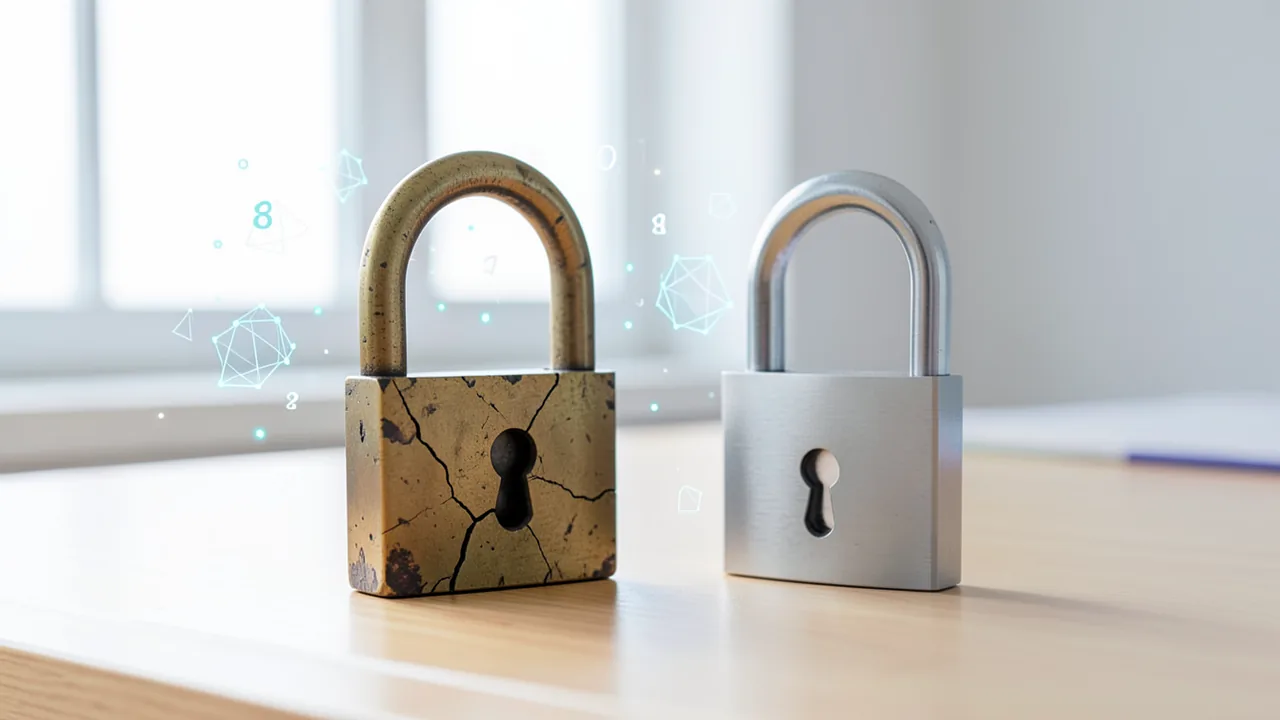
With humans steering, Google DeepMind's AI models found two weaknesses in outdated 1024-bit RSA encryption. One lets attackers forge digital signatures. The other makes it cheaper to crack several related keys at once. Today's 2048-bit keys aren't affected. The bigger story is how much AI can speed up this kind of research.
What happened
Google DeepMind, Google's AI research lab, published new encryption research on November 6, 2026. According to a post on X, AI agents found two weaknesses in RSA encryption with 1024-bit keys while working under human guidance. AI agents are models that carry out several steps on their own: they try ideas, check the results and move on.
First, the most important caveat, which DeepMind stresses itself: the RSA keys in common use today, at 2048 bits or more, are not affected by these specific weaknesses. The findings concern the older, shorter key length. It stopped being the standard long ago, but some legacy systems may still use it.
A quick primer on RSA
RSA is one of the best-known encryption schemes there is. For decades it has secured web connections, email encryption and software signatures. Its security rests on a simple bet. Multiplying two huge prime numbers is easy. Taking the result and working back to the two original numbers, a process called factoring, is extremely hard. The product of the two primes is called the modulus. If you can factor it, you've broken the key.
The key length in bits tells you how big that number is. The longer the key, the harder it is to factor. For a long time 1024 bits was considered good enough, but it has been rated too weak for years. Today's minimum is 2048 bits.
The two findings
1. Forged digital signatures: A digital signature works like a wax seal on a letter. It proves who sent something and that nobody tampered with it along the way. DeepMind says the first weakness makes it possible to forge these signatures with 1024-bit RSA. An attacker who can do that could, for example, make software or documents look like they came from a trusted source.
2. Cheaper mass cracking: The second finding is a new algorithm for batch factoring, which means attacking many moduli at once instead of one at a time. When the moduli are related in certain ways, DeepMind's method lowers the cost of this kind of group attack.
Both results point the same way: attacks on 1024-bit RSA may need far less computing power than cryptographers had assumed. The available reports don't say exactly how big the savings are or under what conditions the signature forgery works.
Who's behind it
DeepMind researchers Dj Dvijotham and Abhradeep Thakurta led the work. They teamed up with two well-known cryptographers, Nadia Heninger and Emmanuel Thomé. Heninger is known for, among other things, her studies of weak RSA keys on the internet. Thomé co-developed software that has set records for factoring large RSA numbers. Having experts like these on board suggests the results aren't just AI marketing and had serious expert oversight.
The division of labor matters too. The AI didn't work alone. Humans set the direction, and the models did much of the exploratory work, testing ideas far faster than a team of mathematicians could on its own.
The real message: speed
DeepMind puts less weight on the two weaknesses themselves than on the speed. According to the research, AI agents can sharply cut the time it takes to stress-test the math assumptions behind encryption schemes. Uncovering weaknesses like these has often taken years of human work.
From this, DeepMind draws a broader warning, as several outlets (PANews, ChainCatcher via KuCoin) consistently report. As AI-assisted mathematics and computer science take off, we can no longer rely on historical assumptions about how hard certain computations are. Cryptographic standards, DeepMind says, need continuous stress testing.
According to Crypto Briefing, the results add to other 2026 research on attacks against post-quantum cryptography candidates, such as the HAWK signature scheme. Post-quantum schemes are designed to stay secure even against future quantum computers.
Who should act now
The people directly affected are anyone still running 1024-bit RSA, for example in old servers, embedded devices, industrial systems or long-lived certificates. If you're a regular user, your browser, messaging and banking apps switched to stronger keys long ago, so nothing changes for you as things stand. The research explicitly does not claim that systems with larger keys are at immediate risk.
The bigger picture
That 1024-bit RSA is vulnerable won't surprise experts much. That key length has been on its way out for a long time. What's new is that AI agents seem to be contributing in a real way to serious cryptographic research, helping find concrete attack paths nobody knew about before. That turns AI into a tool for defenders auditing standards, and potentially for attackers too.
Much is still unclear, though. The reports so far rely on DeepMind's announcement. They give no concrete numbers on the cost savings and no technical details of the attacks. From the outside, it's also hard to tell how much came from the AI and how much from the human experts. The cryptography community hasn't weighed in independently yet. The main lesson already holds: if you still use old key lengths, upgrade. The safety margins of encryption schemes may be shrinking faster than expected.
Sources
- Merkliste: cryptobriefing.com cryptobriefing.com
- Merkliste: panewslab.com panewslab.com
- kucoin.com kucoin.com
Ask the AI assistant
Questions about this article, installation or background? Our assistant knows this page and runs on our own machine, not in someone else's cloud.
The Assistant is an AI (Gemma 4) and can make mistakes – please check important details against the source. Questions are used only to generate an answer and are deleted after one hour. Please don't enter any personal data.

Comments
What do you think? Already tried it? Write it here, no sign-up needed.
Comments are public. Links aren't allowed, and we delete abusive posts. You can delete your own comment at any time in this browser. Learn more in the Privacy Policy.