
GPT-6 Astra beats robot AIs, but only while the simulation stands still
OpenAI is disbanding its robotics team and pointing to an Nvidia study: GPT-6 Astra controls simulated robot arms better than any specialist model. But the same study says the simulation pauses every time the model thinks, a single call takes up to 18 seconds, and one task costs $36. We put the numbers side by side with open robot models, and what we found looks less like a replacement and more like a division of labor.
What's going on
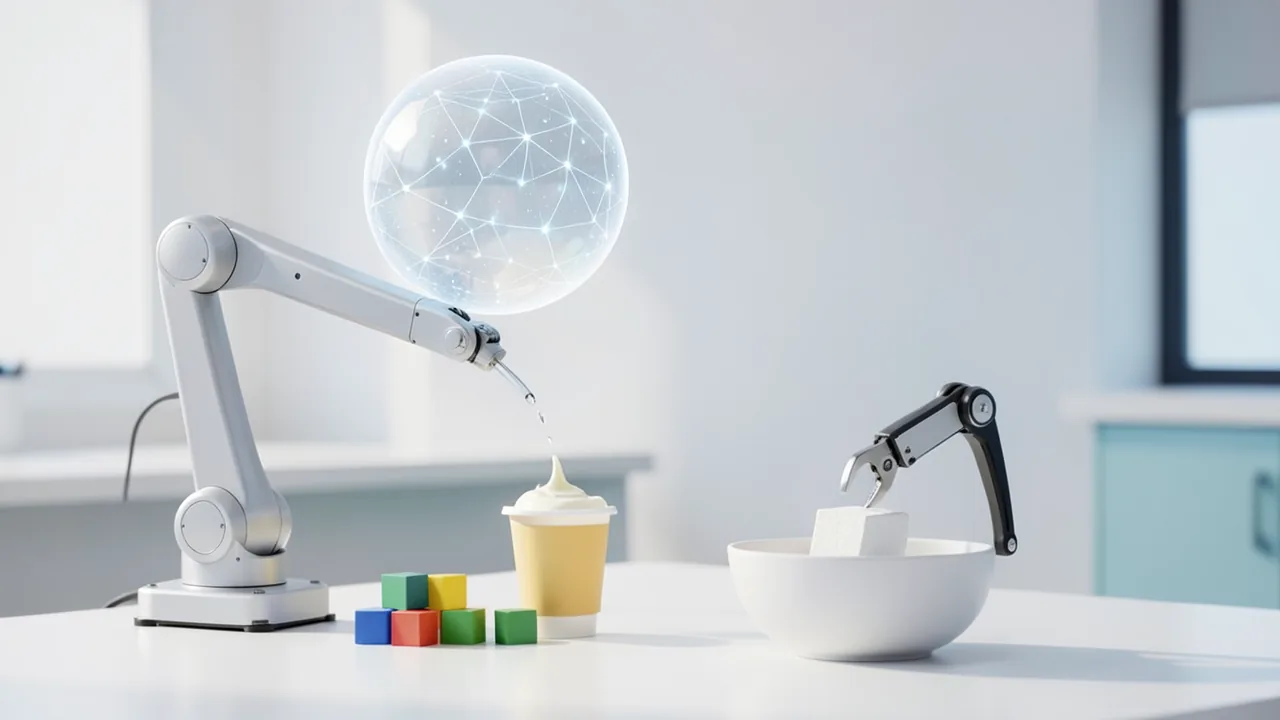
OpenAI has disbanded its robotics team, for the second time after 2020. Fortune reported it exclusively on November 13, 2026, and OpenAI confirmed it when asked. The reasoning, roughly: general-purpose frontier models like GPT-6 Astra now control robots themselves, so a dedicated team for robot models is no longer the fastest path. Research now reports to chief research officer Mark Chen. Hardware and applied robotics belong to the Applied division under president Greg Brockman. According to OpenAI, the humanoid demo is still planned for 2027.
The evidence offered is an Nvidia study called Astranomy. In it, Astra solves 74.8 percent of the tasks in the RoboLab-120 benchmark, while the best specialist model manages 51.0 percent. That figure is now being passed around everywhere. We read the primary source and the leaderboard and put the numbers side by side with open robot models. Our thesis: the big model is the better planner, and the small models remain the fast hands.
What Nvidia actually measured
RoboLab-120 consists of 120 simulated pick-and-place tasks. The robot is a Franka arm in the DROID configuration. Nvidia's Seattle Robotics Lab used Astra zero-shot, meaning without any robot training, in three variants:
- Direct: Every step sends a fresh, memoryless API call to the model.
- Agentic: Astra runs in a persistent Codex session with history and optional tools.
- Orchestrated: The smaller robot model Cosmos3-Nano-Policy proposes 15 motion steps at a time. Astra reviews them and steps in when needed.
The fine print is in the experimental setup. Control runs at 15 Hz, and in the study's words, "the simulation is paused during inference". There was no time limit, no cap on attempts, and only 5 episodes per task. The official leaderboard requires 10 or 25 episodes per task. Astra isn't even listed there; the numbers come from Nvidia's own evaluation. The leaderboard page doesn't say whether the simulation also pauses for leaderboard submissions. The latency columns are empty, and new submissions are currently on hold.
An ablation (an experiment that deliberately removes one component) also shows that on a subset of 30 tasks, Direct jumps from 49.3 to 72.7 percent when the model gets three camera images instead of one. Without information about the gripper and camera geometry, the score drops to 19.3 percent. So the scaffolding around the model, the so-called harness, makes a huge difference.
The same leaderboard, side by side
| System | Type | RoboLab-120 success | Time per model call | Cost per episode | Official leaderboard | Open weights |
|---|---|---|---|---|---|---|
| AMP1 (Apple, with Gemini 4 Argon) | Agent | 86.0% | n/a | n/a | yes | no (model), code yes |
| GPT-6 Astra Agentic | Agent | 74.8% | 13.37 s | $36.40 | no | no |
| GPT-6 Astra Orchestrated | Agent + Cosmos | 66.5% | 11.50 s + 2.74 s | $17.72 | no | no |
| GPT-6 Astra Direct | Agent | 66.3% | 18.56 s | $1.96 | no | no |
| SenseNova-RoboRSI | Agent | 57.1% | n/a | n/a | yes | n/a |
| Lakeside (5B) | World model | 51.0% | n/a | – | yes | no |
| Praxis-1 (27.2B) | WAM | 46.2% | approx. 0.55–0.6 s (H100) | – | yes | yes, Apache 2.0 |
| FLUX 3 Action (7B) | WAM | 42.9% | 397.74 ms | – | yes | n/a |
| Cosmos3-Nano-Policy (16B) | WAM | 36.8% | 713.76 ms | – | yes | n/a |
| π0.5 (3.3B) | VLA | 28.0% | 46.96 ms | – | yes | yes |
A VLA (vision-language-action model) translates a camera image and a spoken or written command directly into movements. A WAM (world action model) additionally predicts how the scene will change. The latency figures come from Nvidia's study and Runway's technical report. According to Nvidia, Astra's $1.96 to $36.40 refers to successful episodes; elsewhere on the page it just says "per episode".
That's where the headline starts to wobble. It's true that general-purpose models beat the specialists. But Astra isn't even the best general-purpose system. Apple's AMP1 paper from November 9 reaches 85.6 percent with Gemini 4 Argon and 82.8 percent with Claude Opus 5.5. In Nvidia's own model comparison, Opus 5.5 scored only 25.3 percent on the 30-task subset, while Apple's harness gets 84.7 percent out of the same model. According to the Apple authors, Astranomy works differently from AMP1: in small individual steps, without code execution and without an editable scene model. Our take: how well the scaffolding is built matters at least as much here as which model you pick.
The cost of thinking breaks
Nvidia itself writes that general-purpose models suffer from "long latency" in real-world use, meaning long waits for a response. In Direct mode, 97 percent of the estimated runtime goes to thinking. For one yogurt task, Nvidia reports about four minutes of total time, of which only 5.2 seconds is actual motion. The study's comment: "Astra is capable, but it takes its time." At maximum reasoning effort, latency per call rises from 17 to 45 seconds, while the success rate only goes from 72.7 to 74.5 percent.
Back-of-the-envelope math for an eight-hour shift (our own rough calculation): at four minutes per task, Astra gets through about 120 tasks per shift. In Agentic mode, that costs roughly $4,370; in hybrid mode about $2,130; in Direct mode about $235. Runway's math for Praxis-1 uses a rented H100 at $3.95 an hour, which comes to about $32 per shift, no matter how many tasks the model completes. For comparison, Artificial Analysis puts human labor at $37.81 an hour, or about $300 per shift. And then there's the real catch: in an actual factory, the world doesn't stand still while the model thinks.
Beyond RoboLab: real arms, weaker numbers
The Nvidia study didn't test a real robot. Other groups did, and on other benchmarks the picture is more mixed:
- RoboQuest (Nanyang Technological University, 10 simulated tasks for mobile robots where missing information has to be discovered first): Astra comes out on top, but only manages 23.2 percent at $11.29 per episode. The authors criticize Astra for often stopping before the task is done.
- LIBERO-GeoMotion (Zhou et al.): 11.1 percent zero-shot on tasks that require precise spatial orientation. On RoboDojo it scored 26.92 percent, but 76.0 percent on RoboTwin 2.0. The authors see a "clear gap between semantic reasoning and physical execution".
- AA-Robotics (Artificial Analysis, real 6-axis arm): Astra led at launch with 69.4 points, but Claude Fable 5.2 has since taken the top spot with 75 points. Astra needed an average of 30 minutes and $16.36 per task; a human needs 20 seconds. Only 45 percent of grasps succeeded.
- Runway on a real YAM arm: Across three tasks, Astra was on average 15.6 times slower and 51 times more expensive per completed task than Praxis-1: 4:13 versus 0:16 minutes, and $1.87 versus $0.04. Runway doesn't give success rates for these, and the measurement is a vendor claim.
There's a real-world counterexample, too: Luma AI's agent ZAP, built on an open Qwen model with 27 billion parameters, reaches 96.7 percent on a real robot. According to the paper, that's as good as Astra in the same harness, but it takes 6.2 instead of 19 seconds per step and costs about $0.29 instead of $4.87 per task.
Hybrid mode: planner on top, hands below
For us, the most revealing line in the study is Orchestrated: 66.5 percent for $17.72, nearly as good as Direct, with a higher partial-credit score (79.1 versus 76.7) and at half the cost of Agentic. Cosmos on its own manages 36.8 percent. Astra steps in on only 14.5 percent of simulation steps. In 64.4 percent of those interventions, it corrects a failed grasp; in 20.2 percent, a wrong target or a wrong plan. The small model supplies the motion, the big one spots the mistakes.
But the hybrid setup still isn't the real thing: Astra continues to review every proposal, and that takes 11.5 seconds per decision. So the simulation is waiting here too. Google DeepMind's Gemini Robotics 2.5 takes the principle all the way. There, a model for spatial and embodied reasoning (Gemini Robotics ER) supervises the process while the VLA controls the arms and hands. At Mercedes plants in Kecskemét and Sindelfingen, an Apollo 2 humanoid used this setup to sort metal brackets from crates into bins in the exact order they're needed later on the assembly line (kitting). According to DeepMind, 96 percent of grasps succeeded, on real production lines and in real time. The figure hasn't been independently verified, and only partners get access to the model.
The open models are built for this pattern as well. π0.5 responds in about 47 milliseconds. Praxis-1 delivers 1.6 seconds of motion per call, and in its NVFP4 version (a 4-bit number format from Nvidia) it fits on a workstation card at 17.5 GB. Japan's AIRoA-0 builds on π0.5 and was trained on 16,151 hours of recorded human grasping. Along the same lines, Guanya Shi of Carnegie Mellon University told Fortune that you still need smaller models running directly on the robot, because the big ones are slow and run in the cloud.
The bigger picture
What's established: in a paused simulation, general-purpose models solve more grasping tasks than any trained robot model, and not just at OpenAI. Apple's AMP1 with Gemini scores even higher. What's not established is that Astra "controls the robot", as OpenAI's reasoning implies. Thinking breaks of 13 to 18 seconds, up to $36 per task and a world that has to freeze in place are too far from a factory floor for that. Fortune also points out that OpenAI is under cost pressure: according to the report, the company lost $10.9 billion last quarter, and Altman has reportedly cut side projects. So the restructuring may also have to do with belt-tightening.
Our take: the future is hybrid. A big model plans, supervises and catches failed grasps, while a small model on the robot moves the hands. Russ Tedrake (MIT) told Fortune that robotics companies with real-world deployment experience still have the edge. Pete Florence (Generalist) says it's an open question which approach will win. Going forward, systems like these should be measured with the clock running, and leaderboards should report latency and cost. As long as those columns stay empty, the percentage mostly shows how well a model thinks, and says little about how well it works.
Sources
- Nvidia Research: Astranomy – GPT-6 Astra als Roboter-Policy research.nvidia.com
- Fortune: OpenAI disbands its stand-alone robotics team fortune.com
- Nvidia RoboLab-120 Leaderboard research.nvidia.com
- arXiv: On Agentic Manipulation Policies (Apple, AMP1) arxiv.org
- Crypto Briefing: Apple's AMP1 cryptobriefing.com
- Runway Research: Praxis-1 – From Video Pretraining to Robot Control runway.com
- GitHub: declare-lab/RoboQuest github.com
- arXiv: Large Multimodal Models for Direct Robot Control: GPT-6 as a Beginning arxiv.org
- arXiv: Robot Manipulation with GPT-6-Astra (Huawei) arxiv.org
- arXiv: Pretraining Knows What, Simulation Teaches How (Luma AI, ZAP) arxiv.org
- Artificial Analysis: Introducing AA-Robotics v0.1 artificialanalysis.ai
- Google DeepMind: Gemini Robotics 2.5 deepmind.google
- Physical Intelligence: Real-Time Chunking pi.website
- Hugging Face: airoa-org/AIRoA-0 huggingface.co
- dev.to: 74.8% in sim, $36 a task dev.to
- dev.to: OpenAI Disbanded Its Robotics Team. GPT-6 Astra Is the Robot Now dev.to
Ask the AI assistant
Questions about this article, installation or background? Our assistant knows this page and runs on our own machine, not in someone else's cloud.
The Assistant is an AI (Gemma 4) and can make mistakes – please check important details against the source. Questions are used only to generate an answer and are deleted after one hour. Please don't enter any personal data.

Comments
What do you think? Already tried it? Write it here, no sign-up needed.
Comments are public. Links aren't allowed, and we delete abusive posts. You can delete your own comment at any time in this browser. Learn more in the Privacy Policy.