
GPT-6 Astra cracks Napoleon's coded 1809 letter after 217 years
An AI engineer with no cryptography background used OpenAI's GPT-6 Astra to decrypt a ciphered 1809 letter from Napoleon's circle. The model needed six hours, a poor scan and a single prompt. Historians are impressed, even though the letter reveals little that's new.
What this is about
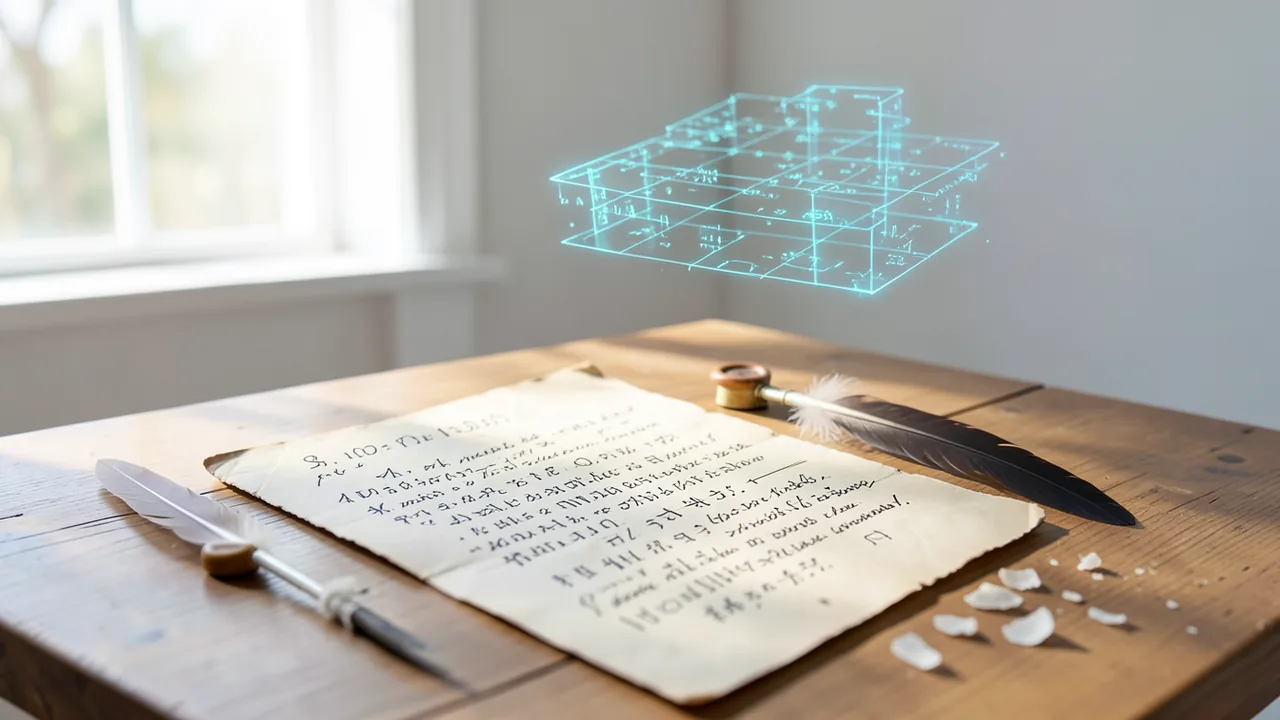
In March 1809, war between France and the Habsburg Empire was looming. So Napoleon Bonaparte had his stepson Eugène de Beauharnais, the Viceroy of Italy, send an encrypted letter to Marshal Auguste de Marmont. Marmont and his troops were stationed in Dalmatia, in today's Croatia, far from the rest of the French armies. If the enemy intercepted the letter, it was supposed to be useless to them. Marmont presumably deciphered it. But the key was lost, and the contents stayed unknown for 217 years.
Now Carter Church has decrypted the letter. He's an AI engineer at cybersecurity firm SentinelOne. He used GPT-6 Astra, OpenAI's new model. According to Live Science, Church made the result public in a post on X on September 30, and according to t3n also on his homepage. The story has been covered by The Telegraph, Live Science and t3n, among others.
A bad scan and a single prompt
The starting material was thin. Church told Live Science that the only publicly available image of the letter was a low-resolution scan printed in a French military journal in 1969. He gave GPT-6 Astra that scan and a single prompt. Six hours later, the solution was ready.
The letter consists of around 1,300 characters and 155 different symbols: two-digit numbers, single letters and made-up glyphs. It's a homophonic code. Common letters like "e" are represented by several interchangeable symbols. That way, nobody can crack the code simply by counting which character shows up most often.
First, the model had to transcribe the blurry scan into a sequence of characters. Then, as Church tells it, it did something remarkable: during its own web research, it found a partial table by cryptology historian Daniel Tant. It lists the meaning of 33 symbols, covering about a third of the letter. Nobody had previously linked this table to the Marmont letter.
"Astra made that connection itself through web research while it was investigating," Church told Live Science.
Tant had catalogued the table as "Code entre Eugène de Beauharnais et le Général Grammont". Church thinks this may be a naming error, Grammont instead of Marmont. The model simply tried the table on the letter, and it worked.
How the AI cracked the rest
Starting from those 33 known symbols, GPT-6 Astra worked out the remaining ones. To do that, it used simulated annealing. This search method tries out many possible mappings and improves them step by step. Early on, it also accepts worse intermediate solutions so the search doesn't get stuck in a dead end too soon. The name comes from metalworking, where slow cooling produces a better crystal structure.
According to t3n, each candidate solution was compared against letter-frequency statistics for French texts. French literature from the period and Marmont's letters served as the basis. According to The Telegraph's report (cited by Incrypted and AzerNews), possible words were also checked against Marmont's personal correspondence. Along the way, the model kept hitting symbols that made no sense as single letters. Trial and error showed that some symbols stand for whole words, some of them archaic.
The sources don't describe the process in quite the same way. t3n writes that the AI was "fed" literature and letters. Church, on the other hand, stresses to Live Science that he provided only a prompt and an image. From the reports, it's impossible to say exactly how much material the model found on its own and how much it was given.
What the letter says
The letter tells Marmont where the French and allied armies were positioned across the continent. According to t3n, this includes 40,000 Bavarian soldiers near Munich or Passau and an elite corps near Augsburg. It also covers Austrian troop strengths. Napoleon urges the marshal to be ready:
"When you receive the order to march, you must not let yourself be intimidated by a few troops or a gathering of rabble."
Elsewhere, it says Austria will be "immediately attacked from all sides" and is therefore rushing toward its ruin.
What historians say
Michael Rowe researches European history at King's College London. He calls the result "impressive". The translation can be trusted, he says, because Napoleon's original letter to Eugène survives and states what the encrypted message was supposed to contain. Rowe likens it to a kind of "Rosetta Stone": a tool that correctly decrypts a text with known contents deserves more trust when applied to the unknown. But that also means the letter brings little new in terms of content. It essentially repeats much of the original, Rowe says. So a headline like "What Napoleon was hiding" promises more than the find delivers.
Zack White of the University of Portsmouth hosts the Napoleonic Wars Podcast. He welcomes this "productive" use of AI but still sees interesting questions. At the time, Napoleon had around 60,000 fewer soldiers available than the letter claims. And he seems almost fixated on how many troops Austria might send to Italy. Historians now need to put the result into its wider context, White says. It will also be interesting to see whether the recovered key works for other correspondence.
The solution was independently confirmed by patent engineer and cryptographer Satoshi Tomokiyo. He runs the website Cryptiana, which documents unsolved historical ciphers. The letter is now listed there as "solved".
An outsider as codebreaker
Church himself says he has no experience with cryptography. He was inspired by a similar case: developer Carter Leffen had used GPT-6 Astra to decrypt a previously unsolved 1941 Enigma message from the German Wehrmacht, in about ten hours according to Incrypted.
Church doesn't consider the code itself particularly hard. "Cryptographers could easily have cracked it with enough time and energy," he told Live Science. But that would have taken experts from several fields and a lot of effort. The hardest part, he says, isn't generating solutions but verifying them. Here the solution can be checked mechanically: a wrong key could practically never produce coherent, historically consistent text.
"Every field has a backlog of niche problems that specialists don't have time for. The people working through those lists will increasingly be curious outsiders."
The bigger picture
The case shows what today's frontier models can do as agents, meaning systems that plan and carry out multiple steps on their own. GPT-6 Astra transcribed a blurry source, did its own research, connected a forgotten reference to the problem and then applied a classic search method. The math isn't new: simulated annealing has been used against codes like this for decades. What's new is that a layperson can kick off the whole chain with a single prompt.
For context: the code was considered solvable, and human groundwork was crucial. Without Tant's partial table, the task would have been much harder. The fact that the result can be checked against an unencrypted Napoleon letter makes it a good test case, but not a historical revelation. Still, the method could pay off for historians, for example with ciphered private letters, hard-to-read handwriting or only partly understood scripts. The Telegraph points out the flip side: researchers worry the same capabilities could be used to unmask people online based on their writing style.
Sources
- t3n – KI (DE) t3n.de
- azernews.az azernews.az
- incrypted.com incrypted.com
- livescience.com livescience.com
Ask the AI assistant
Questions about this article, installation or background? Our assistant knows this page and runs on our own machine, not in someone else's cloud.
The Assistant is an AI (Gemma 4) and can make mistakes – please check important details against the source. Questions are used only to generate an answer and are deleted after one hour. Please don't enter any personal data.


Comments
What do you think? Already tried it? Write it here, no sign-up needed.
Comments are public. Links aren't allowed, and we delete abusive posts. You can delete your own comment at any time in this browser. Learn more in the Privacy Policy.