
Is AI breaking encryption? What MiniMax's MIM actually cracked
MiniMax reports about a dozen "breaks" for its internal model MIM, and in China the story is running as "40,000 times faster than Claude." We sorted every finding into four classes and redid the speedup math. The result: AES, RSA and ML-KEM aren't on the list. But a few hits are real, and they affect schemes that are still in the running.
What this is about
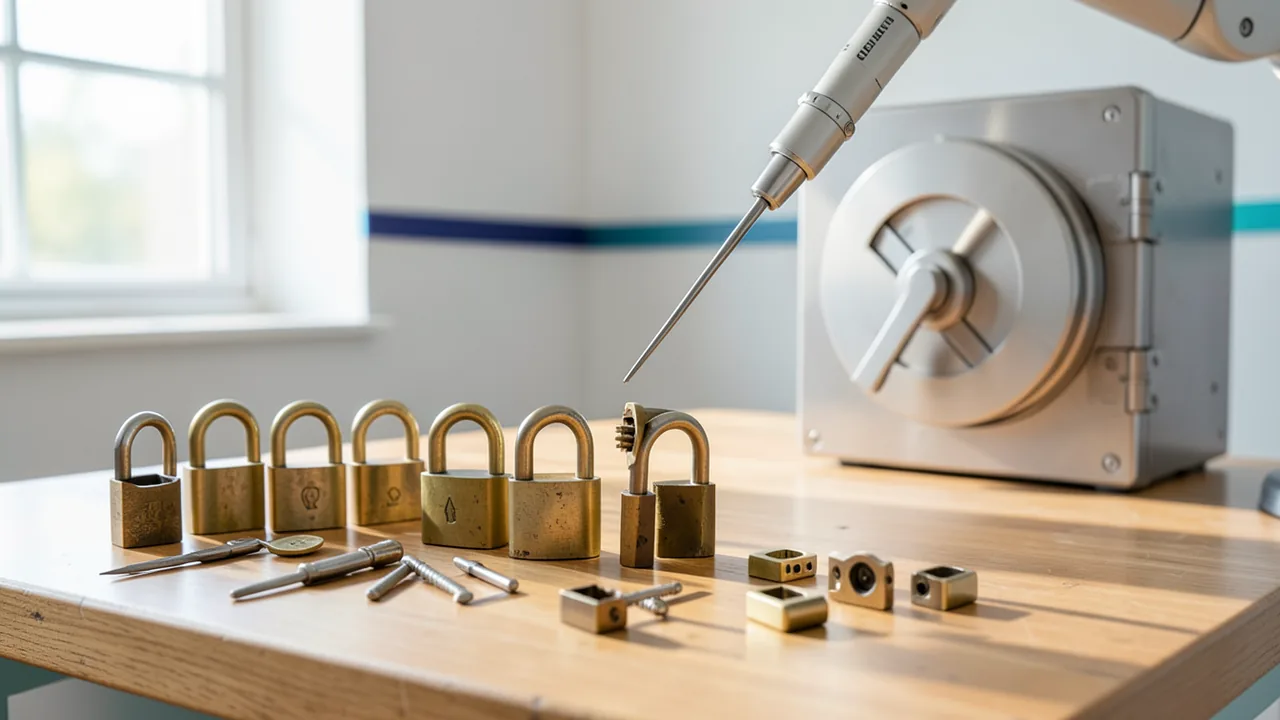
On November 20, 2026, Chinese AI company MiniMax published a blog post and a GitHub repository. They contain cryptanalysis results, meaning attacks on encryption and signature schemes, which MiniMax says came "mainly" from an internal model called MIM. Since November 22, Chinese media have been spreading the news under headlines like "China's AI breaks world records: 40,000 times faster than Claude" (36Kr, Sina). Nobody has independently verified the results so far.
Our question: Which of these is a breakthrough, which is a record on toy parameters, and which is a typo in the code? We sort the findings into four classes. The key point up front: MiniMax itself writes that the work affects no deployed standards. AES, RSA and ML-KEM don't appear on the list at all. A note on method: we haven't yet been able to run the proof-of-concept code ourselves for this article. Anything we say about runtimes comes from MiniMax's own documentation.
The four classes at a glance
| Class | Target | Status of the scheme | MiniMax claim |
|---|---|---|---|
| 1 Code bug | DRS | NIST PQC round 1, weakened by Yu/Ducas in 2018 | & instead of && in the check, forgery in 0.1–0.8 s |
| 1 Code bug | LAC-128, RQC-128, KCL, LEDAkem and others | old NIST candidates | "more than a dozen" previously unknown implementation bugs |
| 2 Retired candidate | Waterfall, Blender | SHA-3 competition, didn't make round 2 in 2009 | practical collisions in fractions of a second |
| 2 Retired candidate | LOCKER, ROLLO-I | PQC round 1 and 2 respectively, not in round 3 | key or plaintext recovery in 1–6 s |
| 3 Challenge | TII McEliece | deliberately shrunk toy sizes | 94 keys, 55 solved for the first time |
| 3 Challenge | HAWK-256 | challenge parameters, HAWK withdrawn since July | key in 30.9 min on one core |
| 4 Still in play | COLM₀ | CAESAR winner, J. Cryptology 2024 | forgery with 2 encryption queries |
| 4 Still in play | SBC-VOLE | ASIACRYPT 2025 | secret key from one signature in 0.06 s |
| 4 Still in play | ARADI | NSA 2024, 16 rounds | key for 8 rounds in ≤ 16 s |
Class 1: Bugs in the reference code
The reference implementation is the sample code a scheme's designers submit along with it. In the lattice signature scheme DRS, MiniMax says MIM found a spot where the bitwise AND (&) is used instead of the logical AND (&&). As a result, the check accepts forged signatures that can be built from the public key alone. That's a programming error, not a weakness in the underlying math. DRS was also already finished in 2018: in "Learning Strikes Again," Yang Yu and Léo Ducas pushed its security from a claimed 128 bits to below 80. The findings for LAC-128 (the error branch hashes uninitialized memory into the key), RQC-128 and other schemes are similar. That's useful for researchers who reuse this code as a template. For today's security, it doesn't matter.
Class 2: Real structural attacks on retired candidates
This is where genuinely new cryptanalysis shows up. For Waterfall, the only previous result was a theoretical estimate by Scott Fluhrer from 2008: about 2^70 operations for a collision. A collision means two different inputs produce the same hash value. MiniMax reports practical collisions for all four output lengths. For Blender, it says the full round count with the standard initial value has been broken for the first time. Previously, there were only "semi-free-start" collisions, where the attacker gets to pick the initial value. For LOCKER, MiniMax says an auxiliary matrix shrinks from 42 petabytes to 58 megabytes. The ratio of roughly 720 million checks out mathematically. ROLLO-I-128 falls in 5.97 seconds on a single core.
However, both hash functions failed to make the second round of the SHA-3 competition in 2009. LOCKER was merged into ROLLO in 2019, and ROLLO didn't make NIST's third round in 2020. Bardet and colleagues had already called the ROLLO and RQC parameters "completely broken" in 2020. MIM turns theoretical attacks on dead schemes into executable ones. That shows how good the machine is at searching, but it changes nothing in practice.
Class 3: Records on deliberately weak challenges
The TII McEliece challenges from the Technology Innovation Institute in Abu Dhabi use shrunk keys. According to Markku-Juhani Saarinen (ePrint 2026/1986), their labels like "TII-253" are estimates for brute-forcing every possibility, not real security levels. In July, Daniel J. Bernstein called the sizes "fake" in a script, and the Classic McEliece team stresses that attacks on these toy sizes have no impact on the real scheme. MiniMax says the same.
Here are the numbers from MiniMax's table, with our own recalculations:
| Instance | Previous | MIM | Factor |
|---|---|---|---|
| TII-83 | 24.3 s | 1.58 s | 15.4× |
| TII-252 | 375 s | 90.0 s | 4.17× |
| TII-254 | 16.0 h | 30.4 s | 1,896× |
| TII-166 | 9.20 h | 5.36 s | 6,180× |
| TII-253 | 21.7 h | 1.80 s | 43,400× |
That clears up the numbers mess. The blog says "6,180 to 43,400 times faster than the CRYPTO 2026 record (9.20 h)." Divide 9.20 h by 43,400 and you get 0.76 s, a value that doesn't appear in the table. The 9.20 h is only the baseline for TII-166. The 43,400 applies to TII-253, where the baseline is 21.7 h. So the blog crammed two different baselines into one sentence. The "6,180 to 43,400" range also leaves out the instances with gains between 4x and 5,778x. Across all eight values, the median is about 3,400.
The hardware doesn't match either. According to MACCUS, the TII-253 baseline from Anthropic researcher Stephen Weis ran on 32 threads, while MIM used 64 cores (0.032 core-hours in 1.80 s). Our take: at the same core count, the factor shrinks to about 21,700 (21.7 h × 32 ≈ 694 core-hours vs. 0.032). That's still enormous, but only half as much. Compared with Kirill Vedenev's 14-hour run on one GPU, MiniMax claims 28,000x. The "first blood" instances, meaning first-ever solutions, didn't run on a single server: TII-250 took 9.20 hours and 66,722 core-hours. That works out to more than 7,000 cores on average.
HAWK-256 is similar. In July, Anthropic needed 3 h 42 min on 96 cores; MIM needed 30.9 minutes on one core. The "690x" refers to compute time per core. In wall-clock terms, MIM is about 7 times faster. HAWK's authors had already withdrawn it from the NIST process on July 29. For HAWK-512 and HAWK-1024, MiniMax lowers the estimated security by another 11.2 and 23.7 bits, to about 2^69.6 and 2^122.7 gate operations respectively. Those are estimates; nothing was actually run there.
Class 4: What hits schemes that are still alive
Three findings concern schemes that still matter today:
- COLM₀: The winner of the CAESAR competition for authenticated encryption (schemes that encrypt data and protect it against tampering at the same time) was specified in the Journal of Cryptology in 2024. MiniMax reports a forgery with just two encryption queries, no access to decryption, and a success probability of 1. That would break the promised 64-bit integrity. Earlier forgeries below 2^64 required a stronger attacker model. COLM is a competition winner, but not a widely deployed standard like AES-GCM.
- SBC-VOLE: This post-quantum signature from ASIACRYPT 2025 is supposedly broken by its own optimization for shrinking signatures. A single signature yields a linear system of 257 equations, solved in 0.06 seconds. MiniMax says the security proof is flawed too.
- ARADI: The NSA's block cipher for memory encryption has 16 rounds. MIM recovers the 256-bit key for up to 8 rounds in at most 16 seconds. According to MiniMax, earlier attacks on 5 to 7 rounds only recovered parts of the round keys. By MiniMax's own account, the full cipher remains unbroken.
If the COLM and SBC-VOLE results hold up, they're the real story. Peer-reviewed designs from top conferences had holes that humans missed.
What can be verified and what can't
On the plus side, every finding comes with code. For Waterfall, for example, the README describes a ./run.sh --demo that checks stored collisions against the unmodified NIST reference and generates new ones in 1 to 4 seconds. In cryptanalysis, a collision or a key either works or it doesn't. Writing about Anthropic in July, Matthew Green noted that complete attacks are easy to verify: you just run the code.
But the claims contradict each other. The blog gives 0.045 s for Waterfall "across all output lengths." In the README, though, the 45 ms figure belongs to a solver for Waterfall-256 only, with a 90 percent success rate, while the all-lengths variant takes 3.5 ms. For Blender, the blog says 0.36 to 2.3 s on one core; the README says 0.045 to 0.73 s with 8 threads. MiniMax itself concedes the manuscripts may contain "minor errors" and aren't finished papers. The repo has two open issues, both about Blender. One reports a contradiction between Section 3.3 and Theorem 2.
On the day of our research, a first external paper appeared: ePrint 2026/2993 by Raullen Chai and Xinxin Fan (Machinefi Labs). They port MiniMax's McEliece sampler to GPUs and solve TII-228 in 18.9 minutes on eight L40S cards, which they say is faster than MiniMax's CPU cluster. Their keys pass the official verifier. That indirectly supports the McEliece part, but it's no check of the other findings. We found no reactions from the authors of COLM, ARADI or SBC-VOLE.
The bottom line
Our take: The headline "AI breaks encryption" is wrong. "40,000 times faster than Claude" is misleading, because Claude never did these runs. What's being compared are individual measurements on different hardware. And contrary to what's claimed for Class 3, there was progress in this area before: on TII-252, Saarinen's AI-assisted HOVER attack was already at 375 seconds.
Still, the finding matters, just somewhere else. In July, the CryptanalysisBench paper from ETH Zurich, Anthropic and others showed that five frontier models break 6 to 12 of the 135 Tier 2 schemes at full strength. MiniMax is now following up, and a second lab is confirming the trend. The gap between "theoretically attackable" and "broken in seconds" is shrinking. Whether a scheme counts as secure will depend less on years of review and more on whether it survives a machine search. The consequence: if you design a new scheme, you'll have to run it through tools like these yourself before publishing. With HAWK, two labs needed just four months to push a scheme out of the race.
The bottleneck the Cloud Security Alliance also points to remains: verification. Humans have to check the claims, and there are far fewer of them than there is AI output. Until cryptographers have independently verified COLM, SBC-VOLE and ARADI, those results remain vendor claims.
Sources
- MiniMax-Blog: Practical cryptanalysis with MiniMax's latest Internal Model minimax.io
- GitHub: MiniMax-AI/Research github.com
- GitHub: MiniMax-AI/Research – Issues github.com
- MiniMax-Repo: TII-McEliece-README raw.githubusercontent.com
- MiniMax-Repo: Waterfall-README raw.githubusercontent.com
- MiniMax-Repo: Waterfall-Artefakte github.com
- MiniMax-Repo: HAWK-README raw.githubusercontent.com
- MiniMax-Repo: COLM-README raw.githubusercontent.com
- MiniMax-Repo: ARADI-README raw.githubusercontent.com
- MiniMax-Repo: SBC-VOLE-README raw.githubusercontent.com
- MiniMax-Repo: Blender-README raw.githubusercontent.com
- MiniMax-Repo: LOCKER-ROLLO-README raw.githubusercontent.com
- MACCUS: MiniMax says its AI cracked 55 unsolved code-breaking challenges maccus.fr
- 36Kr: China's AI Breaks Global Records: 40,000x Faster Than Claude eu.36kr.com
- Sina Finance: 中国AI刷爆全球纪录!比Claude快四万倍 finance.sina.com.cn
- TechNode: MiniMax publishes AI-discovered cryptographic attacks technode.com
- 什么值得买: 大模型开始自动找密码漏洞 post.smzdm.com
- ePrint 2026/2993: Packing Stern into L2 (Chai, Fan) eprint.iacr.org
- ePrint 2026/1986: Solving the TII-254 McEliece Challenge (Saarinen) eprint.iacr.org
- ePrint 2026/1778: HOVER (Saarinen) eprint.iacr.org
- ePrint 2026/1984: Improving GIJS Key Recovery (Weis) eprint.iacr.org
- Bernstein: break fake mceliece sizes from TII cr.yp.to
- The Hacker News: Claude AI cracked post-quantum HAWK thehackernews.com
- PostQuantum.com: AI cryptanalysis HAWK and AES postquantum.com
- Matthew Green: Some notes about Anthropic's new results blog.cryptographyengineering.com
- NIST: Round 3 Additional Signatures csrc.nist.gov
- ePrint 2018/294: Learning Strikes Again – DRS (Yu, Ducas) eprint.iacr.org
- ePrint 2008/531: Collision attack on Waterfall (Fluhrer) eprint.iacr.org
- arXiv: Improvements of Algebraic Attacks for Rank Decoding (ROLLO/RQC) arxiv.org
- NeurIPS 2026: CryptanalysisBench neurips.cc
- CSA Research Note: AI Cryptanalysis and the Cryptographic Assumption Horizon labs.cloudsecurityalliance.org
Ask the AI assistant
Questions about this article, installation or background? Our assistant knows this page and runs on our own machine, not in someone else's cloud.
The Assistant is an AI (Gemma 4) and can make mistakes – please check important details against the source. Questions are used only to generate an answer and are deleted after one hour. Please don't enter any personal data.


Comments
What do you think? Already tried it? Write it here, no sign-up needed.
Comments are public. Links aren't allowed, and we delete abusive posts. You can delete your own comment at any time in this browser. Learn more in the Privacy Policy.