
Lagarde's AI goal meets Trump's build ban: Who owns Europe's compute?
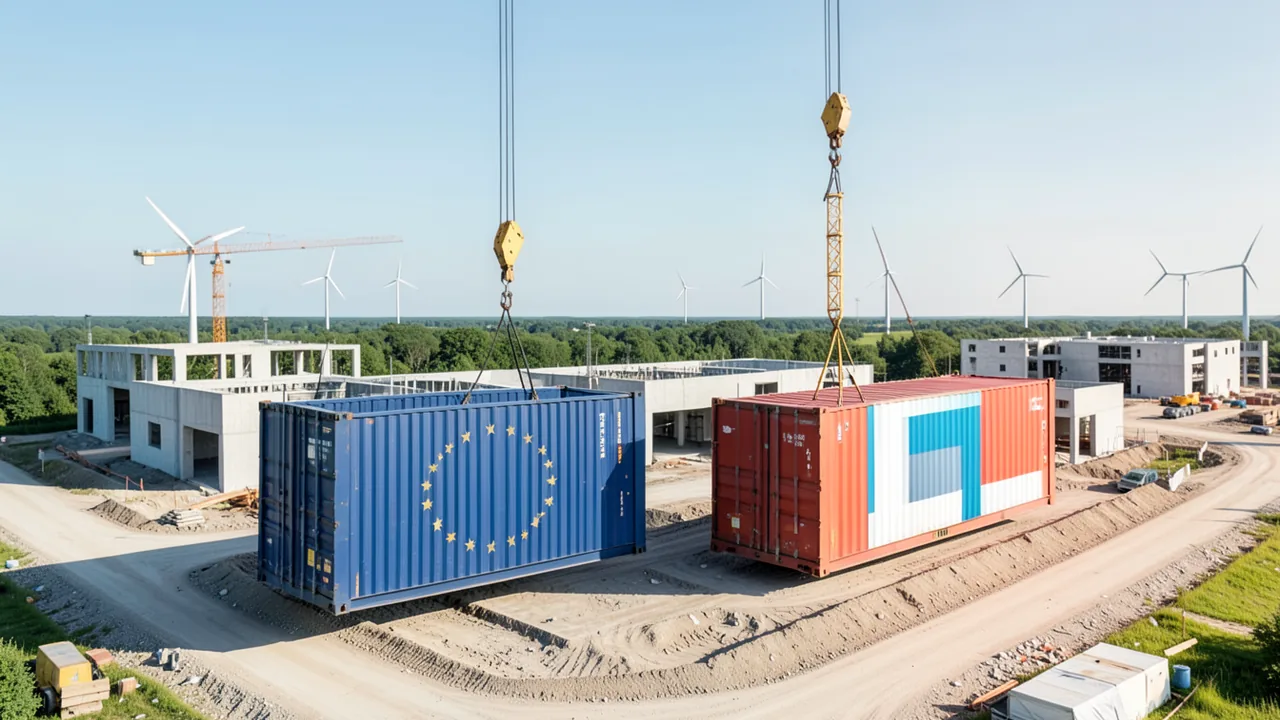
ECB President Christine Lagarde wants Europe to triple its share of global AI compute, a plan with a €1.3 trillion price tag. The same day, Trump threatened US companies with a "tremendous tax" if they build data centers abroad. We ran the numbers on who is actually building and paying for Europe's AI gigawatts.
What's going on
On November 20, 2026, two announcements came out that barely fit together. In Frankfurt, ECB President Christine Lagarde used her final speech at the European Banking Congress to say Europe must raise its share of global AI compute from about 5 to 15 percent by 2030. She put the required investment at around €1.3 trillion. Public money, including from the EU budget, should "absorb the first losses" on large chip fabs and data centers to draw in private capital. A few hours later, Donald Trump said at the White House that the US would "not allow our companies to build data centers outside our country." Anyone who does it anyway would face a "tremendous tax," according to Handelsblatt.
Our thesis: the 15 percent target depends far more on US capital and US customers than the debate admits. That makes Trump's threat more than just noise for Europe. We checked where the numbers come from and who owns the gigawatts that exist today and the ones being planned.
Where the €1.3 trillion really comes from
According to CNBC and Eunews, Lagarde referred only to "a recent estimate" without naming a source. So it isn't an ECB number. It comes from the "Transformative AI Strategy for Europe," published in September 2026. The project was initiated by Monika Schnitzer, a member of Germany's Council of Economic Experts, and Daniel Privitera of the KIRA Center, and its authors include Philippe Aghion and Margrethe Vestager. The authors write in a personal capacity. The calculation sits in footnote 8:
| Assumption | Value |
|---|---|
| Global AI compute in 2030 | 300 GW |
| Target: 15% on EU soil | 45 GW (total facility power incl. cooling) |
| EU baseline 2025 | approx. 1.5 GW (under 5%) |
| Cost per GW (Epoch AI, converted) | $34.4 billion |
| Result | $1.55 trillion ≈ €1.3 trillion |
We checked the math: 45 × 34.4 comes to $1,548 billion, so that holds up. The $34.4 billion is derived from Epoch's figure of just under $38 billion per GW of pure compute, divided by a PUE of 1.1. PUE measures how much extra power goes to cooling and the building. Two points get lost in the debate. First, the study prices in the full 45 GW stock. If you count only the roughly 43 GW of new capacity, you get closer to €1.24 trillion. Second, everything hinges on the 300 GW global assumption. If the worldwide build-out comes in 10 percent smaller, the target drops by 4.5 GW, worth around $155 billion.
The study itself shows how big the leap would be in footnote 6. The EU wants to triple its data center capacity. Even if every new megawatt went exclusively to AI chips, the EU would reach only 28.9 GW, which is under 10 percent. Spread over four years, €1.3 trillion works out to about €325 billion a year. The study estimates global AI investment in 2026 at around €650 billion, so Europe would have to put up roughly half of that every year. Only a small share is meant to be publicly funded. According to Unite.ai, the strategy proposes €100 billion in public funds: €25 billion at EU level as loan guarantees and offtake commitments, and €75 billion from member states. We couldn't find this breakdown in the original text ourselves. If it's accurate, around 92 percent of the total would come from private investors.
What Europe has today and who owns it
The think tank Bruegel estimates EU AI compute at 2.07 GW in 2026 and US AI compute at 35.3 GW. Add up all 101 known projects and the EU reaches 16.8 GW by 2030. That's about 5.6 percent of the world total, so the share would stay essentially flat. That leaves a gap of around 28 GW to the 45 GW target, with no projects behind it today.
Who owns the existing capacity can't be pinned down exactly. According to an analysis by R40, there's no public registry that combines ownership, operation and tenants of data centers. The best sample is Epoch AI's data center database, which StackPath reanalyzed on November 20. It lists seven large AI sites in Europe:
| Site | Country | Operator | MW |
|---|---|---|---|
| Waltham Cross | UK | Google (US) | 88 |
| Mäntsälä | Finland (EU) | Nebius (NL) | 75 |
| Norway | Norway | CoreWeave (US) | 42 |
| Sines | Portugal (EU) | Nscale (UK), tenant Microsoft | 33 |
| Keflavík | Iceland | Nscale (UK) | 5.1 |
By our count, 130 MW (53 percent) of the 243 MW belongs to US companies. Add Microsoft's Sines site and it's 163 MW, or two thirds. Only 108 MW sits inside the EU. For planned projects, Bruegel counts 84 percent of capacity as purely privately financed, mostly by European owners, and lists only two Microsoft projects. The authors stress, however, that AI chips inside the existing cloud data centers of Amazon, Microsoft and Google aren't captured. Those three companies hold around 70 percent of the European cloud market.
The big construction sites: who builds, who rents
For the large announced campuses, the tenant matters as much as the owner. Construction often only starts once a major customer signs a long-term deal. We added the Croatian project to StackPath's list:
| Campus | Capital / offtaker | MW |
|---|---|---|
| Campus IA Fouju (F) | MGX (Abu Dhabi), Nvidia, Bpifrance, Mistral | 1,400 |
| Sines (P) | Start Campus, tenant Microsoft via Nscale | 1,200 |
| Blyth/Cambois (UK) | QTS/Blackstone (US) | 1,100 |
| Pantheon AI, Topusko (HR) | Pantheon Atlas LLC (US) | 1,000 |
| Cambrai (F) + Strängnäs (S) | Brookfield (Canada) | 1,750 |
| Narvik (N) | Nscale, anchor tenant Microsoft | 230 |
| Nebius Lappeenranta + Lille | Nebius (NL) | 550 |
| Lübbenau (D) | Schwarz Digits | 200 |
| Jämsä (FIN) | Sesterce (F) | 200 |
| Cerebras expansion | Cerebras (US) | 200 |
Of these roughly 8 GW, by our count about 3.7 GW (47 percent) depend on US money or US tenants. Around 1.1 GW (14 percent) is clearly European, and the rest comes from Canada and the Gulf. Treat that figure as a rough guide, since the MW numbers sometimes refer to grid connections and sometimes to campus size. Then there are commitments without MW figures: Google is investing €13 billion in Finland, its largest single investment in Europe. Microsoft has contracts with Nscale worth up to $24 billion for Sines, Narvik, Loughton and Texas, and AWS is putting $7.8 billion into its European Sovereign Cloud. The industry association EUDCA expects €176 billion of investment in European data centers through 2031 and, according to Techzine, says "by far the largest share" will come from US players. OpenAI shows how shaky such commitments can be: in April, the company put Stargate UK on hold and handed Narvik over to Microsoft.
The public counterpart is small. Around €10 billion in public money is earmarked for the tender for up to seven AI gigafactories, with at least €20 billion in private funds on top. Awards come in early 2027 at the earliest. Bruegel estimates five gigafactories at about 750 MW combined, less than 2 percent of the 45 GW target. That squares with the cost formula: 750 MW at $34.4 billion per GW comes to around $26 billion. Of the 19 smaller EuroHPC AI factories, only two are running, according to StackPath, including JUPITER in Jülich with around 24,000 GPUs.
What Trump can actually enforce
According to CNBC and dpa, Trump named no tax rate, no legal basis and no date. He even said he "hadn't even told my people yet." His rationale was China: abroad, "the Chinese will take them all." According to Newsweek, he also said the US wouldn't allow a data center in Finland. That likely targets Google's project, which he had already criticized in September. In the US, Congress sets taxes, and both chambers pass to the Democrats in January. A punitive tax by statute is therefore unlikely in the near term.
Our take: the stronger lever is chips. On November 16, the US Commerce Department's Bureau of Industry and Security (BIS) published a rule on remote access to AI chips, which took effect on November 19. Since then, data centers anywhere in the world need a US license if they rent out more than 12 million "TPP" to companies headquartered in China, Macau or other embargoed countries. According to Blogspan, that's roughly 750 H100 accelerators. A Frankfurt-based GmbH with a Chinese parent is explicitly covered, and existing providers get a 90-day transition period. According to the Financial Times, TSMC and Samsung have already halted shipments to Chinese customers, and Elektroniknet reports knock-on effects for German data centers too. The rule shows that Washington can already reach into foreign data centers through licensing, no Congress required. An earlier Biden-era rule even capped AI chips for some EU countries. It has since been formally rescinded, but the tool still exists.
Money is tight – or is it?
Then there's the stock market. According to The Decoder, the Nasdaq 100 lost 10.4 percent this week, its worst stretch since the COVID crash, and Nvidia fell 14 percent on Friday. Lagarde's proposal that public money absorb the first losses is aimed squarely at phases like this. The state acts as a buffer that takes defaults first, so private investors carry less risk.
Bruegel pushes back, arguing that private capital is "not the binding constraint," least of all for US hyperscalers, the big cloud companies with deep pockets. Subsidies for gigafactories are therefore justified only for a few strategic applications. The real brakes are permitting and grid connections: from application to operation takes 42 months in Germany versus 24 in the US. In the major data center hubs such as Frankfurt, London, Amsterdam, Paris and Dublin, new projects wait seven to ten years on average for a grid connection. According to Unite.ai, the strategy itself names "time to power" as the biggest obstacle. It proposes tying land and grid access to commitments from foreign AI companies to give Europe access to their models. A foreign company sinking tens of billions into EU data centers would have strong incentives to honor such deals. In other words, the strategy explicitly plans on large foreign investors.
The bottom line
US companies are the backbone of Europe's existing large AI data centers and of the tenant base for the biggest new builds. The Epoch sample and the project lists show this, even though no complete ownership registry exists. Project planning looks more European, but many projects still need large tenants. Our take: without Microsoft, Google, Amazon and Oracle as builders or tenants, the 15 percent target is out of reach. Today's pipeline only gets to 5.6 percent, and the publicly funded gigafactories cover less than 2 percent of the target.
That's the contradiction. Lagarde frames the build-out as a matter of sovereignty, yet the strategy's math counts on private investors, many of them American, paying more than 90 percent. Trump's tax is legally unclear and hard to implement any time soon. But the export rule shows that Washington can already reach into European data centers through chip licenses. The open question is whether Lagarde's protective buffer would also backstop projects whose tenant ends up being Microsoft. That would mean public risk for someone else's capacity.
Sources
- CNBC: Lagarde says EU funds should take first losses on chip plants, data centers cnbc.com
- Eunews: Lagarde’s J’accuse eunews.it
- Unite.ai: Lagarde Urges EU Funds to Take First Losses on AI Infrastructure unite.ai
- A Transformative AI Strategy for Europe – Part A transformative-ai.eu
- A Transformative AI Strategy for Europe – Pressemitteilung transformative-ai.eu
- TNW: Europe has one year to act on AI thenextweb.com
- Bruegel Policy Brief 18/2026: AI compute infrastructure shortfall bruegel.org
- StackPath: Europe's share of AI compute stackpath.ie
- StackPath: EU AI gigafactories and AI Factories tracker stackpath.ie
- Epoch AI: Hyperscalers control most compute epoch.ai
- R40: Europe's Cloud Is 70% U.S.-Run r40.io
- ComputerBase: Trump verbietet US-Firmen Bau von Rechenzentren im Ausland computerbase.de
- Handelsblatt: Trump warnt US-Konzerne vor Bau von KI-Rechenzentren im Ausland handelsblatt.com
- CNBC: Trump vows to stop U.S. companies from building data centers abroad cnbc.com
- NBC News: Trump threatens companies that build AI data centers overseas nbcnews.com
- Yahoo/Newsweek: Trump threatens massive tax on US companies building data centers overseas yahoo.com
- RTÉ: Trump threatens tax for overseas US data centres rte.ie
- Borncity: BIS-Regel für KI-Chips borncity.com
- Blogspan: USA verlangen Lizenzen für Rechenzentren blogspan.net
- Elektroniknet: Lieferstopp bei TSMC und Samsung elektroniknet.de
- The Decoder: US-Techmarkt im freien Fall the-decoder.de
- Techzine: Europe's data center market booms techzine.eu
- The Decoder: OpenAI's European Stargate plans shrink the-decoder.com
- TechCrunch: Nscale inks massive AI infrastructure deal with Microsoft techcrunch.com
- Google Blog: €13 billion investment in Finland blog.google
- Capacity: Pantheon AI Croatia data centre campus capacityglobal.com
Ask the AI assistant
Questions about this article, installation or background? Our assistant knows this page and runs on our own machine, not in someone else's cloud.
The Assistant is an AI (Gemma 4) and can make mistakes – please check important details against the source. Questions are used only to generate an answer and are deleted after one hour. Please don't enter any personal data.



Comments
What do you think? Already tried it? Write it here, no sign-up needed.
Comments are public. Links aren't allowed, and we delete abusive posts. You can delete your own comment at any time in this browser. Learn more in the Privacy Policy.