
‘Like a Magic 8 Ball’: Judge slams cop who arrested man on an AI face match alone
A Kentucky detective had a Nebraska man arrested after AI facial recognition flagged him as a check fraudster. The man was innocent and spent about two weeks in jail. Now a federal judge has ruled that the lawsuit against the officer can go ahead, and the reasoning is striking.
What's going on
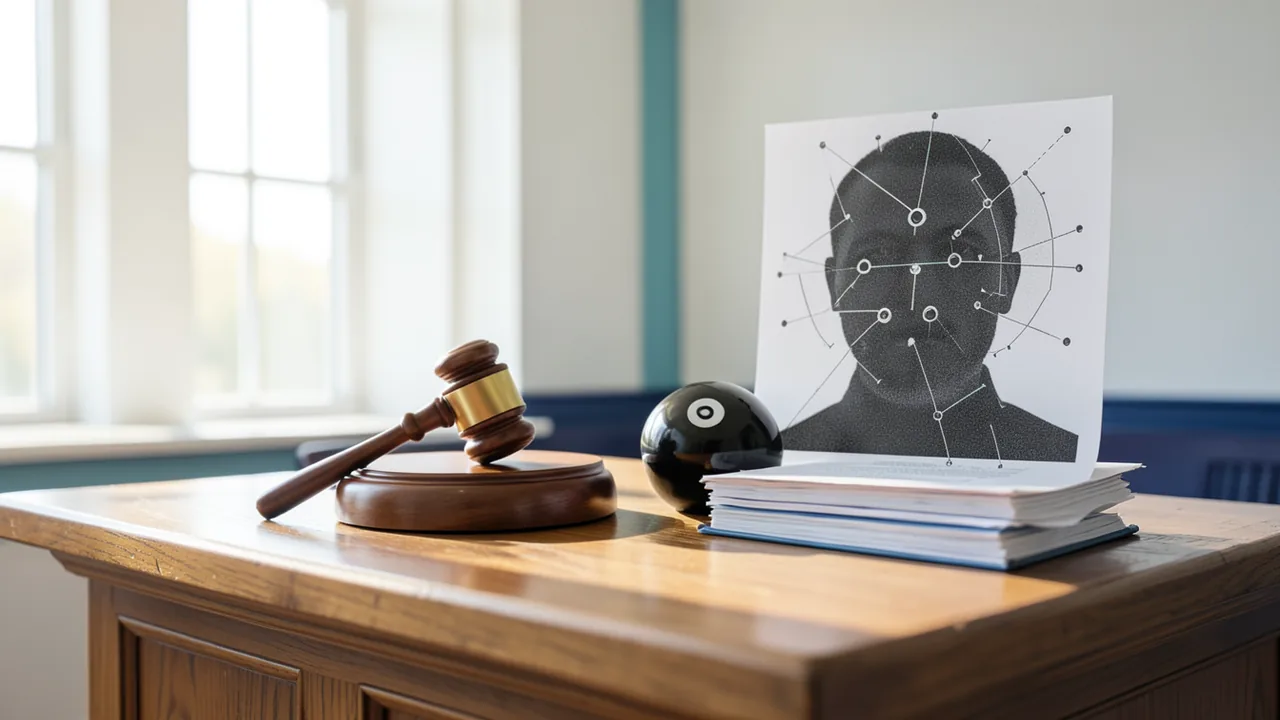
A US federal court has sent a clear message against police relying blindly on AI. On November 9, 2026, US District Judge S. Chad Meredith of the Eastern District of Kentucky denied police officer Ryan Kilmer's motion to dismiss a lawsuit against him. Kilmer is a detective with the Florence Police Department in Kentucky. The plaintiff is Alain Vizcay Osorio, a man from Nebraska. He was arrested over a check fraud he had nothing to do with. According to the lawsuit, it all started with a hit from AI facial recognition software, which the officer allegedly accepted without any further checks.
The core of the ruling: an officer can't hand off the question of whether probable cause exists entirely to software. According to the judge, an arrest based solely on an unverified AI result violates the Fourth Amendment to the US Constitution, which protects citizens from unreasonable searches, seizures and arrests by the government.
The case: a fake check and a screenshot
According to court documents, the story begins on August 30, 2024. A man calling himself "Ernesto Ramirez" tried to cash an allegedly forged check at Heritage Bank in Florence, Kentucky. He presented a Texas driver's license. The bank teller thought the document was fake and refused to pay out, and the man left the bank empty-handed. Surveillance cameras had captured his face clearly.
A few weeks later, Detective Kilmer took over the case. After confirming that the driver's license was indeed fake, he reviewed the camera footage. According to court documents, he took a screenshot of the man's face and had AI facial recognition software compare it with a police photo from a previous arrest (a so-called booking photo) and a Facebook profile picture. These programs convert facial features into numerical patterns and search image databases for similar patterns. What they produce is a probability, not an identification.
Kilmer allegedly relied solely on the AI's result and decided the images matched. One odd detail: the Facebook profile belonged to someone named Yony Smith Npoles Charon. For reasons the complaint doesn't explain, Kilmer nonetheless concluded that the man was Alain Vizcay Osorio, whose photo showed up in police records.
Arrest, extradition, charges dropped
Kilmer signed a criminal complaint stating that he had identified Osorio as the man in the video "using investigative tools." That complaint was used to obtain an arrest warrant. On January 9, 2025, officers arrested Osorio in Florida. The Nebraska resident was transferred to Boone County, Kentucky. He was charged with first- and second-degree possession of a forged instrument.
He was arraigned on January 23 and released on bail the next day. In total, he spent roughly two weeks in custody. Even so, a grand jury indicted him on both counts in March 2025. It wasn't until May 7, 2025, that prosecutors dropped the charges "with prejudice," meaning permanently. They can't be refiled. Osorio had shown that he was at work in Nebraska at the time of the crime.
What Osorio accuses the officer of
Osorio accuses Kilmer of failing to adequately verify his identity before applying for an arrest warrant. According to the lawsuit, the photos of Osorio and the man at the bank differ significantly in head shape, hairstyle, facial features and skin tone. The court noted that the only discernible similarities appeared to be that both are Black men with beards.
On top of that, there's the accusation of misleading the court. Kilmer allegedly made it look in the criminal complaint as though he had used investigative tools and compared photos himself. In reality, the lawsuit says, he relied entirely on the AI. That carries particular weight because his own department's policy stated that facial recognition is advisory only and can't establish probable cause without further investigation.
Osorio is suing under federal and Kentucky law, including for false arrest, false imprisonment, malicious prosecution and battery. Kilmer denies any wrongdoing. He argues that Osorio hasn't shown that the alleged conduct violated "clearly established law."
The judge and the "Magic 8 Ball"
That's exactly where the ruling comes in. In the US, "qualified immunity" shields government employees like police officers from personal liability as long as their conduct doesn't violate clearly established law. In practice, that usually means there has to be an earlier ruling on a very similar case. Because AI facial recognition is new, Kilmer could have argued that there's no case law on it yet.
Judge Meredith didn't buy it and reached for a vivid comparison. He described a hypothetical detective who picks a suspect using a Magic 8 Ball, the toy that displays random answers like "Yes" or "Ask again later." Such an officer, he wrote, couldn't use the result as the sole basis for an arrest warrant and then claim immunity just because no court had ever ruled on Magic 8 Balls. In the judge's words:
"Even though AI facial recognition has advanced rapidly in recent years and is likely more reliable than a Magic 8 Ball, unquestioning reliance on this technology is, in principle, not much different from unquestioning reliance on a Magic 8 Ball. No reasonable officer would believe that Detective Kilmer's alleged sole reliance on AI is lawful – especially since Osorio's booking photo looks nothing like the suspect from the surveillance camera."
Meredith also criticized the warrant application for failing to disclose that the identification rested solely on AI. There is good reason to believe, he wrote, that the warrant wouldn't have been issued at all if the detective had fully explained how he landed on Osorio.
What happens next
Osorio hasn't won yet. The judge stressed that the case is at an early stage. During discovery, the phase in which both sides must disclose evidence, new information could change the picture. Kilmer can also raise further legal arguments. The court granted Osorio leave to file a second amended complaint and denied Kilmer's motion for judgment on the pleadings. Kilmer has 14 days to respond. A status conference is scheduled for November 19, 2026.
The bigger picture
The case is the latest in a series of wrongful arrests in the US following facial recognition hits. What's new and notable here is the legal reasoning. A federal judge has made clear that an officer who blindly follows a machine can't hide behind the lack of case law on a new technology. The duty to verify applies no matter what the tool is. That removes an important shield officials have been able to invoke with new technologies. If this line of reasoning holds, officers could personally face lawsuits in the future if they accept AI results without checking them.
The case also shows that written policies alone don't do much. The Florence police had stipulated that facial recognition only provides leads, and yet exactly what the rule was meant to prevent allegedly happened anyway. Then there's a well-known problem: facial recognition has been shown to produce false matches more often for people with darker skin. The sources don't say whether that played a role here. But the court's observation that the only thing in common was "Black man with a beard" certainly raises the question.
One more important point: so far, all the allegations come from the complaint, and Kilmer denies them. The ruling only says that the allegations, if true, are serious enough to go forward. How the case ends remains open.
Sources
- Google News (US) m.economictimes.com
- economictimes.indiatimes.com economictimes.indiatimes.com
- wowt.com wowt.com
- nebraska.tv nebraska.tv
- Google News (US) news.google.com
Ask the AI assistant
Questions about this article, installation or background? Our assistant knows this page and runs on our own machine, not in someone else's cloud.
The Assistant is an AI (Gemma 4) and can make mistakes – please check important details against the source. Questions are used only to generate an answer and are deleted after one hour. Please don't enter any personal data.


Comments
What do you think? Already tried it? Write it here, no sign-up needed.
Comments are public. Links aren't allowed, and we delete abusive posts. You can delete your own comment at any time in this browser. Learn more in the Privacy Policy.