
Local AI that drives your PC: four tools compared at 12, 16 and 24 GB of VRAM
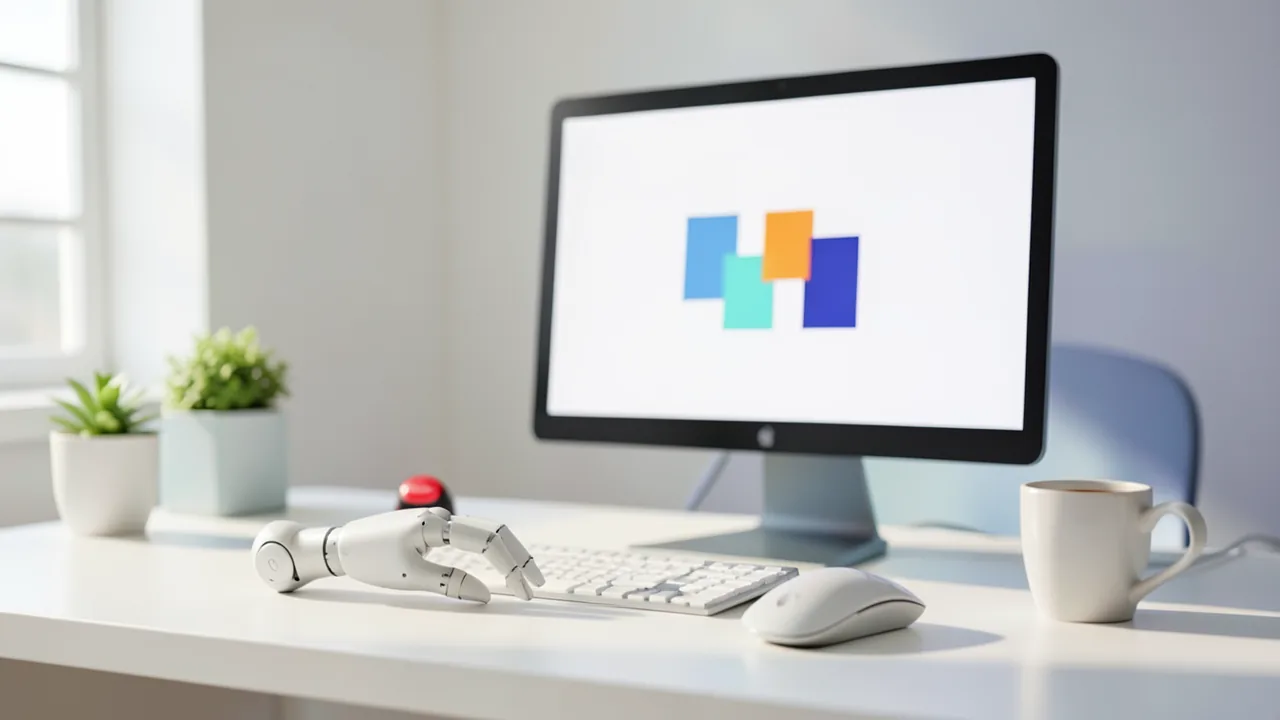
Open models now come close to Claude Mythos on the OSWorld benchmark. On your own machine, they still often fail at simple tasks. We compare Unsloth Studio, Locally Uncensored, UI-TARS Desktop and H Company's Holo tools: how they work, how much VRAM (video memory) they need and how well they protect you.
What this is about
On paper, the race is nearly over. In the OSWorld-Verified benchmark, an AI agent completes real tasks on a virtual Linux, Windows or Office desktop, and vendors now report scores around 80 percent for open models. H Company says Holo3-35B-A3B hits 77.8 percent. The comparison site BenchLM lists the same model at 82.6 percent, flagged as a run by the OSWorld maintainers. Anthropic puts Claude Mythos 5 at about 85 percent.
On your own PC, it's a different story. In Unsloth's own documentation, only a single model manages the sample tasks. In Locally Uncensored, Holo 3.1 9B gets a simple typing task right in one of three attempts. We looked at the four tools that let local models drive your mouse and keyboard today: How do they work, what do they need, and how well do they protect you? At the end, you'll find a recommendation for each GPU size. We didn't test anything ourselves. All measurements come from the sources named.
Benchmarks vs. your living room: why the numbers diverge
| Model | OSWorld-Verified | Source of the number |
|---|---|---|
| Qwen3.8 Max (not open) | 86.1% | Alibaba, via BenchLM |
| Claude Mythos 5 | 85% | Anthropic, via BenchLM |
| Holo4-27B (open, non-commercial) | 85.2% ("OSWorld") | H Company, Model Card |
| Qwen3.8-27B (open) | 84.3% | Alibaba, via BenchLM |
| Holo3-35B-A3B (open) | 77.8% / 82.6% | H Company / BenchLM |
| UI-TARS-1.5-7B (open) | 27.5% | ByteDance, Model Card |
Most of these numbers were reported by the vendors themselves. The official leaderboard at osworld-v1.xlang.ai wouldn't load when we checked. Another tracker, Agentmarketcap, lists Kimi K2.6 at 73.1 percent as the best open model among the systems verified by OSWorld itself. So the figures contradict each other. BenchLM itself warns that scores are only comparable under the same setup: the same task set, the same harness and the same number of allowed steps.
Three factors explain the gap to home use:
- Compute: Benchmarks usually run at full precision on server GPUs. At home, you're running a 4-bit model. Quantization means shrinking a model by storing its numbers more coarsely. According to H Company, even FP8 and NVFP4 cost about two points on OSWorld.
- Step budget: OSWorld runs often allow 100 steps or more. Unsloth stops after 25 tool calls by default, even though its own docs say real tasks "often need 100 to 200 actions." Locally Uncensored ends every task after 25 steps or 8 minutes.
- Task length: On the successor, OSWorld 2.0, with workflows that take a human 1.6 hours on average, the best system manages only 20.6 percent, according to Agentmarketcap. That's Claude Opus 4.8. H Company says Holo4-27B scores 61.7 percent there, but with partial credit.
The four tools at a glance
| Unsloth Studio | Locally Uncensored | UI-TARS Desktop | HoloDesktop CLI | |
|---|---|---|---|---|
| Status | v0.1.918-beta, Nov 16, 2026 | 3.0.10 (computer use since 3.0.6) | archived Nov 9, 2026 | since June 2026 |
| How the model "sees" | Screenshot, coordinates | Screenshot, plus a list of UI elements on Windows | Screenshot, coordinates | Screenshot loop |
| Operating systems | Win, macOS, Linux (X11 only) | Windows tested, macOS untested, Linux X11 only and never tried in the app | Win, macOS | macOS, Win, Linux (kill switch only on X11) |
| Step limit | 25 calls, can be raised | 25 steps / 8 minutes | n/a | 150 steps / 30 minutes |
| Kill switch | Stop button, mouse pointer into a corner | Ctrl+Alt+Esc, pause with Ctrl+Alt+Space | not documented | press Esc twice quickly |
| App blocklist | fully configurable | built in, can't be turned off | none | none |
| Warns about prompt injection | no | yes | no | no |
Unsloth Studio builds computer use into its widely used interface. It loads GGUF, Safetensors and MLX models and can also connect to cloud providers. The model gets a screenshot and replies with coordinates. Qwen3-VL, Qwen3.5 and newer, Gemma 4, UI-TARS and Gemini work on a 0-to-1000 grid laid over the screen like a percentage grid. Other models give pixel values. If clicks miss, switch the setting under "How the model points." The feature has to run on the machine being controlled: you can't control your own desktop from inside Docker or WSL, and it's not available at all over network shares or in hosted notebooks.
Unsloth's own test results are sobering. Qwen3.8-27B in UD-Q4_K_XL, about 19 GB including the vision file, completed the receipts task and the GIMP task without help. But on the receipts, only two of six runs were fully correct, and those took 22 and 30 minutes. Twice an amount was misread, and once the run stopped before creating the presentation. It ran on an A100, not a gaming GPU. Gemma-4-26B-A4B pointed at elements accurately but kept opening the same photos. Qwen3.6-35B-A3B lost the thread, and Gemma 4 E4B couldn't even point at buttons.
Locally Uncensored (AGPL-3.0) takes a second route on Windows. Alongside the screenshot, the model gets a list of the buttons and fields in the window, the same kind screen readers for blind users rely on. A model without vision can even work from that list alone. In two tasks with three runs each, both modes reached the goal, with the list alone taking 381 instead of 497 seconds. The developer himself calls that only a hint, given the tiny sample. A local 9B chat model without image input typed a note in Notepad in 11 to 22 seconds. Holo 3.1 9B managed a simple typing task in only one of three runs, "not a strong result," according to the author. On macOS and Linux, there's no element list, so every click counts as sensitive and has to be confirmed.
UI-TARS Desktop from ByteDance was long the default answer when someone asked for an open computer agent. On November 9, 2026, ByteDance archived the repository, which is now read-only. The last release, v0.3.1 from October 8, was a security update, after a hole that allowed code injection had been patched. The matching model, UI-TARS-1.5-7B, scores 27.5 percent on OSWorld according to its Model Card. A user on r/LocalLLaMA reported back in 2025 that he couldn't get correct coordinates with Ollama and Gemma 3 27B. A third-party guide warns that the program runs with full system privileges and recommends a virtual machine.
HoloDesktop CLI is H Company's command-line tool for Holo3.1 and Holo4. With --local and your own llama-server, screenshots stay on your machine, and only the agent query goes to H. The CLI itself is Apache 2.0. But the actual runtime, "hai-agent-runtime," isn't open source, according to Gigazine. Holo4-27B is based on Qwen3.8-27B and licensed under CC BY-NC 4.0, so it can't be used commercially.
Safeguards: who protects what
Unsloth asks for permission before the first action in every chat, except in "Full access" mode. The approval expires after 30 minutes of inactivity. Every new app has to be approved individually. Terminals, password managers, system tools and keyboard shortcuts for closing or deleting always require confirmation. Typing into operating system security prompts is blocked. Move the mouse pointer into a screen corner and the agent stops.
Locally Uncensored is the strictest. In the default mode, every click and every keystroke has to be confirmed. Terminals, password managers, login dialogs and windows with admin privileges are permanently blocked. The program never types into password fields, and it doesn't take screenshots while one is focused. Detection of risky buttons relies on a word list, though, so unfamiliar wording slips through. Eight fixes and ten security patches made after the Windows test were only checked by automated tests.
H Company says openly that the confirmation before sending, deleting or paying is "not a security boundary," because the calling program makes the final decision. The sandbox for shell commands is only on by default on macOS.
Prompt injection means text on the screen, say in an email or on a web page, gives the agent commands as if they came from you. This isn't a theoretical risk. In RedTeamCUA, a test setup that extends OSWorld, every frontier agent tested could be manipulated, Claude 4 Opus in 48 percent of the cases run. Only Locally Uncensored addresses the problem: screen content is flagged as untrusted, and the confirmation mode is recommended for important tasks. Unsloth's docs don't mention the issue, and neither does H Company's security page.
What's realistic at 12, 16 and 24 GB
| VRAM | Our recommendation | Evidence |
|---|---|---|
| 12 GB | Locally Uncensored on Windows with a 9B chat model in list-only mode, confirm everything | 11–22 seconds for a Notepad note. According to LU, Holo 3.1 9B doesn't fit alongside the 9B chat model |
| 16 GB | Same as 12 GB, plus Holo 3.1 9B as the vision model for simple tasks. Anything more is an experiment | LU recommends Holo 3.1 9B from 16 GB, success rate 1 in 3 |
| 24 GB | Unsloth Studio with Qwen3.8-27B UD-Q4_K_XL, tool calls set to "Max," an X11 session on Linux | Only model that solved Unsloth's tasks, about 19 GB, tested on an A100 |
Our take: below 24 GB, there's no setup with evidence that it reliably handles multi-step tasks. According to Unsloth, Qwen3.8-27B also comes in 3-bit at 12 to 14 GB. But nobody has tested that for computer use. Holo3.1-35B-A3B in Q4_K_M is already 21.3 GB as a file and tight on a 24 GB card with a large context. There are no published computer use measurements for it with Unsloth or Locally Uncensored.
Our verdict
Local desktop agents work now, but only at tinkerer level. The gap between 80 percent on a benchmark and one in three runs at home comes down to quantization, tight step budgets and long tasks. Real measurements on gaming GPUs are almost entirely missing.
The most capable option is Unsloth Studio with Qwen3.8-27B on 24 GB. The most cautious is Locally Uncensored, the only one that uses the element list and warns about prompt injection, though it's only been tested on Windows. Don't set up UI-TARS Desktop fresh now that it's archived. HoloDesktop CLI has the most generous limits, but it depends on a closed-source runtime, and Holo4-27B is licensed for non-commercial use only.
If you try it, use a separate user account or a virtual machine, close your password manager and confirm every action. Double-check the results: Unsloth itself found misread amounts that are easy to miss.
Sources
- Unsloth Docs: Computer Use unsloth.ai
- GitHub: unslothai/unsloth Release v0.1.918-beta github.com
- GitHub: unslothai/unsloth Releases github.com
- GitHub: unsloth Issue #15532 github.com
- Unsloth Docs: Qwen3.8 unsloth.ai
- Hugging Face: unsloth/Qwen3.8-27B-GGUF huggingface.co
- Locally Uncensored Blog: Local AI Computer Use locallyuncensored.com
- dev.to: Local AI computer use – a model that clicks for you dev.to
- GitHub: PurpleDoubleD/locally-uncensored github.com
- GitHub: bytedance/UI-TARS-desktop github.com
- GitHub: UI-TARS-desktop Releases github.com
- Hugging Face: ByteDance-Seed/UI-TARS-1.5-7B huggingface.co
- LocalAIMaster: UI-TARS Desktop Automation localaimaster.com
- Hugging Face Blog: Holo3.1 huggingface.co
- Hugging Face: Holo3.1-Kollektion huggingface.co
- Hugging Face: Hcompany/Holo-3.1-9B huggingface.co
- Hugging Face: Hcompany/Holo-3.1-35B-A3B-GGUF huggingface.co
- Hugging Face: Hcompany/Holo4-27B huggingface.co
- H Company: Holo3 hcompany.ai
- H Company Docs: Run a local model server hub.hcompany.ai
- H Company Docs: Security and privacy hub.hcompany.ai
- Gigazine: HoloDesktop CLI gigazine.net
- WindowsForum: Holo4 lokal unter Windows windowsforum.com
- knightli: Holo 3.1 mit llama.cpp und OpenClaw knightli.com
- BenchLM: OSWorld-Verified Leaderboard benchlm.ai
- Agentmarketcap: OSWorld 2.0 agentmarketcap.ai
- RedTeamCUA (OSU NLP Group) osu-nlp-group.github.io
- Android Headlines: Samsung Personal Agent Core androidheadlines.com
Ask the AI assistant
Questions about this article, installation or background? Our assistant knows this page and runs on our own machine, not in someone else's cloud.
The Assistant is an AI (Gemma 4) and can make mistakes – please check important details against the source. Questions are used only to generate an answer and are deleted after one hour. Please don't enter any personal data.
Comments
What do you think? Already tried it? Write it here, no sign-up needed.
Comments are public. Links aren't allowed, and we delete abusive posts. You can delete your own comment at any time in this browser. Learn more in the Privacy Policy.