
Meow AI Arena: AI models build bridges, and the community builds them cheaper
A small Bilibili channel pits GPT-6.2 Sol, Opus 5.5, Hy4 and other frontier models against each other in games, and puts everything on GitHub so you can check the math. We analyzed the raw data from the bridge-building episode. Most zero scores came from bridges that failed their tests, not from blown budgets. On the open leaderboard, community submissions come in up to 64 percent cheaper than the models.
What this is about
AI model rankings usually boil down to a single number. Since early October, the Chinese Bilibili channel "喵了个猫了个咪了个猫" (roughly "Meow-Cat-Kitty-Cat") has been showing in a video series how to make things more concrete. Current frontier models get the same task, each with its own coding agent. A coding agent is an AI assistant that writes, runs and tests code on its own, such as Claude Code or Codex. The results then face off in games: Bomberman, Diplomacy, tank battles, soccer and, most recently, bridge building.
The material is available under the MIT license in the repository github.com/chen-006/meow-ai-arena: tasks, referees, each model's unmodified code and the scoring. The bridge-building episode came out on November 8. According to reports on the consumer portal smzdm, it had more than 800,000 views by November 10, on a channel with around 38,000 followers. The repository has 285 stars. We found no mentions in English-language media, on Reddit or on Hacker News.
We read through the raw data from the episodes and recalculated the bridge-building numbers. Our starting hypothesis held up only in part.
Nine episodes, changing winners, but one regular at the top
| Episode | Game | Winner per repository | What you need to know |
|---|---|---|---|
| 1 | Territory control | Sonnet 5.5 | 30,000 matches |
| 2 | Bomberman | GPT-6 Astra | 488.6 points vs. Opus 5.5 at 321.8 |
| 3 | Capture the Flag | GPT-6 Astra / GPT-6.1 Sol | shared win |
| 4 | Diplomacy | Fable 5.1 | only three games, sole solo win in game 3 |
| 5 | Team warehouse logistics | MiMo V2.6 Pro + GPT-6 Astra | randomly assigned pairs |
| 6 | Tank battle | GPT-6 Astra | 1,556 wins vs. 240 losses in the final |
| 7a | Tron (light cycles) | Mistral Large 4 | main field without US frontier models |
| 7b | Code speedup | Step 5 preview / Hy4 preview | 139.4x and 138.2x faster |
| 8 | 2v2 soccer | GPT-6 Astra + GPT-6.1 Terra | team record 440:0:0 |
| 9 | Bridge building | GPT-6.2 Sol | 102.67 points |
The winners really do vary. But some wins come down mostly to who was in the field. Ten models competed in the Tron main field, mostly from China, plus Mistral. GPT-6 Astra ran only as a reference. In the special ranking, Astra's bot scored 313 points to Mistral's 120. In code optimization, Step 5 won with a factor of 139.4, while the unranked reference model Sonnet 5.5 hit 169.7. In Diplomacy, a lot depended on the starting position: in each of the first two games, Great Britain scored the most points. Fable 5.1 took the only solo win, playing Italy, and finished with 161.37 points, followed by Opus 5.5 with 55.30. On top of that, the rules changed between games.
Our take: when it comes to programming game bots, GPT-6 Astra leads in most episodes. Real shake-ups at the top mainly happen when the type of game changes fundamentally, as with negotiation (Diplomacy) or physics (bridge building).
The bridge-building episode: how the contest worked
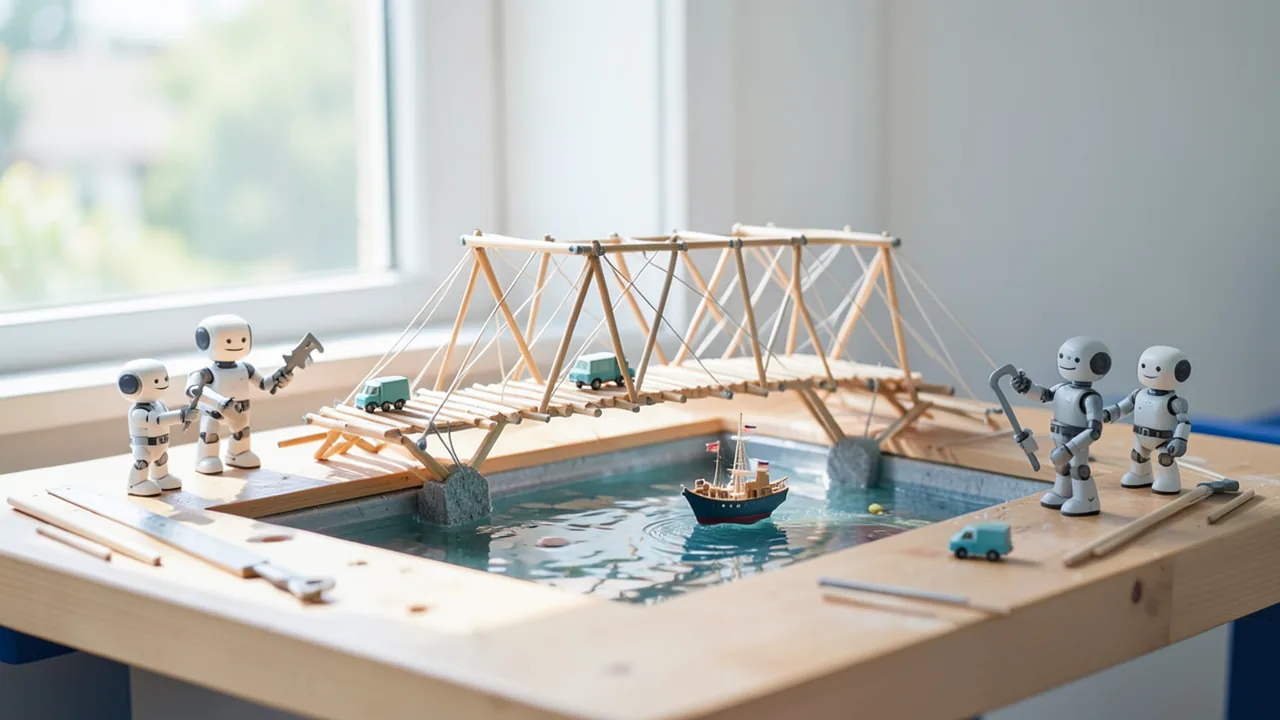
On November 7, nine models got the same starter kit. They had 90 minutes, and all seven levels were released at once, so the agents had to budget their own time. The task is building a 2D truss from wood, steel, cables, springs and hydraulics: a structure of nodes and members, like a lattice crane. Long compression members get weaker due to buckling. The physics is handled by a deterministic XPBD simulation, so the same bridge always produces exactly the same result. According to the organizer, the local simulator is the same program as the referee, and there are no hidden test scenarios.
A level only scores if every vehicle arrives on time and undamaged. You then get 100 × reference cost ÷ your cost. Build cheaper than the organizer's reference solution and you score more than 100 points. In level 7, each model builds a bridge plus a "wrecker vehicle" meant to bring down the other bridges, for a total of 72 duels. The overall score is the average across all seven levels. We checked GPT-6.2 Sol's: levels 1–6 add up to 637.42 points, plus 81.25 from level 7. Divided by 7, that's 102.67. The number checks out.
| Model | Tool | Total | Level 4 | Level 5 | Level 6 | Level 7: held / broken |
|---|---|---|---|---|---|---|
| GPT-6.2 Sol | Codex Desktop | 102.67 | 105.38 | 95.31 | 97.07 | 8/8 / 5 |
| Claude Opus 5.5 | Claude Code | 79.02 | 70.19 | 0 (budget: 13,472 of 10,000) | 91.64 | 8/8 / 4 |
| GPT-6 Astra | Codex CLI | 73.48 | 65.94 | 0 (budget: 10,199 of 10,000) | 84.90 | 8/8 / 6 |
| Gemini 4 Argon | OpenCode | 45.31 | 0 | 0 | 0 | 7/8 / 3 |
| Grok 4.7 | Grok Build | 35.62 | 0 | not submitted | not submitted | 4/8 / 0 |
| Kimi K3.1 Pro | Kimi Code | 32.47 | 0 | 0 | 0 | 5/8 / 0 |
| Tencent Hy4 | OpenCode (OpenRouter) | 31.45 | 0 | 0 | 0 (budget: 34,497 of 20,000) | 6/8 / 0 |
| Doubao Seed Evolving | OpenCode | 30.96 | 0 | 0 | 0 | 4/8 / 0 |
| DeepSeek V4.1 Flash | dsh | 27.93 | 0 | 0 | 0 | 4/8 / 0 |
All nine models passed levels 1–3. From level 4 on, ship clearance, tighter budgets and oncoming traffic came into play, and only the top three made it through. Sol built its biggest lead in level 2: its bridge cost 7,702 versus the reference's 10,617, earning 137.85 points.
Our recalculation: what really tripped up the models
The smzdm analysis concludes that placement wasn't decided by coding skill but by "self-checking, time management and budget discipline". So we assumed most zero scores came from blown budgets. The raw data in scores.json says otherwise. Of 54 submissions in levels 1–6, 20 ended with zero points:
- 15 times, the bridge failed its scenarios. Costs were within budget, but the vehicles didn't arrive on time and undamaged.
- 3 times, the budget was exceeded: by Opus and Astra in level 5 and by Hy4 in level 6.
- 2 times, nothing was submitted: Grok 4.7 didn't deliver levels 5 and 6.
The hypothesis only holds for the leading pack. Opus and Astra lost points exclusively by going over budget. For Astra it was especially close: 199 units, just over 2 percent. A simple calculation shows how much was at stake. Suppose Astra had submitted a passing bridge at exactly the 10,000 budget: that would have earned 82.16 points. Its overall score would have risen by about 11.7 to roughly 85.2, putting Astra ahead of Opus. This scenario is hypothetical.
For the bottom six, by contrast, physics was the problem. Some bridges were even built too cheaply. In level 5, Hy4 and DeepSeek came in at 5,651 and 5,584, about 31 percent under the 8,216 reference, and failed. Kimi built level 6 for 11,741 instead of 16,709 and, according to smzdm, failed the truck scenarios. Our take: these models could have seen locally, using the bundled bridge.py run, that their designs would fail. Self-checking really did break down here, just not the way we assumed. What was missing was testing before submission, not watching the budget.
The level 7 duel also only partly confirms the common narrative. Astra, the strongest attacker, broke six of eight bridges and still finished only third. All 18 broken bridges were taken down by the top four. According to the organizer, no physics glitches occurred in any duel.
The community builds cheaper, with caveats
At arena.meowllm.top/ep9, anyone can submit their own bridges for levels 1–6. We pulled the public leaderboard on November 10:
| Level | Best AI design in the contest | Cheapest submission | Difference | Entries |
|---|---|---|---|---|
| 1 | 3,531.70 (Opus) | 2,311.07 | −34.6% | 201 |
| 2 | 7,701.80 (Sol) | 2,906.52 | −62.3% | 133 |
| 3 | 7,714.88 (Sol) | 4,517.80 | −41.4% | 72 |
| 4 | 11,712.20 (Sol) | 4,234.59 | −63.8% | 103 |
| 5 | 8,620.74 (Sol) | 3,644.91 | −57.7% | 68 |
| 6 | 17,212.99 (Sol) | 14,278.96 | −17.0% | 110 |
Two caveats matter. First, the server only checks costs and formalities, not the physics. Instead, other visitors' browsers spot-check the top entries and remove bridges that fail. Second, the list isn't populated by humans alone. Nicknames like "gpt6.1sol", "Hy4-Redo" or "ds 4.1 flash" (first place in level 5) point to agents that kept working without a time limit. The nicknames can't be verified. Our take: the 90-minute time limit shapes the result at least as much as the model itself.
How to join in ten minutes
- Reproduce the results: Clone the repository. You'll need Python 3.9 or newer and the g++ C++ compiler; on Windows, the repository recommends w64devkit. Then, in the
bridge/folder, runpython build_engine.pyandpython tournament/score.py. The script recomputes all 54 designs, 6 reference solutions and 72 duels, and prints "核对通过" ("check passed") if everything matches. According to the README, this takes up to a minute on an 8-core machine. A manifest with SHA-256 checksums proves that none of the 108 files has changed since the contest. - Build your own bridge: Either in the simulator on the website or with a coding agent, for which the file
bridge/AGENT_PROMPT.mdis provided. The agent tests withpython bridge.py run <level> <file>and shows you the cost and test output before uploading. It may only upload with your approval. You're allowed 12 uploads per hour and 40 per day. - Your own bots for the other games:
sh start.shon macOS and Linux,start.cmdon Windows, or directly, for example,python challenge.py your_bot.cppin thectf/folder. According tocommunity/LEADERBOARD.md, all six community tanks beat the 14 AI bots. Those numbers come from other machines, though, and per the project aren't directly comparable.
A security note from the Diplomacy README: agents there run commands on your machine unsupervised. The project therefore recommends a virtual machine or a separate user account.
How rigorous is it?
The organizer spells out the limitations. Each model ran only once. Tools, access routes and reasoning levels differed, and identically named levels like "max" or "high" aren't comparable across tools. Tool versions weren't recorded. The Tron episode shows how big a role chance can play: repeat runs varied by about 300 points, while Mistral's lead was 92. According to smzdm, the channel operator himself says the episode was made "for fun and in a hurry".
Academic benchmarks work differently. BuildArena from Westlake University evaluates each task-model combination 64 times and uses the physics game Besiege. PolyBridgeBench (arXiv, September 2026) tests six models on 189 levels of the game Poly Bridge. It shows something similar to the Meow episode: a tight material budget changes the rankings. Claude Sonnet 5 hit a 50.8 percent success rate with a strict budget, while Gemini 3 Flash led with a loose one. In return, the hobby project has something both lack: full agent runs under time pressure, a byte-identical reproducible referee and a way for humans to compete themselves. Who's behind the GitHub account chen-006, who pays the API costs and how models and tools are selected isn't stated in the public materials.
The bigger picture
Meow AI Arena isn't a yardstick for model quality, and doesn't claim to be. What it does is expose failure patterns in a form you can verify yourself. GPT-6.2 Sol won the bridge contest as the only model to pass all six levels. Opus 5.5 and Astra lost their points to budget mistakes a simple pre-submission check would have caught. For the Chinese models and Gemini, bridges failed on the hard levels even though local tests could have flagged it.
Our take: if you use agents for longer tasks, keep these patterns in mind. The danger isn't badly written lines of code, it's submissions that go out untested and cut too fine, or never get finished at all. It's still unclear how stable the rankings would be across repeat runs, and a comparison with the same tools for everyone is still missing. If you want to know more, you can crunch the data yourself.
Sources
- GitHub: chen-006/meow-ai-arena (README, Episodenliste) github.com
- GitHub: Brückenbau-Folge (bridge/README) github.com
- GitHub: bridge/results/scores.json raw.githubusercontent.com
- GitHub: bridge/results/README.md (Level-Status und Duellmatrix) raw.githubusercontent.com
- GitHub: bridge/CONDITIONS.md raw.githubusercontent.com
- GitHub: bridge/AGENT_PROMPT.md raw.githubusercontent.com
- GitHub: bridge/source_manifest.json raw.githubusercontent.com
- GitHub: Tron-Folge github.com
- GitHub: Diplomacy-Folge github.com
- GitHub: Lagerlogistik und Code-Optimierung github.com
- GitHub: Fußball-Folge github.com
- GitHub: Panzer-Folge github.com
- GitHub: Bomberman-Folge github.com
- GitHub: community/LEADERBOARD.md raw.githubusercontent.com
- GitHub: Issues des Projekts github.com
- Meow Arena: Upload-Seite Folge 9 arena.meowllm.top
- Meow Arena API: Bestenliste Level 1 arena.meowllm.top
- Meow Arena API: Bestenliste Level 2 arena.meowllm.top
- Meow Arena API: Bestenliste Level 3 arena.meowllm.top
- Meow Arena API: Bestenliste Level 4 arena.meowllm.top
- Meow Arena API: Bestenliste Level 5 arena.meowllm.top
- Meow Arena API: Bestenliste Level 6 arena.meowllm.top
- smzdm: Neun KI-Brücken-Wettbewerb komplett offen, wie man selbst mitmacht post.smzdm.com
- smzdm: Nicht das Programmieren entschied post.smzdm.com
- smzdm: 75 Punkte Abstand, es lag nicht am Code post.smzdm.com
- smzdm: Mensch gegen Modell bei den Baukosten post.smzdm.com
- smzdm: Angriff und Verteidigung im Brückenbau post.smzdm.com
- smzdm: Sechs von neun scheitern in den letzten drei Leveln post.smzdm.com
- arXiv: PolyBridgeBench (2609.21493) arxiv.org
- BuildArena Projektseite build-arena.github.io
- arXiv: BuildArena (2510.16559) arxiv.org
Ask the AI assistant
Questions about this article, installation or background? Our assistant knows this page and runs on our own machine, not in someone else's cloud.
The Assistant is an AI (Gemma 4) and can make mistakes – please check important details against the source. Questions are used only to generate an answer and are deleted after one hour. Please don't enter any personal data.



Comments
What do you think? Already tried it? Write it here, no sign-up needed.
Comments are public. Links aren't allowed, and we delete abusive posts. You can delete your own comment at any time in this browser. Learn more in the Privacy Policy.