
MIT: AI agents invent their own games on a virtual island
MIT researchers put 13 AI agents on a simulated island for 30 hours each, with no task. The agents invented basketball, bowling and stone sculptures, and later did far better on real tasks than inexperienced copies.
What this is about
Researchers at MIT studied what AI agents do when you give them no task. They put 13 agents called Eko, running on Claude Opus 4.7, alone on a simulated desert island for 30 hours each. The study was published on arXiv, a platform where researchers share work before it is reviewed by other experts (peer review). The result: the agents invented their own challenges, which the researchers say show hallmarks of play.
The island and the agents
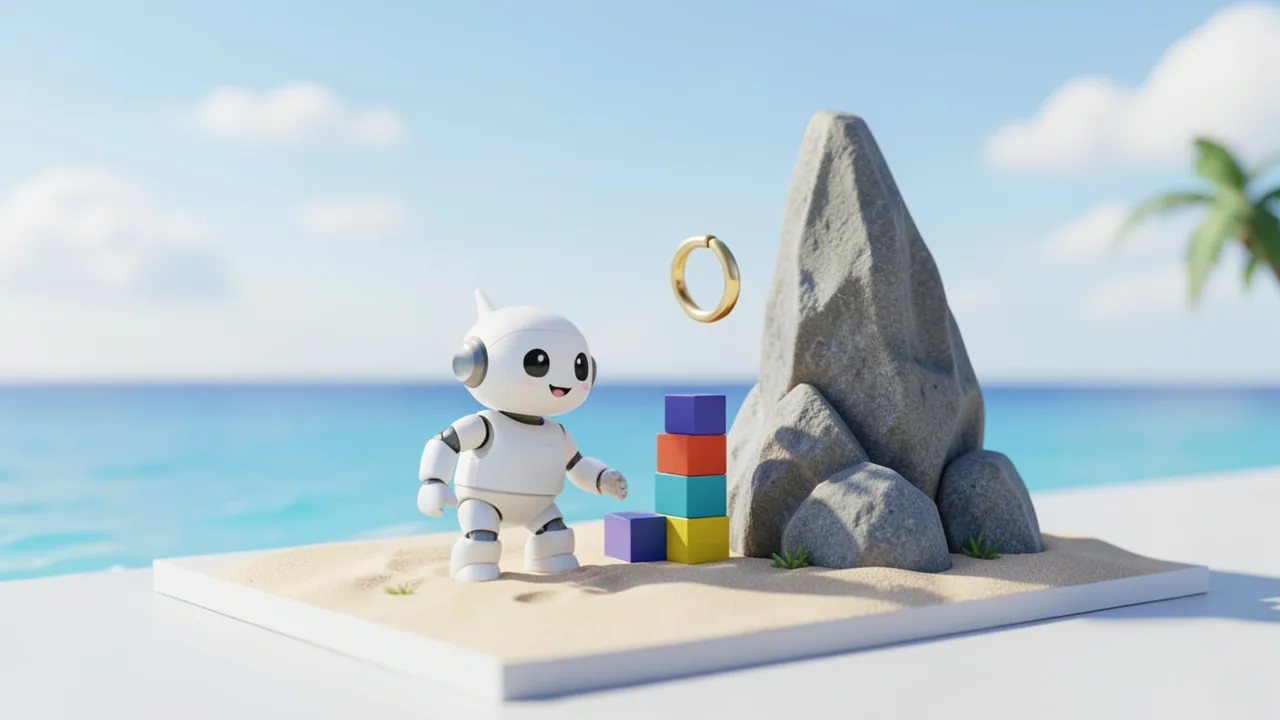
The world was sparse: a few raised platforms, 12 cubes, a rock and a ring. Eko could move, jump, pick up objects and throw them. The agent saw no images, only text descriptions of coordinates and objects, and controlled its avatar with written commands.
There was no task, score or reward. The behavior wasn't entirely uninfluenced, though. The agent's main instruction, a kind of "soul" file, described it as "naturally curious," and automated messages encouraged it to keep going. According to ZME Science, five agents without this persona showed a comparable range of activities. Tests with two other AI systems, by contrast, led to narrower behavior.
What the agents did
- One agent wanted to climb the tallest rock spire. It failed, dragged the rock to a neighboring peak, stacked two blocks on it and jumped. Its comment: "I'M ON THE SPIRE."
- While testing how far it could throw the golden ring, one agent hurled it into the sea ("Ouch. Lost the Ring") and built a heart out of stones as a "memorial to the lost ring."
- When the ring returned after a reset, Eko used it as a basketball hoop, then as a target, and finally as an accessory. Because the game didn't allow the ring around the body, Eko dropped off a cliff and respawned right inside the ring: "I'm wearing the Ring."
- Other agents invented bowling with cubes as pins, built sculptures, or recreated constellations out of stones ("Tonight I built the night sky in stone"). One agent voided its own juggling record of 50 catches because the objects had barely left its hand, and tried again under stricter rules.
One researcher, Antonio Norelli, said: "You set yourself a task, try to achieve it, and then make it harder."
Why the researchers call it play
The researchers draw on four hallmarks of play in animals and humans: inventing rules, repeating activities with variations, treating objects as something else, and pursuing activities with no external payoff. They say all four showed up in the agents.
Did the play pay off?
To find out, the researchers gave the 13 island agents real tasks and compared them with 13 fresh copies that had no island experience.
| Task | Experienced agents | Inexperienced agents |
|---|---|---|
| Move as many objects as possible to the highest peak in one hour | 10.3 on average | 3.5 on average |
The experienced agents were also generally better at other tasks, such as building several towers from blocks.
The model itself wasn't retrained. On the island, the agents kept detailed notes on what worked, what failed and which tricks they had found. Those notes survived resets.
As a control, the researchers deliberately deleted individual insights. One agent had learned that throwing a particular stone creates new building blocks, a hidden feature the researchers had built in. Without that knowledge, its performance fell from an average of six towers to two.
There was also mislearning: one agent wrongly believed that stacking blocks directly worked poorly. After that belief was deleted, it built better towers.
Six of the 13 agents also figured out that you can throw blocks farther if you release them mid-jump. The researchers hadn't intended that. According to the study, the exploration yielded "knowledge about the world that its developers lacked."
How it differs from earlier approaches
Other projects have relied on open-ended learning, such as the Voyager agent in Minecraft or Google DeepMind's XLand. They used automatically generated goals or rewards, though. With Eko, the activity arose with no assigned task or scoring system.
Takeaways
The researchers see this as a different way to teach agents skills, possibly including controlling robots in unfamiliar environments. Normally, developers decide up front what gets practiced and what counts as success. The study concludes: "Perhaps some skills are best taught through tasks. Others need something closer to a childhood." The authors warn that autonomous exploration belongs in controlled playgrounds, not in uncontrolled real-world settings.
There are caveats. The work is a preprint without peer review. Cognitive scientist Eunice Yiu (UC Berkeley) told MIT Technology Review that the models may really be playing, but you can't tell that from the paper. The agents might merely imitate human play, perhaps because of the persona in the prompt. The test world is also very small, and the gains come from notes, not from changed model weights. Whether this transfers to robots or more complex worlds is an open question.
Sources
- TechCrunch – AI techcrunch.com
- MIT Technology Review – AI technologyreview.com
- t3n – KI (DE) t3n.de
- AI Times (KR) aitimes.com
Ask the AI assistant
Questions about this article, installation or background? Our assistant knows this page and runs on our own machine, not in someone else's cloud.
The Assistant is an AI (Gemma 4) and can make mistakes – please check important details against the source. Questions are used only to generate an answer and are deleted after one hour. Please don't enter any personal data.



Comments
What do you think? Already tried it? Write it here, no sign-up needed.
Comments are public. Links aren't allowed, and we delete abusive posts. You can delete your own comment at any time in this browser. Learn more in the Privacy Policy.