
MonoRace: AI with a budget camera beats world champion in drone racing
TU Delft's AI system MonoRace beat drone world champion Yuki Hashimoto in Abu Dhabi in 2025. It gets by with a single camera costing about €30 and a small Nvidia computer, and flies at up to 100 km/h. The work has now been published in Science Robotics.
What this is about
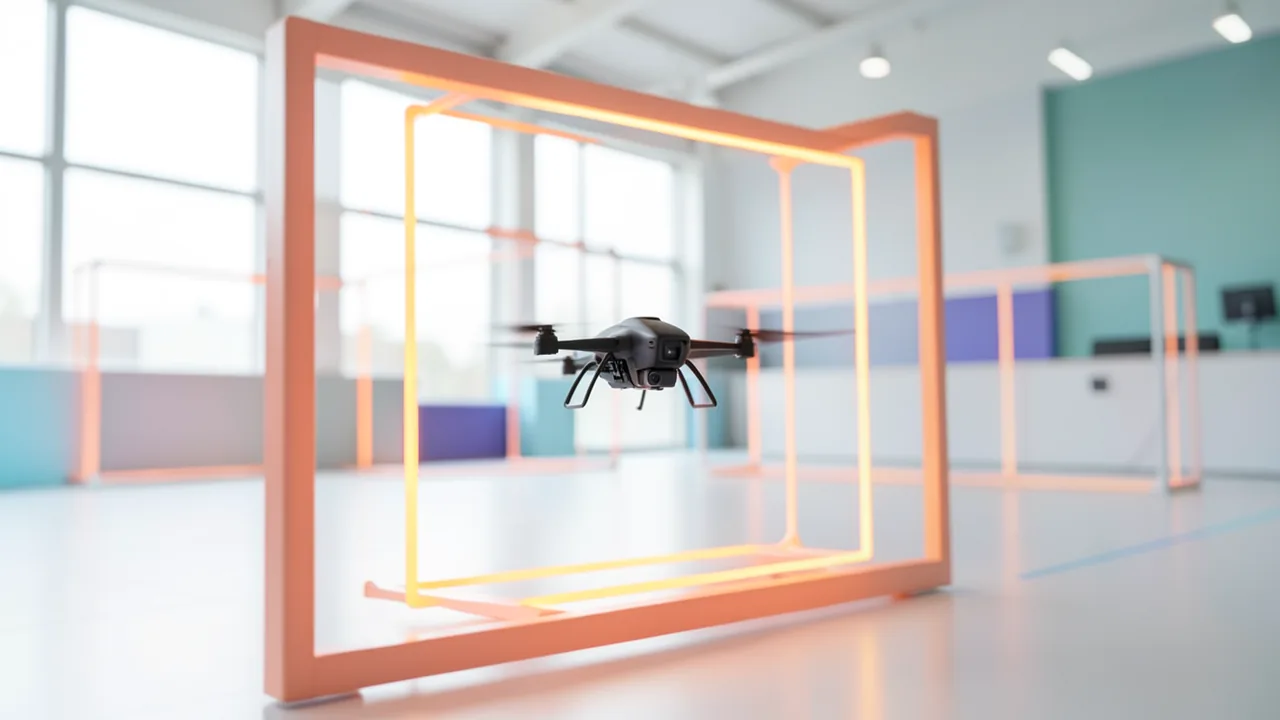
Every year, the best racing drones and their pilots face off at the Abu Dhabi Autonomous Drone Racing Competition. The drones fly through marked gates at up to 100 kilometers per hour. In the 2025 final, world champion Yuki Hashimoto had to concede defeat to the MAVLab team from TU Delft (the Netherlands). It was an uneven duel: Hashimoto flew his drone himself, while MAVLab entered an artificial intelligence called MonoRace. The system has now been presented, peer-reviewed by independent experts, in the journal Science Robotics.
According to t3n, AI beating humans at drone racing isn't new; it has happened in earlier matchups. What sets MonoRace apart is its extremely lean hardware.
Little hardware, lots of performance
MonoRace uses just a single small camera together with an inertial measurement unit (IMU). An IMU measures acceleration and rotation, much like the orientation sensor in a smartphone. There is no GPS and no external tracking system.
The researchers equipped the drone model supplied by the organizers with three components:
- an eight-megapixel camera that costs just under €30,
- an Nvidia Jetson Orin, a small computer optimized for AI workloads,
- a flight controller.
Lead author Stavrow Bahnam (TU Delft) describes the challenge: at very high speed and with only one camera, images are blurry and distorted, and the system has very little time to determine the drone's position precisely. Researcher Christophe De Wagter says the team wanted to find out how much intelligence you can get out of very limited resources, instead of constantly adding stronger sensors and computers.
How MonoRace works
The drone doesn't learn the path through a known course in advance. It reacts in real time. The task is deliberately narrow: fly through the gates without touching them.
Processing runs in several steps:
- The camera passes the images to the companion computer. To save compute, the AI doesn't analyze the whole image, only a 384 × 384-pixel crop.
- Based on the current position, the system predicts in advance where the next two gates should appear in the image.
- A neural network (a learning program that recognizes patterns in images) converts the images into masks that separate the gate frame from the background: essentially white objects on a black field.
- An algorithm analyzes the lines in the masks and finds intersection points. This is how the system calculates the corners of the next gate.
- This information goes to the flight controller at up to 500 commands per second.
Training in simulation
The controller was trained in advance with reinforcement learning in a simulation. In this method, a system tries many actions and is rewarded for good outcomes. That's how MonoRace learned the drone's physical properties and aerodynamic behavior. It was also exposed to realistic disturbances such as image noise and motion blur. Put simply, it learned how to fly the drone and how close to the limit it can go before it crashes.
Results and outlook
In Abu Dhabi in 2025, MonoRace beat not only the best human pilots (who also raced against each other in separate heats) but also other autonomous systems. For TU Delft, drone racing is a chance to push robots to their limits. The findings could be adapted for other autonomous systems. According to the study, the results show that neural networks have the potential to enable optimal control even on the smallest and cheapest robots.
Our take
The work is interesting less for beating humans than for how little it takes: a camera costing about €30 and a small onboard computer are enough for top speed. That matters for cheap, lightweight robots where expensive sensors aren't an option. What remains open is how well the approach works outside a clearly marked course with easily recognizable gates. The article says nothing on that, nor on lap times or details of the duel. The fact that the study was peer-reviewed adds credibility to the results.
Sources
- t3n – KI (DE) t3n.de
Ask the AI assistant
Questions about this article, installation or background? Our assistant knows this page and runs on our own machine, not in someone else's cloud.
The Assistant is an AI (Gemma 4) and can make mistakes – please check important details against the source. Questions are used only to generate an answer and are deleted after one hour. Please don't enter any personal data.



Comments
What do you think? Already tried it? Write it here, no sign-up needed.
Comments are public. Links aren't allowed, and we delete abusive posts. You can delete your own comment at any time in this browser. Learn more in the Privacy Policy.