
Multiplayer AI Dreams: Why World Models Are Reinventing the Game Server
AI world models like Genie generate playable worlds, but only for one player at a time. Once several people need to see the same world, you need a shared game state managed by a single authority. We compared eleven projects, from Multiverse to the new vor.tech beta. Almost all of them land on the architecture Counter-Strike has used for 25 years.
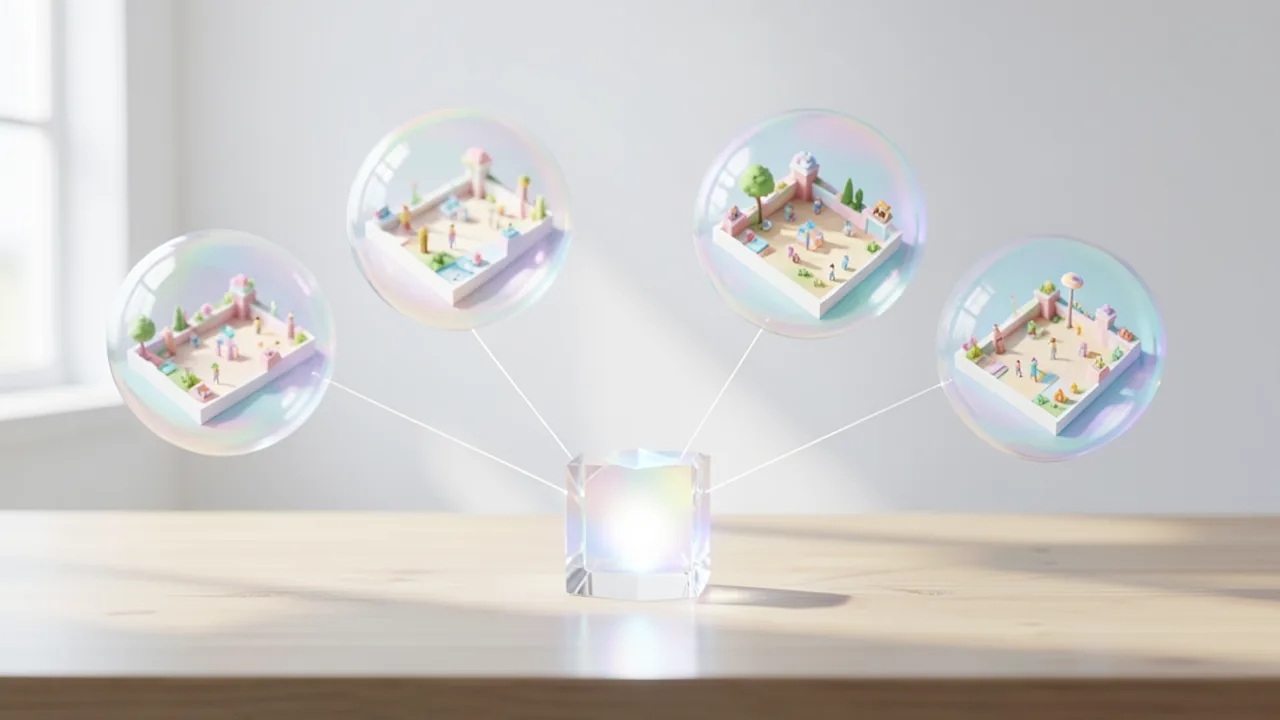
What this is about
Google's Project Genie, Odyssey's models and Overworld's Waypoint all work in a similar way: you press a key, and an AI model generates the next frame of a world that exists only in its "head". These are called world models: AIs that predict what an environment will look like next. So far, this works for exactly one player. According to an analysis of Genie 3 by game studio StraySpark, two requests produce two different worlds. Without determinism, meaning guaranteed identical results, there can be no competitive shooters, no co-op puzzles and not "any kind of authoritative server".
Multiplayer world models have to solve this problem. We compared eleven projects. Our thesis: almost all of them now separate the shared game state from image generation. In doing so, they're reinventing the classic game server. The difference is that the game rules are learned, not programmed.
Why dreamed worlds fall apart
A world model remembers the world only through the frames it has recently generated. Once one player can no longer see another, that other player effectively stops existing for the model. In their Minecraft project Solaris, researchers at New York University state openly that the model loses the shared context "when players leave each other's field of view". The MASS paper describes the same problem: separate frame histories of the same world can "drift apart", and simultaneous views then contradict each other.
The first generation tried to solve this with brute force, generating all views together in one model:
- Multiverse from Enigma Labs, trained on just over four hours of Gran Turismo 4, stitches the views into a split screen, according to Air Street Press. Resolution is 48×64 pixels per player, after which a second model upscales the image.
- Solaris concatenates both players' image tokens and lets them exchange information via "multiplayer self-attention".
- MIRA from General Intuition, Kyutai and Epic Games (Rocket League, four players) packs all four views into a grid, according to Neurohive. The 5-billion-parameter model runs at 20 frames per second on an Nvidia B200.
- γ-World from Nvidia and partners uses so-called hub tokens to cut the cost of coordination between players from quadratic to linear. The model reaches 24 frames per second and was trained on two-player data, but also works with four.
MIRA shows that joint generation can work: a car that drives out of one view persists in the others. But the authors themselves point to a short context memory, and the clock and score drift. The WorldCast team sums up the fundamental drawback: compute costs grow with every additional player.
The turning point: one state, many cameras
The second approach splits the work into two jobs. One model calculates what happens: positions, health, hits. A second one paints what it looks like from that state, separately for each camera.
- Agora-1 from Odyssey (May 2026) does this in a four-player GoldenEye deathmatch. One model learns how position, health and ammo change. A diffusion transformer (an image AI that gradually carves images out of noise) renders each view from that. Odyssey itself calls the state model "relatively simple".
- Khora from Ophilus records everything on a shared "Spatio-Temporal Board". The public demo allows eight players; the team has run measurements with up to 80 agents.
- MASS (arXiv, August) borrows its terminology straight from the games industry. A "Logic Engine" advances an "authoritative" state, and a "Rendering Engine" draws any camera you like.
- Agora-2 (September) says it most plainly. A World Server aggregates the simulation model's predictions so that every renderer gets "the same representation of events". According to Odyssey, characters stay stored in the state even when nobody is looking at them.
That's exactly how an authoritative game server has worked for decades. Gabriel Gambetta describes it in his well-known networking series: clients send only inputs, while the server decides and is the single source of truth. Tampered clients can display whatever they want, but that doesn't change the server's state, "which is what the other players see".
The comparison
| Project | Game | Players | Shared state | Where rendering happens |
|---|---|---|---|---|
| Multiverse | Gran Turismo 4 | 2 | no, joint generation | one model |
| Solaris | Minecraft | 2 | no | one model |
| MIRA | Rocket League | 4 | no | one B200 |
| γ-World | virtual environments | 2–4 | no, hub attention | one model |
| Agora-1 | GoldenEye | 4 | yes, learned | cloud, stream |
| Khora | Deathmatch | 8 (demo) | yes, STBoard | n/a |
| MASS | Snake | 1,024 units | yes, typed | one GPU for all views |
| Agora-2 | Diablo II | 4 humans + 16 agents | yes, World Server | 4 GPUs for 4 players |
| WorldCast | Counter-Strike 2 | 2–16 | yes, but decentralized | one H200 per player |
| vor.tech beta | Counter-Strike map | up to 10 | yes, server | your own GPU (RTX 3080 or better) |
The figures come from the developers and authors. Nobody has independently verified them yet.
Two outliers: WorldCast and vor.tech
WorldCast (arXiv, October) goes one step further toward a classic game and drops the central machine entirely. Each player has a local client with a video generator based on Wan2.2-5B and a state model that estimates the player's own position from the image and controls. The clients exchange only positions and scene state. With 16 players, that's about 3.5 megabits per second per GPU. Testing used real Counter-Strike 2 pro demos. Other players show up where they belong 81.7 percent of the time. For Solaris, the figure is 5.6 percent. Per client, the team measures 23.4 frames per second with two players and 18.7 with sixteen, each on its own H200.
The weaknesses are in the appendix. Position error on generated video grows from 1.49 to 2.64 body widths within a minute. According to the paper, "no component" determines hits, damage or deaths. And data from other clients is accepted without checks: one faulty client changes what everyone else sees. That's exactly the problem the authoritative server was invented to solve.
vor.tech has launched the first multiplayer beta you can download yourself. It's about 3 GB, free, and runs on Windows and Linux. Mac is "untested", according to the developer. Up to ten players compete on the map aim_map_usp_s, in 5v5, deathmatch or against bots. Every frame is generated on your own graphics card, at least an RTX 3080, while "a server keeps everyone in the same game". The site doesn't say exactly what the server transmits. Training used 3,958 hours of bot matches; the videos are 256×256 pixels at 16 ticks per second. vor.tech itself warns that the image drifts and the software may crash. The outlet remio hasn't tested the beta itself and cautions that a scene can look convincing while still giving players different reasons to move or shoot.
Latency and cost: what the numbers tell us
Classic shooters hide network lag with client-side prediction: your machine shows the effect of an input immediately and corrects itself when the server's response arrives. For world models, there are no measurements of this yet. None of the projects has published the delay between key press and visible frame. Here's what's available:
- Khora: 107 to 117 milliseconds of pure compute latency, not counting the network.
- Agora-2: about 57 milliseconds per renderer call, according to OrcaRouter's analysis. Live latency wasn't measured; 30 displayed frames per second is a target, not a measurement.
- MASS: 45.55 milliseconds per Logic Engine step. That's enough for 20 ticks per second, but more than ten times the 3 to 4 milliseconds of the simple baseline models.
- WorldCast: clients sync up in blocks of one second of video and estimate in between. Network latency, jitter and packet loss weren't studied.
On cost, the picture is clear. The game state is cheap: MASS's Logic Engine has 5.66 million parameters, and Agora-2's simulation model about 4.5 million, according to OrcaRouter. The painting is what's expensive. The Agora-2 renderer has about 1 billion parameters, and a four-player session occupies four RTX PRO 4500 cards. Khora reports 2,741 view frames per second with 80 agents. By our math, that's just over 34 frames per second per player, on unspecified hardware. MASS renders 1,024 views in 842 milliseconds, or about 0.8 milliseconds per view. But that applies to Snake grids with a small U-Net, not photorealistic 3D scenes.
Our take: today you need roughly one GPU per player. Local approaches like vor.tech and WorldCast just shift that load to the player's machine. As remio puts it: the compute moves, it doesn't disappear.
Our verdict
The developments largely confirm our thesis. If you want to reliably keep more than two players in one world, you need an explicitly stored, shared state, and usually a server that has the final say over it. MIRA and γ-World show that joint generation still works for a handful of players. But Agora-2, Khora, MASS and vor.tech all bet on separating state from image. WorldCast distributes that separation across the clients and thereby inherits the trust problem that classic games solved long ago.
That tempers the promise of "games without an engine". The model learns the transitions, but a human still decides what belongs in the state. With MASS, every game needs its own schema, its own tokenizer and its own weights. Agora-2 feeds its renderer a carefully structured preamble of map section, characters and effects. The training data comes, without exception, from games built on classic engines: GoldenEye, Diablo II, Counter-Strike. Our take: what's emerging is a hybrid of a small, learned server and a huge, learned graphics driver.
Three questions remain open. What does it feel like to play with real network latency? What does an hour of play cost per player? And does this work for games that weren't first built and recorded with an engine? If you want to try it yourself, you'll find the vor.tech beta at vor.tech/play.
Sources
- arXiv: MASS – Multiplayer World Models with Authoritative Shared State arxiv.org
- MASS – Volltext (HTML) arxiv.org
- arXiv: WorldCast – Distributed Multiplayer World Models arxiv.org
- WorldCast – Volltext (HTML) arxiv.org
- VOR.TECH: Multiplayer Open Beta vor.tech
- VOR.TECH: Startseite und Datensatz vor.tech
- remio: vor.tech Multiplayer Beta Uses Local World Models remio.ai
- Odyssey: Introducing Agora-1 odyssey.systems
- Odyssey: Introducing Agora-2 odyssey.systems
- OrcaRouter: Agora-2 Multiplayer World Model Preview orcarouter.ai
- AlphaSignal: Odyssey's Agora-2 Lets 20 Players Share One AI-Generated World alphasignal.ai
- The Decoder: Agora-1 turns GoldenEye into a playable AI simulation the-decoder.com
- Air Street Press: Odyssey Starchild-1 and Agora-1 press.airstreet.com
- Ophilus: Introducing Khora ophilus.ai
- arXiv: Solaris – Multiplayer Video World Model in Minecraft (HTML) arxiv.org
- Hugging Face: Enigma-AI/multiverse huggingface.co
- Neurohive: MIRA simuliert Rocket League neurohive.io
- Nvidia Research: γ-World research.nvidia.com
- arXiv: Gamma-World arxiv.org
- arXiv: MultiGen arxiv.org
- Gabriel Gambetta: Client-Side Prediction and Server Reconciliation gabrielgambetta.com
- StraySpark: Genie 3 World Model vs Game Engines strayspark.studio
Ask the AI assistant
Questions about this article, installation or background? Our assistant knows this page and runs on our own machine, not in someone else's cloud.
The Assistant is an AI (Gemma 4) and can make mistakes – please check important details against the source. Questions are used only to generate an answer and are deleted after one hour. Please don't enter any personal data.



Comments
What do you think? Already tried it? Write it here, no sign-up needed.
Comments are public. Links aren't allowed, and we delete abusive posts. You can delete your own comment at any time in this browser. Learn more in the Privacy Policy.