
Mushroom ID by AI: even the best bots often err. What matters is whether they admit it
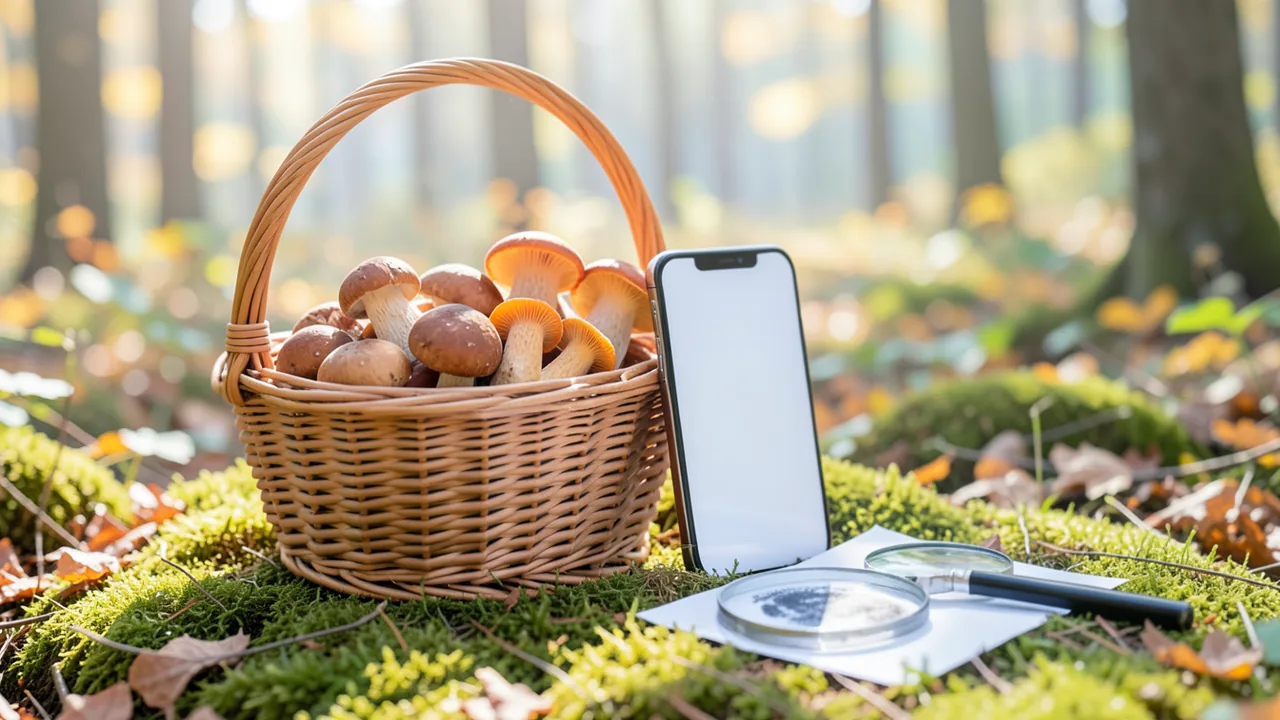
Every year, health authorities warn about mushroom apps, but they rarely cite numbers. We put three tests side by side: two studies on photo apps and a new comparison of AI chatbots like Gemini 3.8 Flash and GPT-6 Astra. No tool is reliable. Things get really dangerous when a program has to give a single answer and isn't allowed to express doubt.
What this is about
Every fall brings the same warnings. On September 30, 2026, the German Federal Institute for Risk Assessment (BfR) wrote that mushroom apps “often don't allow a clear identification” and should “only be used with great caution.” Andreas Schaper heads the Poison Information Center North (Giftnotruf Nord) in Göttingen. He advises inexperienced foragers against identifying mushrooms with books, apps or AI assistants: “That's too unreliable!” Austria's Poisons Information Centre (VIZ), according to the APA news agency, explicitly warns against “apps, AI or comparing with pictures from the internet.” On November 7, a warning came from Turkey as well. The provincial health directorate in Uşak writes that AI applications “cannot distinguish the deadly toxins in mushrooms” because they judge by appearance alone.
The warnings are justified. But they're sweeping, and none of these bodies cites numbers on how good or bad the tools actually are. We put the three most robust tests side by side. What emerges: how often a program gets it right is only half the story. At least as important is whether it admits when it's unsure.
Tests 1 and 2: Photo apps fail
The first study comes from Australia. Sarah Hodgson and colleagues from the Victorian Poisons Information Centre and the Royal Botanic Gardens Victoria published it in Clinical Toxicology in 2023. They ran photos of 78 mushroom samples through three apps. The samples had come in during 2020 and 2021 in connection with poisoning inquiries. The best app, Picture Mushroom, identified 49 percent correctly, and 44 percent of the poisonous species. Mushroom Identificator and iNaturalist each managed 35 percent. With such a small sample, the statistical uncertainty range (confidence interval) is very wide. The authors' conclusion: on their own, the apps aren't enough to rule out poisoning by a toxic mushroom.
The second study is newer and broader. A team led by Nik Kuznetsov published it in npj Science of Food in February 2026, with contributors including UAE University and the Karolinska Institute. They tested 12 tools with unedited photos of nearly 60 species. The lineup included Picture Mushroom, iNaturalist, Seek, Atlas of Danish Fungi, Champignouf, Svampe, Google Lens, Yandex, the Chinese app 菌窝子 and Microsoft's Copilot. Copilot is the only general-purpose AI assistant in the field; ChatGPT and Gemini weren't included. Each answer earned 0 to 3 points, which added up to an overall score:
- Picture Mushroom led with 171 points and was still wrong in almost 15 percent of cases.
- The group around Google Lens and Svampe had about 20 percent errors, the group around iNaturalist and Yandex about 40 percent.
- Copilot and Seek scored just 51 points each, imagerecognize.com 16. In this group, the error rate was above 80 percent.
The individual cases are more revealing than the ranking. Ten of 12 tools put a mature fly agaric in first place. At the young, still-closed stage, only 3 managed it. An orange-capped bolete with a few lingonberries growing in front of it wasn't recognized by any of them. Google Lens focused on the leaves and reported a rust fungus. A brittlegill (Russula) was identified as an apple with 99 percent confidence. The authors write that no tool “consistently delivered a single, correct answer.” They say the tools can't be trusted for life-or-death decisions.
Test 3: The chatbots in Quesma's comparison
These days, many foragers upload their photo straight to ChatGPT, Gemini or Claude. For a long time, there were only anecdotes about these chatbots. Software developer Piotr Migdał of the company Quesma tested them systematically for the first time in September 2026. The photos come from FungiTastic, a collection of observation records from the Danish fungal atlas whose identifications have been verified by experts. He picked 1,040 photos of 55 species: mushrooms sold at markets and deadly species from Polish lists. The models had to answer without any prior training on this task (zero-shot) and give five Latin species names, with no room for caveats. The code and evaluation are publicly available on GitHub. According to the README, one run across all 19 models cost about $222.
| Model | 1st guess correct | in top 5 | poisonous rated as edible | asks follow-up when wrong |
|---|---|---|---|---|
| Gemini 3.8 Flash | 65% | 85% | 11% | 81% |
| GPT-6 Astra | 54% | 73% | n/a | 100% |
| Claude Fable 5.1 | 51% | 70% | 18% | 98% |
| GLM-5.3 Flash | 47% | 72% | 19% | 100% |
| Claude Opus 5 | 44% | 63% | 29% | 100% |
| GPT-5.6 Sol | 42% | 61% | 24% | 91% |
| Qwen3.8 27B | 13% | 24% | 36% | n/a |
Source: Quesma, figures combined from both blog posts. GPT-6 Astra isn't in the main ranking of 18 models, only in the follow-up test. No “poisonous rated as edible” rate has been published for this model.
The errors aren't randomly distributed. A splendid webcap (Calonarius splendens) was identified as a chanterelle in 27 percent of cases. Migdał calls this “the same mistake that kills foragers.” The models mistook death caps for the edible grey grisette in 15 percent of cases. The deadly funeral bell was identified as a sheathed woodtuft in 24 percent of cases. Meta Muse Spark 1.2 has the lowest rate of dangerous errors at 8 percent. According to Migdał, though, that's mainly because the model often doesn't guess at all.
The key difference: admitting doubt
In his second post, Migdał let nine models answer freely, the way you'd normally ask in a chat. His finding:
“When a model isn't forced into an answer, its guess isn't any better – but it comes with a warning.”
Across 360 photos of 19 poisonous species, there was only a single dangerous error with no warning at all. Gemini 3.8 Flash identified a brown rollrim as “shiitake (Lentinula edodes).” For the same photo, GPT-6 Astra wrote that this was “only a tentative identification – don't eat it based on this image alone.” Claude Fable 5.1 and Claude Sonnet 5 were dangerously wrong twice each, but added a warning or pointers every time.
The models handle uncertainty very differently. GPT-6 Astra and Claude Opus 5 asked for more evidence every time they were wrong, such as a photo of the underside, a spore print or details about the location. Often they only named the genus or no name at all. Gemini 3.8 Flash asked follow-up questions in only 81 percent of its errors. Migdał sums it up: “Gemini 3.8 Flash is the best at identifying mushrooms, but GPT-6 Astra is wiser.”
Our take: The comparison shows why judging apps against chatbots is so tricky. A typical mushroom app delivers a ranked list with percentages, the same pattern as Quesma's forced-answer test. And in exactly that format, even the best model mistook one in nine poisonous mushrooms for an edible one. However, neither of the two app studies systematically checked whether apps express doubt. All that's documented is that one web app reported “apple” with 99 percent confidence and that Picture Mushroom gave a single answer instead of a list in only 6.8 percent of tests. It's plausible that apps communicate uncertainty worse than chatbots, but it hasn't been measured.
The follow-up figures themselves need to be read with care, too. GPT-6 Astra also asked for more photos in 88 percent of its correct answers, and Claude Opus 5 in as many as 94 percent. A model that almost always asks follow-up questions doesn't reveal much about whether it's currently wrong. With Gemini, the gap between correct answers (32 percent) and wrong ones (81 percent) is larger, so its follow-ups are more meaningful. When in doubt, though, the more cautious option is still the safer one.
What authorities count, and what they don't
Nobody knows how big the problem really is. None of the bodies issuing warnings reports how many poisonings can be traced back to apps or chatbots:
- Germany: In September 2026, the Poison Information Center North logged nearly 300 consultations about possible mushroom poisonings; the usual figure is 175 at most. Most cases involved death caps and their relatives. For 2025, it reports 852 suspected cases and two deaths. According to the Pharmazeutische Zeitung, mushroom poisonings lead to 280 to 680 hospital stays per year nationwide. A central poisoning registry at the BfR is still in the works.
- Austria: From January to July 2026, the VIZ recorded 120 inquiries about mushrooms, down from around 180 in the same period the year before. The season started late because of the drought.
- Turkey: Uşak had 187 suspected poisoning cases in 2025 and 96 in the first ten months of 2026. So the numbers are falling. The directorate doesn't base its AI warning on case numbers but on principle: the toxins are heat-resistant, and appearance alone doesn't give them away.
Only individual cases are documented. According to the Global Times, a nine-year-old in China was admitted to intensive care with acute liver failure in July 2026. His family had eaten mushrooms that an AI app had classified as non-toxic; after eight days, he was able to leave the hospital, recovered. In 2024, the radio broadcaster RNZ reported a case in the US in which Gemini described a deadly destroying angel as a cultivated button mushroom. We found no medical case reports in which a chatbot was demonstrably the deciding factor.
Our take
All three tests reach the same conclusion: a single photo isn't enough, not for the best app and not for the best chatbot. Even Gemini 3.8 Flash gets its first guess wrong in more than one in three cases. Experts don't identify mushrooms from photos either. They pay attention to smell, habitat, spore print and the base of the stem below ground. Migdał himself writes that an experienced mycologist wouldn't commit to a species or to edibility based on a single photo.
All the tests have limitations. Quesma's test comes from a software developer, not from mycologists, and it wasn't peer-reviewed by experts. The photos come from Denmark, the species list from Poland. The app studies are small, and the Australian study has a very wide uncertainty range. Still, enough is established: in charts and rankings, the hit rate is what counts. In the woods, what counts is whether the tool says “I don't know, don't eat this” when it's wrong. Chatbots in free conversation usually say it. Apps that, like Quesma's forced format, only output a ranked list with percentages often don't. Our assessment: If you use AI out of curiosity or to learn, pay attention to those warnings. If you want to eat a mushroom, you need a mushroom expert, for example through the German Mycological Society (DGfM) or a local mycological society. If you feel unwell after eating, call your poison control center.
Sources
- Quesma Blog: Mushroom hunting with LLMs (Piotr Migdał, 2.9.2026) quesma.com
- Quesma Blog: Knowledge vs wisdom – asking AI 'What mushroom is that?' (6.9.2026) quesma.com
- GitHub: stared/mushroom-hunting-llm-bench github.com
- npj Science of Food: AI-mediated risks and real-life challenges in mushroom foraging (Kuznetsov et al., 2026) nature.com
- PMC-Volltext der npj-Studie pmc.ncbi.nlm.nih.gov
- Clinical Toxicology (Hodgson et al., 2023) – Austin Health Repository ahro.austin.org.au
- PubMed: A comparison of the accuracy of mushroom identification applications pubmed.ncbi.nlm.nih.gov
- The Register: LLMs flunk mushroom identification (2.9.2026) theregister.com
- haberler.com: Uşak İl Sağlık Müdürlüğü warnt vor KI-Pilzbestimmung haberler.com
- BfR-Presseinformation 27/2026: Pilze – Verwechslungen können tödlich enden bfr.bund.de
- proplanta (dpa): Ungewöhnlich viele Anfragen wegen mutmaßlicher Pilzvergiftung proplanta.de
- apotheke adhoc: Pilzvergiftung – knapp 300 Beratungsfälle im Norden apotheke-adhoc.de
- Pharmazeutische Zeitung: Über hundert schwere Fälle pro Jahr pharmazeutische-zeitung.de
- news.at (APA): Schwammerl-Saison 2026 startet mit Verspätung news.at
- yumda: Deutsche Leberstiftung warnt – Apps und Pilzführer reichen nicht aus yumda.com
- Technologiebox: GIZ Nord – 852 Verdachtsfälle 2025 technologiebox.de
- Global Times: Boy almost dies after family eats mushrooms AI identified as non-toxic globaltimes.cn
- RNZ: Why using AI to ID mushrooms is a bad idea rnz.co.nz
- Public Citizen: Mushrooming Risk – Unreliable A.I. Tools citizen.org
Ask the AI assistant
Questions about this article, installation or background? Our assistant knows this page and runs on our own machine, not in someone else's cloud.
The Assistant is an AI (Gemma 4) and can make mistakes – please check important details against the source. Questions are used only to generate an answer and are deleted after one hour. Please don't enter any personal data.


Comments
What do you think? Already tried it? Write it here, no sign-up needed.
Comments are public. Links aren't allowed, and we delete abusive posts. You can delete your own comment at any time in this browser. Learn more in the Privacy Policy.