
Nvidia GR00T 2: Robots learn fine motor skills from videos of humans
At the CoRL robotics conference in Austin, Nvidia unveiled GR00T 2, an AI model that teaches robots manual tasks, partly by watching videos of people doing everyday chores. Nvidia is also releasing 100,000 hours of that footage. The test results are impressive, but Nvidia's own paper puts its best numbers in context.
What's going on
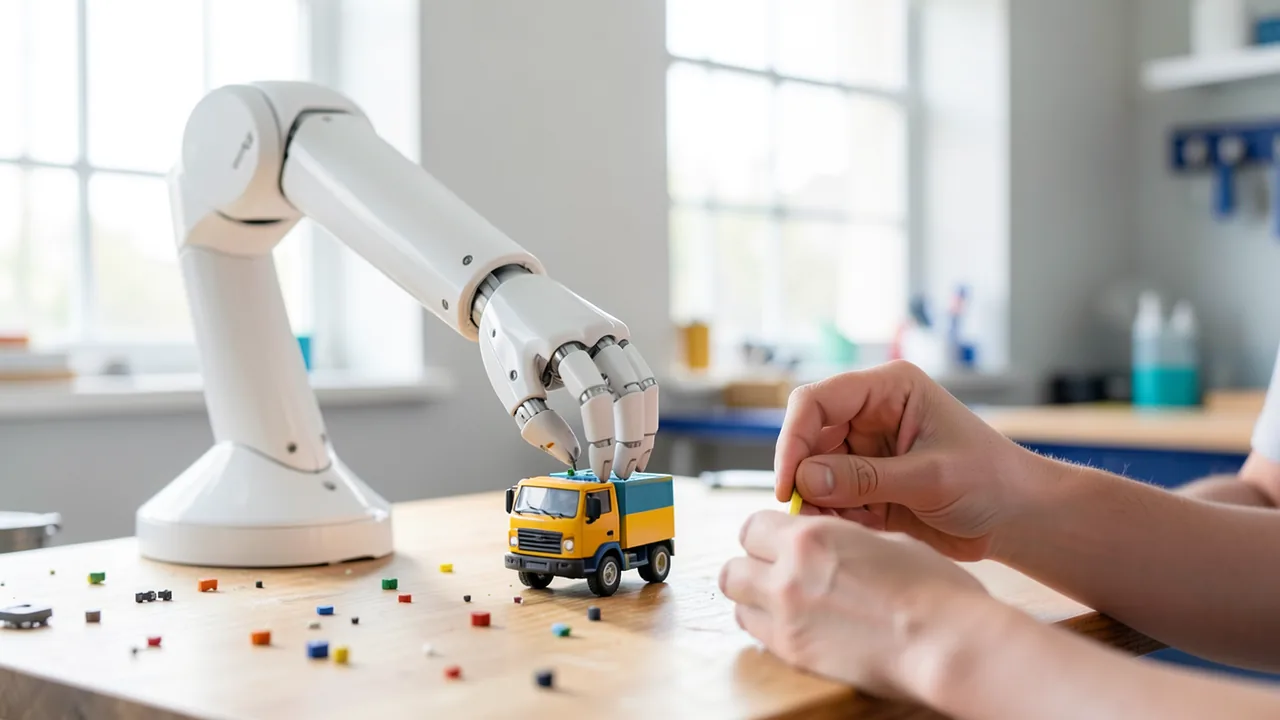
On November 9, 2026, at the Conference on Robot Learning (CoRL) in Austin, Texas, Nvidia unveiled GR00T 2, the next generation of its foundation models for robots. A foundation model is trained once on huge amounts of data and then adapted to many individual tasks, much like the language models behind chatbots. GR00T 2 is primarily meant to teach robots fine manual work: grasping, inserting and assembling parts. It learned much of this by analyzing videos of people doing everyday tasks.
Nvidia calls GR00T 2 an open "World Action Model." That means a model that, before every movement, predicts how its own action will affect what it sees next. In a sense, it pictures the consequences in advance. It isn't fully open yet, though: according to Nvidia's research page, cited by Unite.AI, the code won't be released until December. A large part of the training data is already available.
Alongside the model, Nvidia showed the simulation tool Isaac Lab 3.0 and several new benchmarks, standardized test suites for comparing robots.
How GR00T 2 works
According to Unite.AI, GR00T 2 is a 2-billion-parameter transformer model built on Nvidia's video model Cosmos-Predict2.5-2B. It takes three inputs: the most recent camera frames, the robot's current state (such as its joint positions) and a written instruction. From these, it generates the frames it expects to see next and the next sequence of movements. A single pretrained checkpoint, meaning a saved training state, is supposed to work for arms with simple two-finger grippers, for robots with dexterous hands and for a humanoid.
According to Cryptobriefing, its predecessors GR00T N1.6 and N1.7 were 3-billion-parameter VLA (Vision-Language-Action) models. A VLA model sees an image, understands an instruction in plain language and outputs movements.
The real trick lies in the training data:
| Data source | Volume |
|---|---|
| First-person videos of humans | 402,730 hours |
| Handheld gripper demonstrations (2,897 tasks) | 10,184 hours |
| Teleoperation (robots remote-controlled by humans) | 23,500 hours |
Robots have a data problem: language models can learn from the internet, but you can't just download years of practice material for folding laundry. Videos of humans are much easier to come by, but they aren't ready-made robot commands. The model has to learn to map what it sees onto its own body. How sought-after this kind of data is shows in the startup Maxinsights, which, according to The Next Web, pays people to film themselves doing housework.
Nvidia is releasing 100,000 hours of the human data as Human-1M-100K: videos, language descriptions, and head and hand motion data. The CC BY 4.0 license allows commercial use as long as you credit the source.
What the tests show, and where to look closely
Nvidia examined how well skills transfer from one body to another (cross-embodiment). The model learned to insert a coffee filter paper purely from human demonstrations, without any teleoperated robot data for that task. It succeeded in 65 percent of attempts. Assembling a toy dump truck, transferred from the handheld gripper to a YAM robot arm, worked 60 percent of the time.
Accounts of the zero-shot test, meaning tasks without any prior training on them, differ. The Next Web writes that GR00T 2 completed 40 of 50 tasks at least once without training. Unite.AI and Diario Bitcoin, on the other hand, report a 40 percent zero-shot success rate on 50 tasks that weren't in the target robot's training data. Unite.AI also mentions that in the "Dexter" test suite, the model completed at least one attempt successfully on 40 tasks.
Show the robot a task once, and it succeeds 71 percent of the time on average; with five demonstrations, that rises to 95 percent. Five demonstrations amount to less than three minutes of robot data per task. That's followed by roughly 30 minutes of fine-tuning a so-called adapter on a single RTX 5090. An adapter is a small add-on module that gets retrained while the large model stays unchanged.
The catch is in Nvidia's own whitepaper: only tasks the model can learn to at least 80 percent with five demonstrations were tested. So the high average partly comes down to task selection. The Next Web and Unite.AI explicitly point this out.
An AI agent as supervisor
For longer tasks, GR00T 2 works with a reasoning agent. This is a higher-level AI system that plans the individual steps, monitors progress and triggers recovery routines when, say, a part falls. GR00T 2 itself handles the actual manual work. With recovery data and the agent, Nvidia says it succeeded on 98 toy airplanes, 97 toy tractors and 97 Hot Wheels models, out of 100 attempts each. The parts started out randomly scattered every time. With plain supervised fine-tuning, meaning conventional retraining on examples, the numbers were just 69, 51 and 23.
The price is waiting time. When sorting trash, the robot spent a median of 38 percent of a task waiting for the agent. Across the long tasks overall, the whitepaper reports an average success rate of around 70 percent.
Isaac Lab 3.0 and new benchmarks
Isaac Lab 3.0 is Nvidia's open-source tool for training robots in simulation before they go into the real world. According to Unite.AI, it has been generally available since October 20, 2026. Different physics engines such as Newton or PhysX can be plugged in; Newton can simulate rigid and deformable bodies as well as particles. Many workflows run without a full Isaac Sim installation. In a benchmark for vision-based dexterous manipulation, Nvidia says Isaac Lab 3.0 with Newton trains up to 2.5x faster than version 2.3 with PhysX. According to Cryptobriefing, the release also includes LEAPP, a tool meant to make it easier to move trained policies onto real hardware.
Other projects:
- AlphaNIST trains 20 assembly tasks from the NIST Assembly Task Board in simulation, with parts as small as 4 millimeters. A single shared policy that only receives "success/failure" feedback reaches a 98.2 percent training success rate. Separate per-task policies reach 81.4 percent and need about 39x more GPU time. These are simulation results, though.
- Behind it is Success-Guided Sampling from the University of Washington and Nvidia. The method prioritizes practicing situations the robot gets right about half the time. According to the authors, it scales to more than a million simulated environments and transfers without retraining to real UR5e robot arms.
- Isaac Lab-Arena builds repeatable tests from modular components and shows under which conditions a robot fails. Version 0.4 is being released as a developer preview at CoRL.
- DexBench v1.0 from RLWRLD and Nvidia comprises 15 tasks from retail, logistics, assembly and hospitality. VABAR from UC Berkeley and Nvidia tests things like meshing gears and routing cables. A harder test set is still to come.
- Graph-as-Policy from UC Berkeley uses multiple agents to assemble robot skills into a traceable workflow graph. After ten trial runs, success on the "make popcorn" task rose from 33 to 94 percent in simulation and to 90 percent (18 of 20) on the real robot.
Partners and reactions
Foxconn, which now makes most of its revenue from AI servers, is using GR00T 2 in manufacturing them. Siemens is exploring industrial applications, and Nexuni is testing the model for laundry handling. According to all sources, these are tests; nobody has announced a production rollout. Earlier GR00T models already power robots in development, including an LG humanoid slated for 2027. Ken Goldberg, a robotics professor at UC Berkeley who worked with Nvidia on two of the projects, told The Next Web:
"For me, agentic robotics is the most exciting technological development since the internet in 1995."
Analysis
GR00T 2 bets on training robots with the vast, cheaply available supply of human videos instead of relying only on expensive robot data. For the industry as a whole, the freely usable Human-1M-100K dataset may matter even more than the model itself, since competitors and researchers can use it too. The model, on the other hand, isn't available to try yet, because the code isn't due until December.
All the numbers come from Nvidia, and they're a lot less shiny than they look at first glance. The 95 percent figure rests on preselected tasks, many record results only hold in simulation, and high reliability requires per-task fine-tuning plus an agent that costs time. For companies, what counts isn't the model's success rate alone but the whole pipeline: how much adaptation and supervision each individual task needs. Cutting that effort without sacrificing reliability is the open challenge that Nvidia's own results expose.
Sources
- Merkliste: thenextweb.com thenextweb.com
- Unite.AI unite.ai
- Bing News (es-MX) diariobitcoin.com
- cryptobriefing.com cryptobriefing.com
- finance.yahoo.com finance.yahoo.com
- gcn.com gcn.com
Ask the AI assistant
Questions about this article, installation or background? Our assistant knows this page and runs on our own machine, not in someone else's cloud.
The Assistant is an AI (Gemma 4) and can make mistakes – please check important details against the source. Questions are used only to generate an answer and are deleted after one hour. Please don't enter any personal data.
Comments
What do you think? Already tried it? Write it here, no sign-up needed.
Comments are public. Links aren't allowed, and we delete abusive posts. You can delete your own comment at any time in this browser. Learn more in the Privacy Policy.