
Nvidia's AI agents run a SETI telescope, but humans still check the findings
Nvidia shows how AI agents can operate the Allen Telescope Array: researchers control pointing and data processing in natural language. The reported detection is a pulsar in the Crab Nebula, not an alien message. The key question is how to verify the agents' work.
What this is about
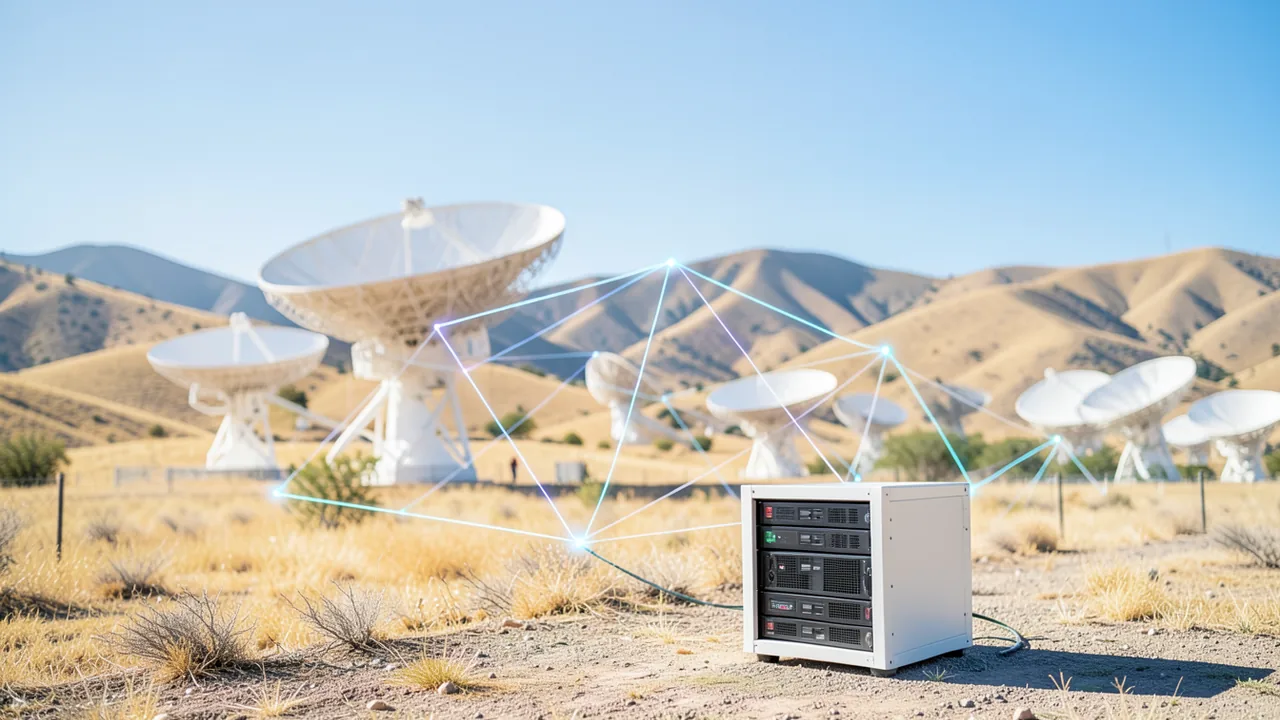
On October 30, 2026, Nvidia described how AI agents – software that uses tools to carry out tasks on its own – can help operate the Allen Telescope Array. Breakthrough Listen and the SETI Institute are involved. The array sits in Hat Creek in Northern California, consists of 42 antennas, and is used both for the search for extraterrestrial intelligence (SETI) and for other radio astronomy. The report from remio.ai stresses that the reported sky detection is a pulsar, a rotating stellar remnant with regular pulses, and not alien technology.
What Nvidia actually describes
According to Nvidia, researchers can request telescope pointing, data correction and model runs in natural language. The Holoscan platform carries the live processing pipeline, and a system called Nexus coordinates the state of the instrument and the computing hardware. Nvidia cites a throughput of 2.4 terabits per second on RTX PRO 6000 Blackwell GPUs. The test result it names is real-time AI detection of the pulsar in the Crab Nebula. That is an astronomical test, not evidence of an extraterrestrial transmission.
From classification to control
Earlier machine learning in SETI research had a narrower scope. In 2023, Peter Ma and colleagues used deep learning on observations of 820 stars and found eight "signals of interest" that were not confirmed as extraterrestrial. A classifier helps prioritize within existing data. An agent in operations, by contrast, influences which data is produced in the first place. Mistakes can therefore change the body of evidence available for later checks.
The article offers a comparison: the SETI Institute's COSMIC system at the Very Large Array, which collects data in parallel with other observations (commensal observing). That is not direct competition, it says, but a different approach.
Why verification remains crucial
The author recalls BLC1: a signal from the direction of Proxima Centauri initially looked worth investigating, but according to Berkeley it was traced to human-made interference. The pulsar test does not show that the setup reliably tells earthly interference from extraterrestrial technology. The public account also lacks a comprehensive comparison of how agent-based operation affects missed detections, false alarms and workload.
The text proposes benchmarks for checking the system. These are explicitly not results of the announcement: inject simulated signals with known properties, keep the raw measurements, log processing steps and versions, and distinguish between intended, attempted and instrument-confirmed actions.
Additional background
Tech Times reports on a separate study by Louisa Mason (University of Manchester) from the Royal Astronomical Society meeting. A first SETI search with the ALMA observatory at millimeter wavelengths found no signal. A new counting method suggested that a Breakthrough Listen survey probably covered around 6.1 million background stars rather than about 288,000. There is no link to the Nvidia announcement. A SkyMapper press release also describes a blockchain-based network for verifying telescope data, likewise unrelated to the Nvidia demo.
Our take
The news is the use of agents in a working scientific instrument, not a discovery. Whether voice control benefits science depends on whether actions stay traceable and measurements stay unaltered. Solid evidence is still missing; the figures on throughput and the pulsar come from Nvidia itself. What matters now: validation with test signals, operating logs and reproducible independent checks.
Sources
- Bing News (en-US) remio.ai
- seti.org seti.org
- techtimes.com techtimes.com
Ask the AI assistant
Questions about this article, installation or background? Our assistant knows this page and runs on our own machine, not in someone else's cloud.
The Assistant is an AI (Gemma 4) and can make mistakes – please check important details against the source. Questions are used only to generate an answer and are deleted after one hour. Please don't enter any personal data.


Comments
What do you think? Already tried it? Write it here, no sign-up needed.
Comments are public. Links aren't allowed, and we delete abusive posts. You can delete your own comment at any time in this browser. Learn more in the Privacy Policy.