
OlmoEarth v1.3: Open satellite embeddings for the whole planet
The Allen Institute for AI (Ai2) has released OlmoEarth v1.3, an open model that turns satellite data into compact feature vectors. It comes with precomputed embeddings for the entire Earth and a browser tool for exploring them, no sign-up required.
What this is about
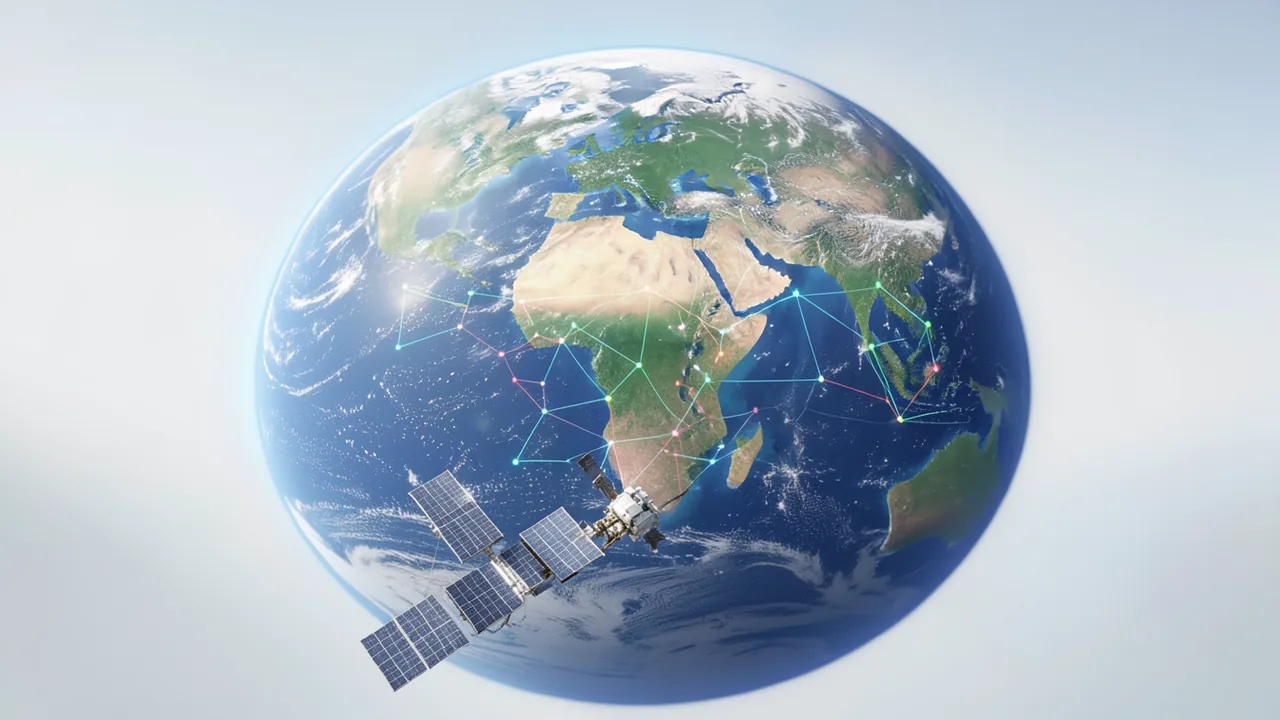
The Allen Institute for AI (Ai2) has released OlmoEarth v1.3, a satellite embedding model. An embedding is a compact sequence of numbers (a vector) that summarizes what a model has "learned" about a location. The release also includes precomputed yearly embeddings for the entire planet (10-meter resolution, in 64 and 128 dimensions) and the OlmoEarth Embeddings Explorer, a browser tool that needs no sign-up. The embeddings are hosted on Source Cooperative.
Why embeddings?
Until now, OlmoEarth was mostly used through fine-tuning in OlmoEarth Studio: you train a model for each task and run it over satellite imagery. That takes GPUs, plus downloading and storing the imagery. Embeddings, by contrast, are reusable. Once computed, a small classifier running locally on top of them is enough to produce crop maps, land cover or change detection.
OlmoEarth v1.3 reads a year of radar (Sentinel-1) and multispectral data (Sentinel-2, Landsat) and produces a 128-dimensional vector for every 10-meter pixel. Internally, a Vision Transformer reads the data, an attention pooler combines it per patch of land, and a linear layer reduces it to 128 numbers.
Results
Ai2 compared the model with AlphaEarth Foundations (AEF) and Tessera v2 across 27 evaluations on six continents. The 128-D embeddings perform best in 20 of 27, the 64-D variant in 18. New is PLANTEUR, a benchmark for crops in tropical agriculture; according to Ai2, the embeddings generalize best to unseen regions here. Examples include smallholder crops in Kenya, brick kilns near Dhaka, fire damage in Indonesia and gold mining in the Peruvian Amazon. The comparisons come from Ai2 itself.
v1.3 was the cheapest training run so far: 53% of the compute of v1.2 and 18% of v1, with 50% and 22% of the CO₂ emissions respectively. As a fine-tuning model, it matches v1.2. Pre-training the Base variant would cost about US$2,720 in rented H100 time.
Example: gold mining in Madre de Dios
In Peru's Madre de Dios region, illegal gold mining around La Pampa peaked in 2017 and 2018, clearing more than 1,200 hectares in the buffer zone of the Tambopata Reserve, according to MAAP. In February 2019, Operation Mercurio put an end to most of it. Comparing the per-pixel vectors between years, with no training at all, shows the spread to the southeast in 2017–2020. In 2020–2025 that area is quiet, but there is still change in the northwest and in the old mining zone (recovery, but also new digging). According to the Associated Press, Peru sent naval patrols back into the reserve in August 2026.
The Embeddings Explorer
The tool shows the embeddings as a false-color map. You can navigate, switch years, overlay Sentinel-2 imagery for comparison, search for similar places with a click, or place a few labeled points, train a small classifier and export the result as a GeoTIFF. A first run takes seconds instead of hours, with no GPU.
The archive is around 150 TB per year and covers land and near-coastal waters. 2023–2025 is available globally, 2017–2022 for selected countries. For every 20-km tile and year, provenance tables list the scenes used, with links.
Our take
Global, open embeddings significantly lower the barrier for environmental monitoring, agriculture and conservation, because teams don't need their own compute and storage infrastructure. Compared with AlphaEarth and Tessera, Ai2 stresses the openness of weights, data and code. Keep in mind: the benchmark comparisons come from the vendor, the license is the custom OlmoEarth Artifact License rather than a standard one like Apache 2.0, and time series before 2023 are only available for a few countries. Embeddings don't replace fine-tuning in every case, but they help you decide where it's worth the effort.
What you need to try it
You can use the Explorer in your browser with no account, GPU or installation. For your own classifiers on downloaded embeddings, a normal computer is enough. Note that the global archive is around 150 TB per year, so only download the sections you need. Generating your own embeddings requires GPU power; according to the source, a tutorial is available.
Sources
- Hugging Face Blog huggingface.co
- Google News (DE) news.google.com
Ask the AI assistant
Questions about this article, installation or background? Our assistant knows this page and runs on our own machine, not in someone else's cloud.
The Assistant is an AI (Gemma 4) and can make mistakes – please check important details against the source. Questions are used only to generate an answer and are deleted after one hour. Please don't enter any personal data.



Comments
What do you think? Already tried it? Write it here, no sign-up needed.
Comments are public. Links aren't allowed, and we delete abusive posts. You can delete your own comment at any time in this browser. Learn more in the Privacy Policy.