
One developer, a fleet of AI agents: free CAD app SolidCraft tops 1.5M downloads
In October 2026, US developer Brennen Herbruck started building an open-source 3D CAD program with Claude Code and Codex. Five weeks later it has 58 releases and around 1.5 million downloads on GitHub, and AI agents can design parts in it themselves. SolidCraft shows how much software one person can now ship with AI help.
What it's about
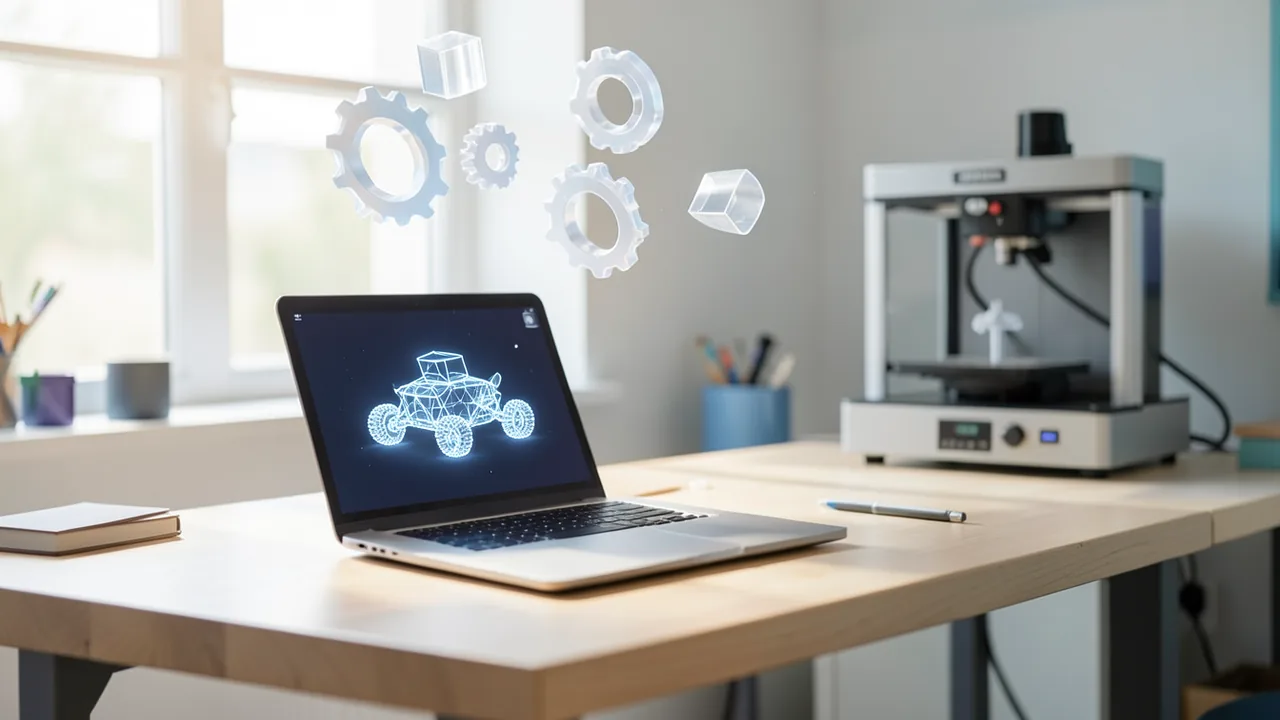
SolidCraft is a free, open-source program for 3D design. In other words, it's CAD software, the kind of tool used for 3D printing, mechanical engineering and product design. It was written by Brennen Herbruck from Michigan. He started on October 7, 2026, and published the first version, 0.1.0, on October 9. In an interview with the Japanese maker magazine FabScene, he said there had been 58 official releases by November 12, up to v0.41.0. That doesn't count the daily test builds (nightlies) or the release candidates. By November 13, the program had been downloaded around 1.5 million times via GitHub, and the repository has about 16,000 stars.
Prebuilt binaries are available for Windows, macOS, Linux and FreeBSD. You can also try SolidCraft in the browser without installing anything. The source code is available under your choice of the MIT or Apache 2.0 license. Both allow free use, including commercial use. The repository now belongs to an organization called Tangency Labs. Two things make the project stand out: Herbruck built it with heavy help from AI coding tools, and AI agents can design parts in it themselves.
What SolidCraft can do
SolidCraft is a parametric CAD program. You start by drawing a flat sketch, add dimensions and constraints (such as "these two lines are parallel") and then turn it into a solid. You might extrude it, pulling the face out into depth, or revolve it around an axis. Every step goes into a timeline. If you change a dimension later, the program automatically recalculates every step that follows. Commercial programs like Autodesk Fusion and SolidWorks work the same way.
According to 3D Printing Industry, the timeline offers extrude, revolve, sweep, loft, fillet and chamfer, shell, draft, holes, threads, patterns and mirror, among other features. There are also assemblies with joints, sheet metal parts and some of the features used for plastic enclosures. Since v0.14.0, 3Druck.com reports, SolidCraft has also added gears, racks, inverse kinematics and motion paths.
SolidCraft exports STEP AP242, IGES, 3MF, STL and OBJ, plus URDF for robot simulators. You can import STEP and IGES solids and use them as the basis for further steps. The desktop version can also read FreeCAD (.FCStd) and Rhino (.3dm) files. STL and 3MF files, by contrast, load as triangle meshes. A command called mesh.convert can turn simple, closed parts with a constant cross-section back into real parametric solids. A handy touch for 3D printing: if you specify a material like PETG, the app shows you the part's mass.
The project describes its own state as "early, but usable for simple parts." Of 76 public reference parts, 75 match theoretical values or values calculated in FreeCAD for volume, surface area, center of mass and bounding box. The project admits these tests don't prove full parity with other programs. Still missing are mesh modeling, T-splines, advanced freeform surfaces, PCB design, simulation, CAM (toolpath planning for CNC machines) and 2D drawings.
From Fusion clone to its own project
The program was originally called SolveCraft and was renamed in v0.6.0. The first README advertised a user experience modeled on Autodesk Fusion, and accuracy was measured against 76 parts created in Fusion. At the same time, a "clean room" rule applied: Fusion could only be observed from the outside. Autodesk icons, help text and Fusion files had no place in the repository. According to 3D Printing Industry, the AI agents are also barred from reading GPL-licensed code, including OpenCASCADE, FreeCAD and SolveSpace. The goal is to keep code under stricter licenses out of the project. The current README no longer puts the Fusion comparison front and center and stresses that SolidCraft isn't affiliated with any CAD vendor. Benchmarks now run against theoretical values and FreeCAD.
Key milestones, according to FabScene:
| Date | Version | What's new |
|---|---|---|
| Oct. 12 | v0.6.0 | Renamed from SolveCraft to SolidCraft |
| Oct. 14 | v0.10.0 | Surface tools, URDF export |
| Oct. 15 | v0.13.0 | In-app chat panel for AI agents |
| Oct. 16 | v0.14.0 | FreeCAD and Rhino import, gear and screw joints |
| Oct. 17 | v0.15.0 | New download location, repository moves to Tangency Labs |
| Nov. 11 | v0.40.0 | Geometry kernel replaced |
A new kernel after just one month
The kernel is the heart of any CAD software. It describes 3D shapes and computes operations like extruding, drilling or filleting edges. SolidCraft stores solids as B-rep (boundary representation): a solid is described by its faces, edges and vertices and how they connect. At first, the project used Truck, an open-source kernel written in Rust. Even the v0.14.0 release notes admitted that fillets and Boolean operations (adding solids together or subtracting one from another) were slow. The real fix, they said, would be a new kernel.
The switch began on October 21 and was completed with v0.40.0 on November 11. SolidCraft now runs on SolidCore, a Rust port of SMLib, a C++ geometry library NVIDIA released under Apache 2.0 as part of its USD BRep project. According to 3D Printing Industry, the port covers NURBS math (the way curved surfaces are described), B-rep topology, intersection calculations, Boolean operations, fillets, shelling, healing functions and mass properties. Results are said to match the C++ original to within a relative deviation of 1e-9, verified module by module. Herbruck puts it this way:
"Continuing to build around those limits seemed like more work than moving to a more solid foundation."
With everything now written in Rust, the desktop and browser versions are easier to build. The hardest part remains stabilization, Herbruck says: just because a feature exists doesn't mean it works reliably across the huge variety of designs real users create.
AI on both sides of the screen
The repository includes instruction files, CLAUDE.md and AGENTS.md, that tell AI agents how to work on the project. Herbruck uses tools from Anthropic and OpenAI for coding, debugging, testing and code review, and often runs several agents in parallel on different tasks. He says most of the contributions are still his own. There's no fixed split between him and the AI. According to 3D Printing Industry, the project bans crashes (panics) in production code, and every crash fix has to come with a regression test that will automatically catch the bug in the future. The roadmap reportedly estimated around 82 agent-hours to reach a usable alpha.
AI also plays a role in the finished program. SolidCraft includes an MCP server. MCP (Model Context Protocol) is an open standard Anthropic introduced in November 2024 that lets AI assistants operate external programs. Since v0.13.0, there's also a chat panel inside the app. From there, you can call agents such as Claude Code, Codex, Gemini CLI or OpenCode with your own login, and since v0.14.0, Grok as well. Herbruck's thinking behind it:
"Anything you built by hand, the AI should be able to keep working on, and anything the AI built, you should be able to edit yourself."
One example is the SELENE research rover by user 0xlillith. It consists of a chassis, wheels, solar panels and a camera mount, and was modeled entirely through the MCP server. Its timeline has 3,323 steps, every one of them individually editable, and according to 3D Printing Industry they all recompute without errors.
Around 200 pull requests a day
The community is growing fast. By November 13, 5,140 changes had been merged into the main branch, including 247 pull requests on November 10 alone and 202 on November 12. Around 410 author names appear in the commits. The AI code review service CodeRabbit helps triage submissions. Blacksmith provides the compute for CI, meaning the automated builds and tests that run on every change. Even so, Herbruck says he can barely keep up with reviews. The first outside translation arrived on October 11, in Japanese, followed by German a day later.
How the project will be organized is still undecided: as a community project, as a nonprofit foundation like Blender, or with a company behind it. SolidCraft is meant to stay open source. Herbruck says no commercial direction has been settled yet. What matters to him is that people control their own tools and aren't forced into cloud services.
The big picture
SolidCraft shows how much AI coding tools are changing what one person can build. A parametric CAD program with its own geometry kernel used to be considered a job for large teams working over many years. The project is interesting for Linux users who can't run Fusion and for makers who find FreeCAD too clunky. Open, permissively licensed kernels like NVIDIA's SMLib lower the barrier even further.
There are limits, though. The project calls itself "early" and has only just swapped out its foundation. What makes CAD software work in practice hasn't been proven yet: reliable Boolean operations on complex geometry and dependable exchange with commercial formats. As 3D Printing Industry puts it, the hurdle is shifting from the kernel to proving that it can produce genuinely manufacturable parts. It's also unclear whether a pace of around 200 merged changes a day can be sustained without quality slipping. The numbers aren't entirely consistent either: 3D Printing Industry cited around 2,900 stars at an earlier point. That's probably an older snapshot, but it shows how fast the project has grown. If you want to try SolidCraft for simple 3D printing parts, you can do so risk-free right in your browser. For serious design work, by the project's own admission, it's still too early.
Related videos
Sources
- Bing News (ja-JP) fabscene.com
- 3dprintingindustry.com 3dprintingindustry.com
- 3druck.com 3druck.com
Ask the AI assistant
Questions about this article, installation or background? Our assistant knows this page and runs on our own machine, not in someone else's cloud.
The Assistant is an AI (Gemma 4) and can make mistakes – please check important details against the source. Questions are used only to generate an answer and are deleted after one hour. Please don't enter any personal data.


Comments
What do you think? Already tried it? Write it here, no sign-up needed.
Comments are public. Links aren't allowed, and we delete abusive posts. You can delete your own comment at any time in this browser. Learn more in the Privacy Policy.