
One mirror is all it takes: robot AIs keep grabbing at reflections
Researchers at Peking University put five current robot controllers next to a mirror or on a reflective table. Four of them collapse, and one manages just 4.2 percent of its tasks on the mirrored table. The cause isn't a collision with the mirror. The robots reach for reflections and misjudge where real objects are.
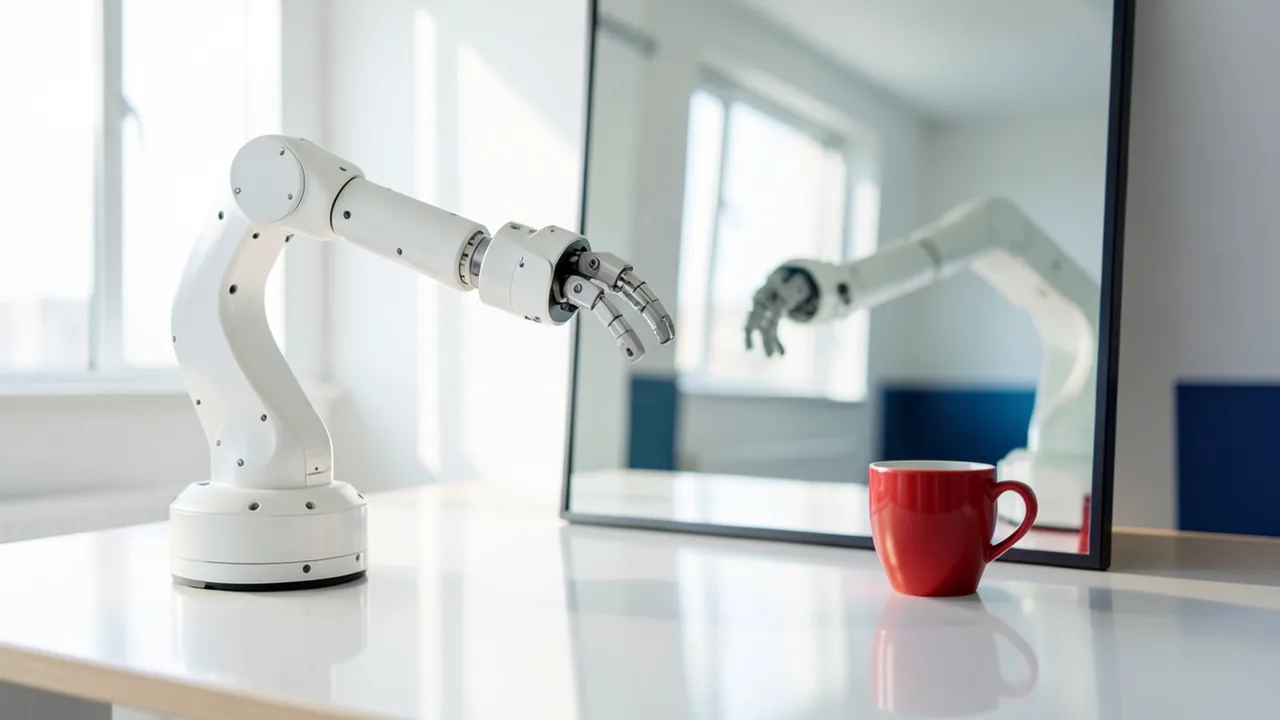
What this is about
Animal researchers use the mirror test: does an animal recognize itself in a mirror, or does it take the reflection for another member of its species? Chimpanzees pass. A team at Peking University has built a simpler version for robots. The question isn't whether a robot recognizes itself. It's just whether it can still grab a real cup when the cup's reflection is visible right next to it.
The paper "Embodied AI Fails the Mirror Test" (arXiv 2611.33010, submitted November 24, 2026) has a clear answer: four out of five current robot controllers collapse. It's not because they crash into the mirror. They apparently reach for things that aren't there. That's awkward timing in a week when XPENG is selling its IRON humanoid as a "qualified work partner." Below, we explain what happens in the experiments, why mirrors and glass have tripped up machines for years, and what the study doesn't show.
The setup: same tasks, plus a mirror
The benchmark is called RoboDojo-Mirror and builds on RoboDojo, a test environment for robot arms in Nvidia's Isaac Sim simulator. Tasks, starting configurations, success criteria and model versions stay the same. Only the scene changes:
- no mirror (baseline),
- one vertical mirror about 5 cm from the table,
- two mirrors at right angles to each other,
- a reflective tabletop.
There are eight tasks, including covering blocks, folding clothes, inserting tubes, stacking blocks or bowls, and pressing buttons in numbered order. The controllers come from three families. WALL-OSS is a VLA model (vision-language-action: a model that turns camera images and a text instruction directly into motor commands). VPP2 and Awomo-0.5 are world-action models. According to Nvidia, these models also learn to predict "how the world is likely to change." The paper doesn't assign Rex-M1 Preview to a category. OpenAI's GPT-6 Astra is an "agentic" controller: the language model reasons step by step and calls tools like "move gripper" or "give up," at most 100 times per episode. All models see only color images from head and wrist cameras. None of them get depth data.
The numbers, double-checked
| Controller | no mirror | 1 mirror | 2 mirrors | mirrored table | avg. loss (points) |
|---|---|---|---|---|---|
| WALL-OSS | 67.5 % | 21.7 % | 15.0 % | 25.0 % | 46.9 |
| VPP2 | 72.5 % | 33.3 % | 35.0 % | 27.5 % | 40.6 |
| Awomo-0.5 | 60.8 % | 15.8 % | 6.7 % | 10.0 % | 50.0 |
| Rex-M1 Preview | 66.7 % | 15.8 % | 10.0 % | 4.2 % | 56.7 |
| GPT-6 Astra | 65.0 % | 62.5 % | 52.5 % | 47.5 % | 10.8 |
We recalculated the averages from the individual values, and they check out. The biggest single drop is 62.5 points: Rex-M1 on the mirrored table. That leaves the model with about 6 percent of its original success rate. On several tasks, including tube insertion and button pressing, it fell to zero. VPP2 stacked every block successfully without a mirror and not a single one on the mirrored table.
The numbers are based on 15 trials per task and condition, so 120 per column. For cost reasons, GPT-6 Astra only ran 5 times per task, which makes 40 trials per column. Accordingly, the confidence interval for Astra's loss is wide: between 1.7 and 20 points. The authors also stress that the models had different compute and time budgets, so the table isn't a controlled leaderboard.
Not a collision, but a phantom
A mirror is also an obstacle. So do robots simply fail because they run into it? To check, the researchers placed identically shaped, non-reflective panels in the same spots for WALL-OSS and Awomo-0.5. With two mirrors, WALL-OSS failed in 25 cases only with the mirror and in 2 cases only with the panel. For Awomo-0.5, the count was 42 to 3. Between 50 and 87.5 percent of the mirror-induced failures happened without the robot touching the surface at all.
The motion data reveals two recurring patterns. In phantom targeting, the gripper heads for the reflected object instead of the real one. In mislocalization, the robot grabs just beside the real object. An extra test with VPP2 shows this most clearly: without a mirror, grasps succeeded 97.8 percent of the time; on the mirrored table, only 4.4 percent. In 95.6 percent of trials, the gripper closed on thin air and lifted nothing. The authors carefully describe the behavior as "consistent with" phantom targeting. They didn't look inside the models.
GPT-6 Astra presents a striking contrast: it touched the mirror more often than any other model, in 85 percent of two-mirror trials. Yet its success rate held up best. According to the paper, it repeatedly changed its path after contact, as if it were planning around the mirror as an obstacle. Astra isn't infallible, though. It never successfully inserted a tube under any condition. And in a test where the main camera was blocked and only the reflection showed the cups, it solved the task in at most one out of five cases.
Real robots fall for it too
Simulated mirrors could be artifacts. The GitHub README doesn't describe how the reflections are rendered and doesn't mention real-robot experiments. Those only appear in the paper's appendix. There, a Franka FR3 arm with two Intel RealSense cameras, depth channel switched off, worked on four tasks with 10 trials each:
| Controller | no mirror | upright mirror | mirrored table |
|---|---|---|---|
| π0.5 (VLA) | 77.5 % | 52.5 % | 27.5 % |
| FastWAM (world-action model) | 60.0 % | 30.0 % | 10.0 % |
In block stacking, both models hit 80 percent without a mirror and 0 percent on the mirrored table. The sample is small, but the trend matches the simulation.
Why mirrors and glass have bothered machines for years
The problem isn't new, just the place where it shows up. Depth sensors that measure distance with infrared light fail on smooth surfaces, according to a study on glass detection for drones (arXiv 2510.06518): the light bounces off without scattering and barely makes it back to the sensor. In the depth map, a pane of glass therefore looks like empty space. According to the Mirror3D dataset (CVPR 2021), mirrors are "a significant source of error" for depth sensors and 3D reconstruction: the sensor measures the reflected scene as if it lay behind the mirror. The Booster dataset (arXiv 2301.08245) was built specifically because depth networks struggle with reflective and transparent surfaces. A 2026 paper (arXiv 2604.18336, IROS) tries to repair corrupted glass measurements for robot navigation using depth AI.
Camera-only AI doesn't automatically solve this either. With the first Depth Pro, Apple itself wrote that the model is limited on translucent surfaces and with stray light, because a pixel's depth there is "ill-defined and ambiguous." A test by LearnOpenCV found that Depth Pro sometimes treats reflections of people as real people. The newly released Depth Pro 2 doesn't mention mirrors, glass or reflective surfaces in its Model Card, README, project page or technical report. Whether it does better is simply unknown.
Do big end-to-end models solve the problem?
The study doesn't suggest so. In simulation, VLA and world-action models performed similarly badly. On the real robot, the world-action model FastWAM actually lost proportionally more than π0.5. On the mirrored table, it kept a sixth of its baseline performance, π0.5 a little over a third. Our take: these models learn from camera images which pixel patterns go with which movement. A well-rendered reflection looks like a cup, and without an understanding of space and geometry, there's little reason to ignore it. A world-action model that predicts future video frames will, if anything, predict the reflection too. That's our hypothesis; the authors didn't test it.
The paper doesn't fully explain why Astra is more robust. It points to the agentic approach with explicit reasoning and tool calls. That fits with another paper (arXiv 2611.09892) finding that general-purpose AI models used agentically outperform specialized VLA and world-action models at manipulation. However, benchmarks like MirrorBench (arXiv 2604.14785) and "Mirror, Mirror on the Wall" (arXiv 2605.08816) show that even strong multimodal models lag well behind humans when dealing with reflections. Weaker models do look in the mirror, but misinterpret what they see. In RoboDojo-Mirror, a simple prompt hint ("Caution, mirror") brought no reliable improvement. The authors don't propose a solution.
The question for manufacturers
On November 25, XPENG presented IRON as a work partner: 170 cm tall, 62 kg, 76 degrees of freedom, more than 1,000 tests to automotive standards, and millions of stress tests for its mechanics and hands. Unite.AI's report says nothing about cameras, depth sensors or environmental conditions like glass and mirrors. The first deployments are customer guidance and tours, in other words showrooms, where shop windows, glass doors and chrome are everywhere. The day before, XPENG unveiled its WorldGPT world model, which is supposed to control six types of machines and, according to the company, achieves 95.2 percent success across 50 tasks for a robot arm. That announcement is silent on safety evaluation as well.
Other vendors look similar. For 1X NEO, we found information on padding, no-go zones and remote human supervision, but nothing about reflective surfaces. An industry report by humanoidintel.ai quotes an anonymous humanoid developer:
"The safety frameworks don't exist yet."
According to ISO, the ISO 25785-1 standard for industrial robots that must actively balance themselves is still a draft and doesn't cover the home.
Our assessment
RoboDojo-Mirror exposes an easy-to-miss weakness with very little effort: a single reflective surface is enough to push popular robot controllers from roughly two-thirds success to near zero. Code and setup are openly available under the MIT license at github.com/iPPLab/robodojo-mirror, and the results are on the project page. So other labs can verify them.
The authors name the limitations themselves: small samples in the extra tests, control panels for only two models and none for the mirrored table, different compute budgets, and only four tasks on the real robot. According to the README, it also hasn't been verified that everything runs on a fresh RoboDojo install. How realistically the mirrors are rendered remains an open question.
Our take: for robots meant to work in homes, shops and factories among glass doors, bathroom mirrors and stainless steel, this isn't an edge case. It's everyday life. It's a good sign that an agentic model loses far less. But for a coworker who grabs what it's supposed to grab, 47.5 percent success on a mirrored table isn't good enough. Manufacturers should disclose whether and how they test with reflective surfaces. The documentation we found says nothing about it.
Sources
- arXiv: Embodied AI Fails the Mirror Test (2611.33010) arxiv.org
- arXiv HTML-Volltext 2611.33010 arxiv.org
- Hugging Face Papers: 2611.33010 huggingface.co
- Projektseite RoboDojo-Mirror ipplab.github.io
- GitHub: iPPLab/robodojo-mirror github.com
- arXiv: RoboDojo-Benchmark (2607.04434) arxiv.org
- arXiv: On Agentic Manipulation Policies (2611.09892) arxiv.org
- OpenAI: GPT-6 Astra Modelldokumentation developers.openai.com
- Nvidia Glossar: World Action Model nvidia.com
- arXiv: Fast-WAM (2603.16666) arxiv.org
- arXiv: Mirror3D (2106.06629) arxiv.org
- arXiv: Booster-Datensatz (2301.08245) arxiv.org
- arXiv: Robotic Perception of Transparent Objects (2304.00157) arxiv.org
- arXiv: Glass Surface Reconstruction for Robot Navigation (2604.18336) arxiv.org
- arXiv: Real-Time Glass Detection onboard Aerial Robots (2510.06518) arxiv.org
- arXiv: Depth Pro (2410.02073) arxiv.org
- arXiv: Depth Pro 2 technischer Bericht (2611.26603) arxiv.org
- Hugging Face: apple/DepthPro2 huggingface.co
- GitHub: apple-aiml-research/ml-depth-pro-2 github.com
- LearnOpenCV: Depth Pro im Test learnopencv.com
- arXiv: MirrorBench (2604.14785) arxiv.org
- arXiv: Mirror, Mirror on the Wall (2605.08816) arxiv.org
- Unite.AI: XPENG IRON als Arbeitspartner unite.ai
- Unite.AI: XPENG WorldGPT unite.ai
- humanoidintel.ai: Housekeeping Humanoids – Safety Concerns humanoidintel.ai
- ISO: ISO/CD 25785-1 iso.org
- emergent.sh: Mirrors Drop Robot Policy Success Rates emergent.sh
Ask the AI assistant
Questions about this article, installation or background? Our assistant knows this page and runs on our own machine, not in someone else's cloud.
The Assistant is an AI (Gemma 4) and can make mistakes – please check important details against the source. Questions are used only to generate an answer and are deleted after one hour. Please don't enter any personal data.



Comments
What do you think? Already tried it? Write it here, no sign-up needed.
Comments are public. Links aren't allowed, and we delete abusive posts. You can delete your own comment at any time in this browser. Learn more in the Privacy Policy.