
Radical Numerics reports first use of AI-designed phages in a human patient
AI lab Radical Numerics says phages from its genome model Omnii-1 have been used in a patient for the first time under a compassionate-use pathway. Whether the treatment helped is unclear, since the company has not published a clinical course. The lab figures come from the company itself and have not been independently verified.
What this is about
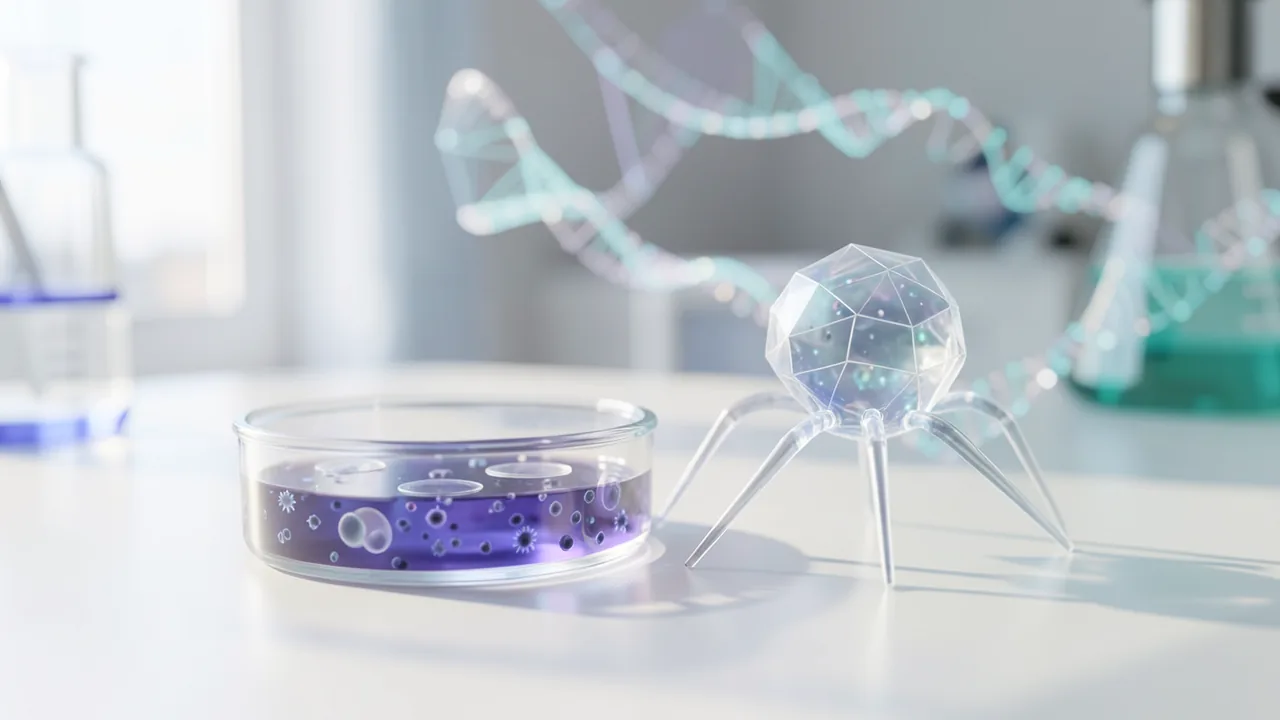
AI company Radical Numerics says in a blog post dated October 20, 2026 that AI-designed bacteriophages have been used in a human for the first time. These are designs from its model "Omnii-1." This is a research and single-case report from a company: not an approved product, not a clinical trial, not a treatment recommendation. It doesn't show that AI can cure resistant infections. All lab figures are vendor claims and have not been independently verified.
Bacteriophages (phages for short) are viruses that infect only bacteria. Lytic phages multiply inside the bacterial cell and make it burst. Because each phage recognizes only certain bacterial strains, it has to be chosen to match the patient's infection. That is where the AI comes in.
The patient case and what it doesn't prove
Radical Numerics writes that Omnii-1 designs were given to a patient under an "authorized, physician-led compassionate-use pathway." Compassionate use means giving an unapproved treatment to seriously ill patients who have no adequate alternative. This framework permits treatment under exceptional circumstances but does not produce controlled data.
Therapy starts with a sample of the bacteria causing the infection. In the lab (in vitro), the phages eliminated this antibiotic-resistant isolate, according to the company. Neither the company nor press coverage says which pathogen it was, and there is nothing on tolerability either. The company says it cannot disclose the clinical course in order to protect privacy. That is understandable, but it means there is no way to check whether the infection receded, whether side effects occurred or whether further treatment was needed. A lab result is no substitute for evidence of an effect in the body.
The company itself stresses that the therapies are not approved by regulators for broader use and that observations in one person cannot establish general safety or efficacy. The Register sums it up by saying people shouldn't push for results, and notes that Radical Numerics did not answer questions. The research description mentions tests on Pseudomonas aeruginosa without saying that the treated person had that infection. No connection is established.
How Omnii-1 designs phages
Omnii-1 is an AI model for genome sequences. It learns from large amounts of genetic data which changes are likely to produce which function (a related example from human genetics is AlphaGenome). The approach is modest: instead of designing an entirely new genome, it adapts selected regions, such as those that determine which bacteria a phage recognizes. The rest stays natural, which lowers the risk of non-functional designs.
The well-studied E. coli phage T7 (genome of about 40 kilobases) serves as the showcase. The lab results:
| Measurement (vendor figures) | Result |
|---|---|
| Recovery with 11–15 amino acid changes | 69.9% of AI designs vs. 4.8% random controls |
| Variants with measurable activity | 6,694, of which 2,161 better than wild type (up to 28 changes) |
| Top 100 candidates, two strains | 97 and 96 above the activity threshold |
| Third, harder strain | 4.5% of all variants, 24% of the top 100 above the threshold |
"Recovery" means that functional phages were actually obtained from the design. Amino acids are the building blocks of proteins. Random changes usually destroy function, targeted ones rarely do, and that gap is the main argument. The model enriches for usable candidates but doesn't always hit: even 24% means three quarters of the top candidates missed the threshold. Roughly one in three active variants outperformed the original, measured by lab activity, not treatment success.
Predicting which phage fits which bacterium
A personalized therapy needs the right phages. To test generalization, the company held back an entire E. coli clade (a group of related strains) of 37 strains from training. Against two specialized workflows, Omnii-1 achieved higher hit rates among its top five recommendations, according to the company, and covered 91.4% of "suitable" strains with just two phages. Suitable here means strains for which an effective phage exists in the dataset at all.
For Pseudomonas aeruginosa, adding E. coli data, without any additional P. aeruginosa measurements, raised average precision (a ranking metric: 1 would mean all correct hits are at the very top) from 0.570 to 0.608, beating GenoPHI (0.581). The 0.027 lead is small, and without any spread figures its significance is unclear. That knowledge from one bacterial species helps with another is methodologically interesting. These are in silico (computer-based) and in vitro tests, not patient data. In the body, dose, infection site, immune response and possible phage resistance decide the outcome.
Background: antibiotic resistance
Radical Numerics points to estimates that in 2021 around 4.7 million deaths worldwide were "associated" with antibiotic resistance (not always as the sole cause), and that between 2025 and 2050 nearly 40 million deaths will be attributable to it. Both are model projections. Phages are seen as an option because they work differently from antibiotics: a resistance gene doesn't automatically protect against a phage. The catch is specificity, which is why researchers want a model that can quickly suggest suitable candidates. The post doesn't show whether this reduces effort, and there are no figures on time or cost.
Our take
This is an announcement with company lab figures, nothing more. The blog post is neither peer-reviewed nor labeled as a preprint, the clinical course is secret, and the company isn't answering press inquiries. The field would only become solid through published data with clinical outcomes and studies with multiple patients, defined endpoints and comparison groups. Only then could anyone judge whether AI-designed phages are safe and outperform natural phages or existing therapies. As the first documented use, though, it's a reason to ask exactly those questions.
Sources
- Bing News (de-DE) digital-magazin.de
Ask the AI assistant
Questions about this article, installation or background? Our assistant knows this page and runs on our own machine, not in someone else's cloud.
The Assistant is an AI (Gemma 4) and can make mistakes – please check important details against the source. Questions are used only to generate an answer and are deleted after one hour. Please don't enter any personal data.


Comments
What do you think? Already tried it? Write it here, no sign-up needed.
Comments are public. Links aren't allowed, and we delete abusive posts. You can delete your own comment at any time in this browser. Learn more in the Privacy Policy.