
RAM Prices Up 5x: Is Local AI Still Worth It? Four Setups Run Through the Numbers
In Germany, RAM costs almost five times what it did a year ago, and graphics cards up to three times as much. If you run AI models at home, that hits especially hard. At the same time, new software tricks like the freshly merged MoE cache in llama.cpp squeeze much more out of the cards you already have. We ran the numbers on four typical setups using German prices and real benchmark results.
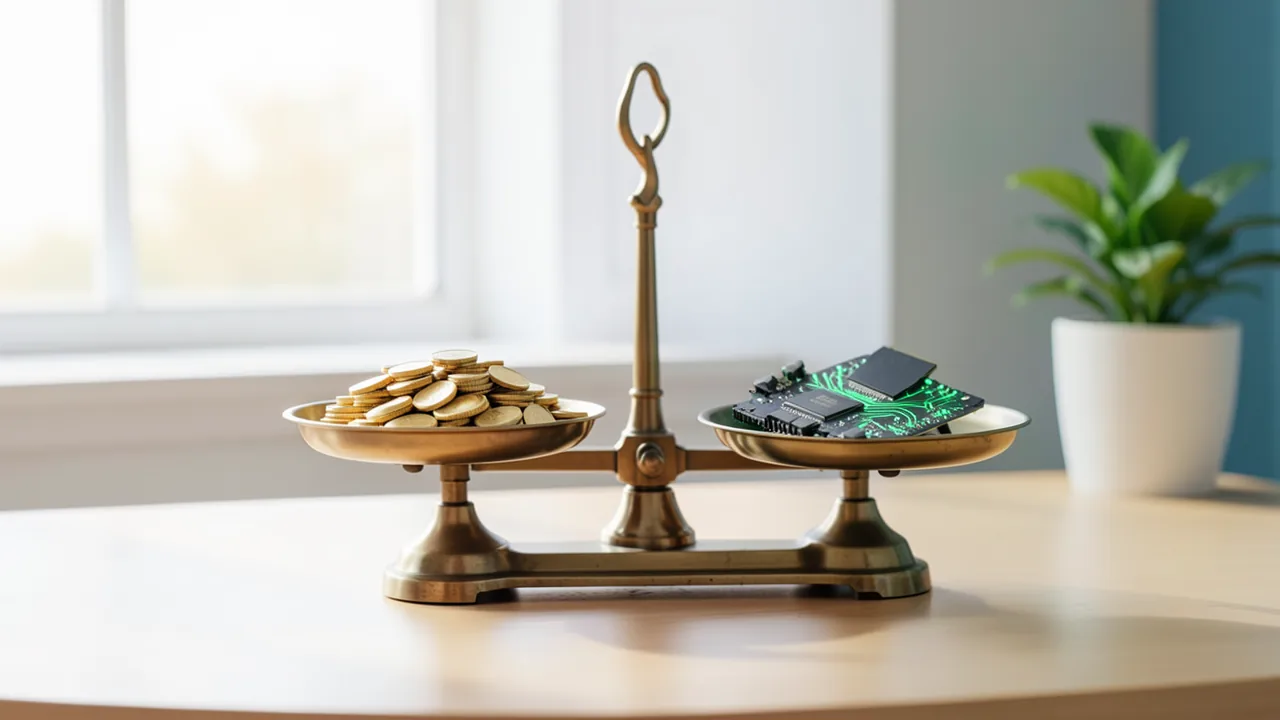
What this is about
Coverage of the memory crisis usually focuses on people who want to buy a laptop or a phone. If you run AI models on your own machine, it hits you harder. The component that's gone up the most is plain old system memory (RAM), which is exactly where you offload large mixture-of-experts models (MoE). These models only consult a small fraction of their "experts" for each word, so they cope well with keeping those experts in slower RAM instead of on the graphics card. At the same time, the open-source community has shipped software over the past few weeks that gets noticeably more out of existing hardware.
Our thesis, just ahead of Black Friday: right now, software savvy gets you further than buying hardware. To test it, we compiled German price histories, benchmarks from GitHub and community tests, and API prices, and ran the numbers on four typical setups. We didn't measure anything ourselves. All speeds come from the sources cited.
Prices: RAM up fivefold
The market data from the past few days is unambiguous. According to Counterpoint Research, global DRAM revenue rose 369 percent to almost $200 billion in Q3 2026. Bit shipments grew only about 4 percent, so the increase comes almost entirely from price. As analyst Jeongku Choi puts it:
"Buyers are now competing for supply rather than negotiating on price."
Counterpoint expects prices to stay high through 2027. Major new fabs won't deliver until 2028. According to PCWorld, SK Hynix expects demand to outstrip production until 2030 and has already committed more than half of its 2027 and 2028 output under long-term contracts. TrendForce expects contract prices to rise another 10 to 15 percent in Q4. According to a dpa report from November 8, citing NIQ figures, graphics cards cost almost twice as much in September as a year earlier, and desktop PCs 41 percent more. Sony CEO Hiroki Totoki hinted that the PlayStation 6 might not arrive until 2028 because of the memory shortage.
In the US, the cheapest 32 GB DDR5-6000 kit cost $59 in April 2025, according to Capital and Compute. On November 3, 2026, it was $429, more than seven times as much. For Germany, we use 3DCenter's memory crisis index, which tracks the cheapest available offer on Geizhals each month. We back-calculated the October 2025 values from the year-over-year increase it reports.
| Component | about a year ago | today | Factor |
|---|---|---|---|
| DDR5-6000, 2×16 GB | approx. €95 (Oct. 2025) | €447 (Oct. 17, 2026) | ×4.7 |
| DDR5-6000, 2×32 GB | approx. €191 (Oct. 2025) | €960 (Oct. 2026) | ×5.0 |
| DDR4-3200, 2×16 GB | approx. €82 (Oct. 2025) | €239 (Oct. 2026) | ×2.9 |
| RTX 5090 | approx. €2,450 (Oct. 2025) | €6,790 (Oct. 2026) | ×2.8 |
| RTX 5060 Ti 16 GB | €420 (Black Friday 2025) | €799 (Geizhals, Nov. 7, 2026) | ×1.9 |
| RTX 3090 used | previously mostly $600–800 | approx. €1,260 or $1,511 (eBay sales) | approx. ×2 |
| Mac Studio, Max chip, 128 GB | €4,374 (M4 Max) | €5,859 (M5 Max) | ×1.3 |
Specific 32 GB kits from Corsair and Kingston were listed on Geizhals at €565 to €620 in early November, even above the 3DCenter figure. One thing that surprised us: Apple's soldered memory has gone up far less than standalone RAM sticks. The Macs still aren't cheap, though. According to ComputerBase, going from 96 to 256 GB on the Mac Studio now costs €4,400 instead of €2,000.
What software has changed in the past few weeks
On November 7, the MoE cache was merged into llama.cpp, the backbone of most local language model setups (pull request #30966 by developer am17an). Until now, offloading worked like this: the experts sit in RAM and get sent to the graphics card over PCIe, the slot connecting the card to the motherboard, whenever they're needed. The cache now keeps the most frequently used experts permanently in VRAM (--moe-cache-mib). When an expert isn't in the cache, some of those cases can be computed directly on the CPU instead of uploading it first (--moe-cache-cpu-share). A tuning script starts the server six times, benchmarks for a few minutes and then suggests suitable settings.
User benchmarks from the pull request:
| Graphics card | Model | without cache | with cache, measured | script's prediction |
|---|---|---|---|---|
| RTX 3070 8 GB | Cyber-Tiel-Coder-35B-A3B, Q4_K_S | approx. 35 t/s | 62.4 t/s | 61.1 t/s |
| RTX 2080 Ti 11 GB | Qwen3.6-35B-A3B, Q6_K_XL | 42.1 t/s | 64.5 t/s | 66.7 t/s |
| RTX 5060 Ti 16 GB | Qwen3.6-35B-A3B, Q6_K_XL | 44.2 t/s | 61.1 t/s | 73.7 t/s |
| RTX 3090 24 GB, 96 GB RAM | Qwen3.8-Flash-Next, IQ4_XS | 19.5 t/s* | 32.4–35.9 t/s | 36.1 t/s |
*For the 3090, the baseline is a small cache with no CPU share. t/s stands for tokens per second.
You have to read these numbers carefully. According to the tester, the system behind the 2080 Ti and 5060 Ti results has RAM with 136 GB/s of bandwidth, far more than a typical dual-channel DDR5 system. For the 5060 Ti, the script's prediction was well above the measured result. A Lemmy user with a Ryzen 2600, 32 GB of DDR4 and an 8 GB RTX 2080 says his everyday numbers come in about 20 percent below the prediction, but he's still seeing "the fastest numbers I've ever seen in llama.cpp on my machine." There are setbacks too. One tester found CPU offloading mostly slower on his system and hit 45 t/s with manual tuning. With the Vulkan backend, one user got garbled output, and with a vision module loaded, the script overestimated available VRAM. According to the documentation, the CPU share only helps if the experts are locked in RAM (for example with -lm mlock). So the model really has to fit in system memory.
The second lever is quantization: you shrink a model by storing its numbers at lower precision. PrismML's Bonsai 27B stores just one bit per weight, bringing it down to 3.9 GB. The company says it retains about 89.5 percent of Qwen3.6-27B's performance, but on tool calling it scores only 66 instead of 80 points. The ternary variant Ternary Bonsai 2 27B, where each weight can only be −1, 0 or +1, weighs in at 5.95 to 7.21 GB. It does, however, require PrismML's own build of llama.cpp. According to OrcaRouter, an older format produces fluent-sounding nonsense on standard llama.cpp. Unsloth claims its new "Dynamic V3.1" files for Qwen3.8-Flash-Next use 50 percent fewer thinking tokens and are 15 percent more accurate than quantizations of the same size. Those are vendor claims. And the smallest file is still 72.5 GB.
Four setups, by the numbers
For pricing, we only counted the AI-relevant parts: the graphics card and RAM, or the whole Mac. Case, motherboard and CPU aren't included.
| Setup | Price today | What runs and how fast | Euros per token/s |
|---|---|---|---|
| Used RTX 3090 + 64 GB DDR5 | approx. €1,260 + €960 = €2,220 | Qwen3.6-35B-A3B Q4 fully in VRAM: 157 t/s at short context, 80–101 t/s at 64K; dense 27B model Q4: approx. 33–41 t/s | approx. €14 (without buying RAM approx. €8) |
| RTX 5060 Ti 16 GB + 32 GB DDR5 | approx. €799 + €447 = €1,246 (a year ago approx. €515) | 35B-A3B with MoE cache approx. 60 t/s, without 44 t/s; Bonsai 27B fits entirely in VRAM | approx. €20 (a year ago approx. €12) |
| Mac Studio M5 Max 128 GB | €5,859 | Qwen3.8-Flash-Next (125B): 46–59 t/s in community benchmarks | approx. €100–127 |
| CPU-only machine (already owned) | €0 (adding 32 GB DDR4: €239) | 35B-A3B: approx. 22–26 t/s (estimates and uncontrolled runs); Bonsai 27B on Ryzen 5 5600: 6.7 t/s | – |
A few notes. The 157 t/s figure for the 3090 comes from InsiderLLM (llama-bench, short context). At 64K context, the same source reports 80 to 101 t/s. The dense 27B numbers come from Hardware-Corner and community reports on the previous generation. Our take: for the 35B-A3B class, the 3090 doesn't need the expensive 64 GB at all. And for Qwen3.8-Flash-Next, 64 GB isn't enough: the IQ4 file is 93.7 GB, and the 3090 tester in the pull request used 96 GB of RAM.
For the Mac mini with M5 Pro and 64 GB (€3,099), PrismML cites 44.2 t/s for Bonsai 27B. That's a vendor figure. For CPU-only operation, we did a back-of-the-envelope calculation: dual-channel DDR5-6000 delivers a theoretical 96 GB/s. A model with 3 billion active parameters at about 4.5 bits reads roughly 1.7 GB per token. That gives a theoretical ceiling of just under 60 t/s, and in practice you typically get about half. That matches the 22 to 26 t/s cited.
The math against the cloud
According to several price comparisons, Qwen3.6-35B-A3B costs about $0.15 per million input tokens and $1.00 per million output tokens on OpenRouter. Qwen3.8 Flash, the hosted version of Flash-Next, costs $0.15 and $0.47 respectively. DeepSeek V4.1 Flash costs $0.30 and $1.20 directly from the provider at peak times, and half that at night.
Our example calculation for the 5060 Ti setup: at 60 t/s, a million output tokens takes a little over 4.5 hours. Assuming 250 watts and 35 cents per kilowatt-hour, the electricity costs about 40 cents. Compared with the API, you save roughly 60 cents per million tokens (we're ignoring the exchange rate for this ballpark figure). To recoup €1,246, the card would have to generate around two billion tokens. That's more than a year of running around the clock. If you generate 100,000 tokens a day, the API costs you about three dollars a month. For the Mac Studio versus Flash-Next at $0.47, the math looks even worse.
Is it worth waiting?
None of the forecasts sees real relief before 2028. That's why the OpenClawDC blog advises tinkerers to shift their budget from RAM to VRAM, because offloading is no longer cheap at around $17 per GB:
"The cheap-RAM strategy was cheap. It isn't anymore."
The problem: graphics cards have also doubled or tripled in price. Soldered memory like Apple's has gone up the least in relative terms, but you can't upgrade it later.
Our verdict
The thesis holds, but only for one group. If you already own a card with 8 to 16 GB and 32 GB of RAM, update llama.cpp, run the tuning script and use a 35B-A3B model in Q4. According to the benchmarks, you can then get 50 to 60 t/s instead of 35 to 44. You've never gotten this much free performance from an upgrade. Buying more RAM to offload bigger models, on the other hand, is about the most expensive decision you can make right now. If you're buying new, you get less per token/s than a year ago despite better software (about €20 instead of €12 for the entry-level setup). On cost alone, the cloud clearly beats any newly purchased setup. Buying only makes sense if privacy, offline use or unlimited experimentation are worth the premium to you. In that case, a used 3090 or a 5060 Ti offers better price-to-speed than a Mac, which only pays off for models with more than 100 billion parameters.
Several questions remain open. The MoE cache is two days old, the benchmarks come from a handful of users, often with above-average RAM speeds, and there are bugs under Vulkan. The quality claims for Bonsai and Unsloth Dynamic V3.1 come from the vendors and haven't been independently verified yet.
Sources
- GitHub: llama.cpp PR #30966 (MoE-Cache) github.com
- llama.cpp-Dokumentation: moe-cache.md github.com
- Lemmy LocalLLaMA: Erfahrungsbericht MoE-Cache mit 8 GB VRAM sh.itjust.works
- Dataconomy: DRAM-Umsatz +369 % (Counterpoint) dataconomy.com
- 3DCenter: Speicherkrise-Preisindex Oktober 2026 3dcenter.org
- PCGH: Speicherkrise – RAM kostet das Fünffache pcgameshardware.de
- Geizhals: Corsair Vengeance DDR5-6000 32-GB-Kit geizhals.de
- Elitegear: RTX 5060 Ti 16 GB Preisverlauf elitegear.io
- Capital and Compute: RAM-Preisverlauf 2025–2026 capitalandcompute.net
- Yahoo Nachrichten (dpa): Preisschock zu Weihnachten de.nachrichten.yahoo.com
- Headtopics: PlayStation 6 verschiebt sich auf 2028 us.headtopics.com
- PCWorld: SK Hynix erwartet Speicherknappheit bis 2030 pcworld.com
- ComputerBase: Apple zieht Preis des Mac mini um 50 Prozent an computerbase.de
- pcprice.watch: RTX 3090 Gebrauchtpreise pcprice.watch
- InsiderLLM: Qwen 3.6 35B MoE lokal betreiben insiderllm.com
- Hardware-Corner: RTX 3090 LLM-Benchmarks hardware-corner.net
- XDA: 35B-Modell auf 8-GB-Laptop-GPU mit --n-cpu-moe xda-developers.com
- llmcheck: Qwen3.8-Flash-Next auf M5 Max llmcheck.net
- Unsloth: Qwen3.8-Next Anleitung unsloth.ai
- Hugging Face: Daniel Han zu Unsloth Dynamic V3.1 huggingface.co
- Hugging Face: prism-ml/Ternary-Bonsai-2-27B-gguf huggingface.co
- MakeUseOf: 27B-Modell auf 4 GB VRAM (Bonsai 27B) makeuseof.com
- OpenRouter: Qwen3.8 Flash Preise openrouter.ai
- BenchLM: DeepSeek API-Preise November 2026 benchlm.ai
- OpenClawDC: RAM-Preise für lokale KI openclawdc.com
- SpecPicks: Local-LLM-PC mit 16-GB-Karte specpicks.com
Ask the AI assistant
Questions about this article, installation or background? Our assistant knows this page and runs on our own machine, not in someone else's cloud.
The Assistant is an AI (Gemma 4) and can make mistakes – please check important details against the source. Questions are used only to generate an answer and are deleted after one hour. Please don't enter any personal data.



Comments
What do you think? Already tried it? Write it here, no sign-up needed.
Comments are public. Links aren't allowed, and we delete abusive posts. You can delete your own comment at any time in this browser. Learn more in the Privacy Policy.