
Silent speech: What earbuds, cameras and electrodes can actually do today
OpenAI has filed a patent for earbuds that read silently mouthed words from inside your ear canal. Apple paid up to $2 billion for a startup that scans skin movements on your face with light. We explain the three sensing approaches and line up the published accuracy figures. With a handful of fixed commands, silent speech already works fairly well. With free-form speech and in everyday use, it doesn't yet.
What this is about
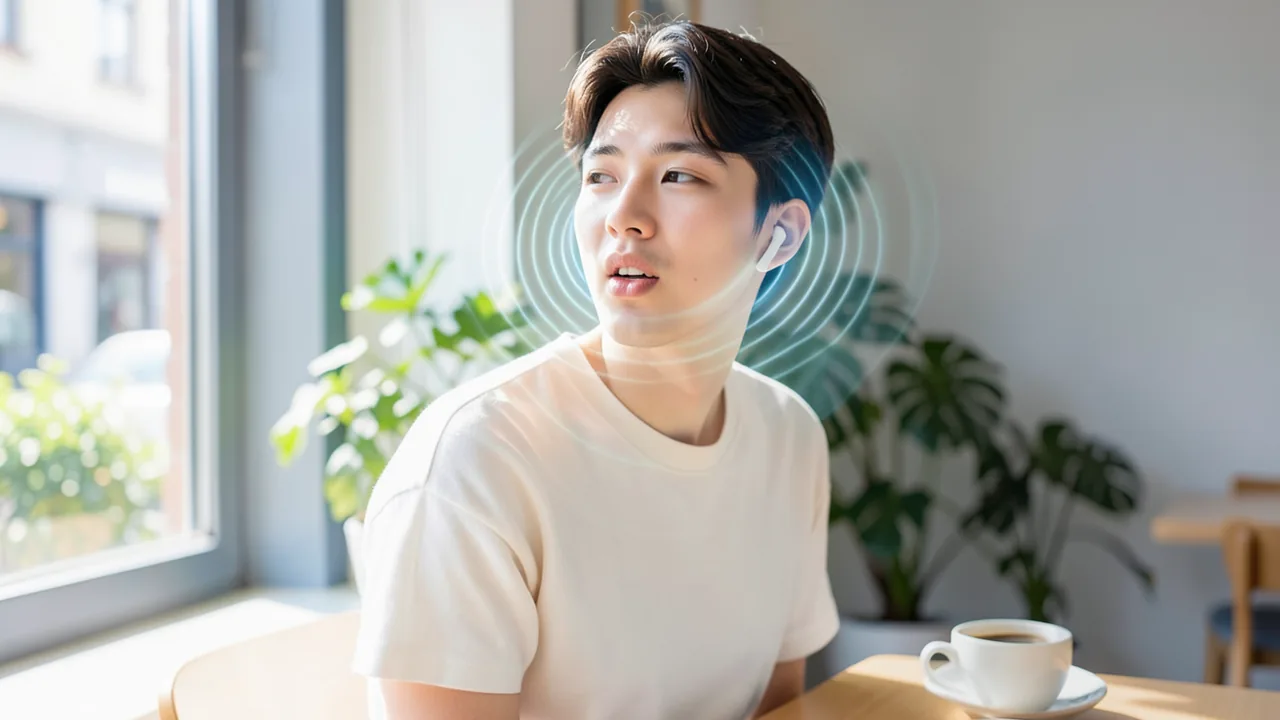
Voice assistants have a problem anyone who has ridden a bus or worked in an open-plan office knows: you have to talk to them out loud. That's why several companies are working on "silent speech." You form words with your mouth and jaw without making a sound, and a sensor turns the movement into text. The technical term is a silent speech interface.
Three pieces of news pushed the topic to the front this year. On November 19, 2026, an OpenAI patent application was published describing earbuds that read silent words from the ear canal. Back in January, Apple bought the startup Q.ai, which captures skin movements using light. And Boston startup AlterEgo measures signals at the jaw and throat. On top of that came a week in which Neuralink made headlines with a patient playing GTA 6 through a brain implant.
We explain the three sensing approaches and how they differ from implants. Then we line up the published numbers side by side. Our thesis: with a few fixed commands, silent speech already works decently in the lab. With open vocabulary and in real everyday life, where you put the device back on every day, recognition collapses. And for the announced products, there isn't a single independent measurement so far.
Approach 1: The ear canal moves with you
The ear canal sits right next to the jaw joint. When you move your jaw while speaking silently, the ear canal changes shape slightly, and a little differently for each word. That's the idea behind OpenAI's application US 2026/0369273 A1. OpenAI OpCo filed it on May 14, 2026; the provisional application dates from May 14, 2025. According to PPC Land, the named inventors are Douglas Stuart Brodie and Daniel Boothe.
The 20 claims describe two approaches: - Claim 1: Motion sensors such as an accelerometer and gyroscope capture movement in the ear canal, roughly 100 to 1,000 times per second. Your phone has the same kind of sensors, which is how it knows when you rotate it. - Claim 10: A compliant earbud tip rests against the wall of the ear canal. A strain gauge (a sensor that converts tiny deformations into electrical signals) measures how the shape changes.
The dependent claims add a bone-conduction microphone, whispering below about 30 decibels, and a machine learning model trained on the user's own silently spoken words. In other words: each user will probably have to train the system on themselves first. Large language models and agents only show up in the description, not in the claims. They're supposed to draft messages, add calendar entries, query databases, or place a call when you say "call XYZ." According to tbreak, the application contains no figures on accuracy, latency or battery life. OpenAI hasn't announced a product, and an application isn't a granted patent.
The University at Buffalo already showed in 2022 with EarCommand that the principle basically works. There, an inward-facing speaker sends inaudible near-ultrasound into the ear canal and a microphone picks up the echo, a bit like sonar. According to the paper, the word error rate across 12 test subjects was 10.02 percent for 32 single commands and 12.33 percent for 25 sentences. According to New Atlas, the system also worked with a face mask and in noisy environments.
Approach 2: Light reads your skin
Q.ai, based in Ramat Gan, was founded in 2022 and, according to Ynet, had about 100 employees and no product yet. Co-founder Aviad Maizels previously founded PrimeSense, whose technology Apple acquired in 2013 and which became the foundation of Face ID. Apple didn't disclose the price. Reports based on Reuters put it at $1.6 billion; the Financial Times, per 9to5Mac, at just under $2 billion. That would make it Apple's second-largest acquisition after Beats.
How the technology works is laid out in patents such as US 11,922,946, granted in 2024. A source of coherent light, i.e. laser light, illuminates several spots on the cheek. The skin reflects back a grainy light pattern, known as a speckle pattern. Even the tiniest skin movements change it. The sensor doesn't touch the skin and sits at least 5 millimeters away; in active mode it captures 100 to 200 frames per second. One of the patents describes a clip on a pair of headphones as a possible form factor. According to FourWeekMBA, an Apple application (US 2026/0369274 A1) was published the same day as OpenAI's, for a head-worn device that reads micro-movements of facial skin via light reflections. We weren't able to review the full text. The Q.ai patents don't include any measured results.
Approach 3: Muscle signals at the jaw and throat
The third approach relies on electromyography (EMG). Electrodes on the skin measure the faint electrical signals that nerves use to drive the speech muscles. AlterEgo came out of the MIT Media Lab in 2018. Of 16 electrode positions, seven turned out to be informative; later, four on one side of the jaw were reportedly enough. In a user study with 10 people, the system averaged 92 percent accuracy. But the vocabulary per application was only about 20 words, such as digits and arithmetic operators, or chess moves. Each participant had to calibrate the system to themselves for about 15 minutes beforehand. The startup unveiled a device in September 2025. To this day, alterego.io only shows a "pre-production prototype" with no price, release date or performance data.
How this differs from implants: All three approaches measure movements or muscle signals outside the head. If you only "think" words internally without moving your jaw and lips, none of them will pick it up. Brain implants like Neuralink's, or those in the Stanford and UC Davis studies, tap signals directly from the cerebral cortex. That requires surgery, and so far they're only used in people with paralysis.
The numbers side by side
| System | Sensing approach | Vocabulary | Subjects | Result |
|---|---|---|---|---|
| AlterEgo (MIT, 2018) | EMG jaw/face | approx. 20 words | 10 | 92% accuracy |
| EarCommand (2022) | Ultrasound in the ear canal | 32 commands / 25 sentences | 12 | 10.0% / 12.3% word error |
| SilentWear (ETH Zurich et al., 2026) | EMG textile neckband | 8 commands + rest | 4 | 77.5% (cross-validation), 59.3% on a new day |
| AESSI (preprint, Sept. 2026) | Electrical signals around the ear | 25 Mandarin sentences | 24 | 92.2% without recalibration, 98% online after 21+ days |
| Gaddy & Klein (2021) | EMG face | open | – | 42.2% word error |
| MONA LISA (2024) | EMG face + language model | open | – | 12.2% word error |
| Stanford implant (2023) | Cerebral cortex | 125,000 words | 1 | 23.8% word error, 62 words/min |
| UC Davis implant (2024) | Cerebral cortex | 125,000 words | 1 | 90.2%, later 97.5% |
| OpenAI, Apple/Q.ai, AlterEgo product | – | – | – | no data |
The thesis about lab success with fixed commands only partly holds up. Most systems land closer to 90 percent than above 95. The most revealing is the SilentWear study from Zurich, Turin and Bologna, published in March 2026. Its cross-validation (the model is trained on part of the recordings and tested on the rest, all from the same sessions) came out at 77.5 percent. When the neckband was put back on on a new day, that dropped to 59.3 percent, with just eight commands like "up," "down" or "stop." The authors attribute this to the fit and position of the electrodes. Less than ten minutes of fresh training data brought recognition back up to about 72 percent.
There is a counterexample, though. The Chinese AESSI preprint from September 2026 reports 92.2 percent accuracy across several days without recalibration, and 98 percent in 250 online tests with five people, at least 21 days after the last recording. But that involved 25 fixed sentences, and the work hasn't been peer-reviewed yet.
With open vocabulary, the gap is wider. Gaddy and Klein reached a 42.2 percent word error rate with EMG in 2021. In 2024, MONA LISA pushed that down to 12.2 percent with the help of a language model. The authors call it the first non-invasive result below 15 percent on open vocabulary. For comparison: at a 12 percent word error rate, statistically about one word in a ten-word sentence is wrong. Implants now exceed 90 percent on 125,000 words. But even there, the 2025 Stanford study decoded free inner speech with only up to 74 percent accuracy.
What else the sensors give away
A sensor that measures all day in your ear or on your face captures more than words. OpenAI's application lists further possible sensors in its description: EMG, heart rate, oxygen saturation, temperature and hydration. A Q.ai application cited by Reuters describes using skin micro-movements to identify a person and to estimate emotions, pulse and breathing rate. Privacy Guides calls the emotion detection "concerning." Whether Apple would process the data on-device or in the cloud is unknown. According to tbreak, OpenAI's application also says nothing about where data is processed, consent or retention. Reaction on Hacker News to the Q.ai deal was mixed accordingly. One user found the technology "pretty privacy-invasive" if it ever made its way into glasses worn in public. Others doubted that whispering can be reliably detected.
Legally, a lot is unresolved. The GDPR doesn't explicitly list neural or muscle data as a special category of protected data. The UK's data protection authority, the ICO, writes that such data becomes health data when used for medical purposes, and biometric data when it's meant to uniquely identify a person. The ICO considers emotion analysis particularly risky because the science behind it is "highly contested." The EU AI Act is clearer: it bans AI that infers emotions from biometric data in the workplace or in educational institutions, with exceptions for medical and safety purposes. Outside those areas, emotion recognition counts as a high-risk application. In the US, California and Colorado also count data from the peripheral nervous system, such as muscle signals, as "neural data."
Our take
Silent speech is no longer science fiction. For a small set of commands like "pause," "louder" or "call Mom," several independent research groups show results around 90 percent. That could be enough for earbuds if the system asks for confirmation when it's unsure. Our assessment: freely dictating silent emails, as OpenAI's agent examples suggest, is still a long way off with non-invasive sensors. The best open-vocabulary results come from a handful of datasets under lab conditions. And even with eight commands, putting the device back on costs almost 20 percentage points.
OpenAI, Apple and AlterEgo haven't published any verifiable figures for their own devices. Patents describe what a company wants to protect, not what works. If you ever buy one of these devices, ask two questions above all: How well does recognition work on day two? And what else is the sensor measuring on the side?
Sources
- PPC Land: OpenAI patent describes earbuds that read silently mouthed words ppc.land
- tbreak: OpenAI patent describes earbuds that read words you don't say aloud tbreak.com
- FourWeekMBA: OpenAI and Apple Patent Wearables That Read Silent Words fourweekmba.com
- UploadVR: Apple Acquired Silent Speech Startup Q.ai uploadvr.com
- Ynetnews: Why Apple paid $1.5 billion for a secret Israeli startup ynetnews.com
- 9to5Mac: Apple's new acquisition could solve my biggest AI problem 9to5mac.com
- Implicator: Apple pays $2 billion to read your face implicator.ai
- Privacy Guides: Apple Acquires Q.ai Startup for Silent Voice Input privacyguides.org
- Google Patents: US11922946B2 – Speech transcription from facial skin movements patents.google.com
- New Atlas: EarCommand tech lets users silently mouth commands newatlas.com
- arXiv: A Survey of Earable Technology (EarCommand-Werte) arxiv.org
- MIT News: Computer system transcribes words users speak silently (2018) news.mit.edu
- MIT Media Lab / Axios: Startup lets you query AI with silent speech media.mit.edu
- Decrypt: 'Near Telepathic' Wearable Lets You Communicate Silently decrypt.co
- AlterEgo: Produktseite alterego.io
- arXiv: SilentWear – EMG-based Silent Speech Recognition (2603.02847) arxiv.org
- arXiv: AESSI – Around-Ear Silent Speech Interface (2609.21436) arxiv.org
- arXiv: Gaddy & Klein 2020 – Digital Voicing of Silent Speech arxiv.org
- arXiv: Gaddy & Klein 2021 – An Improved Model for Voicing Silent Speech arxiv.org
- arXiv: MONA LISA – Cross-Modal Approach to Silent Speech arxiv.org
- Nature: Willett et al. 2023 – High-performance speech neuroprosthesis nature.com
- PubMed: Metzger et al. 2023 – Speech decoding and avatar control pubmed.ncbi.nlm.nih.gov
- UC Davis Health: BCI allows man with ALS to speak again health.ucdavis.edu
- EurekAlert: Stanford inner speech BCI (Cell, 2025) eurekalert.org
- ICO: Tech Futures Neurotechnology – Regulatory issues ico.org.uk
- Future of Privacy Forum: Emotion recognition prohibition under the EU AI Act fpf.org
- Stanford Law: What Are Neural Data? law.stanford.edu
Ask the AI assistant
Questions about this article, installation or background? Our assistant knows this page and runs on our own machine, not in someone else's cloud.
The Assistant is an AI (Gemma 4) and can make mistakes – please check important details against the source. Questions are used only to generate an answer and are deleted after one hour. Please don't enter any personal data.



Comments
What do you think? Already tried it? Write it here, no sign-up needed.
Comments are public. Links aren't allowed, and we delete abusive posts. You can delete your own comment at any time in this browser. Learn more in the Privacy Policy.