
The “AI purple” gradient has a name, and its story starts with Claude 4
The blue-to-purple gradient on countless AI-built landing pages didn't come from nowhere. It comes from a 2017 gradient gallery, sat mostly unused for eight years, then suddenly showed up everywhere from May 2025. We look at the data, explain an apparent contradiction and check what actually works against the cookie-cutter look.
What this is about
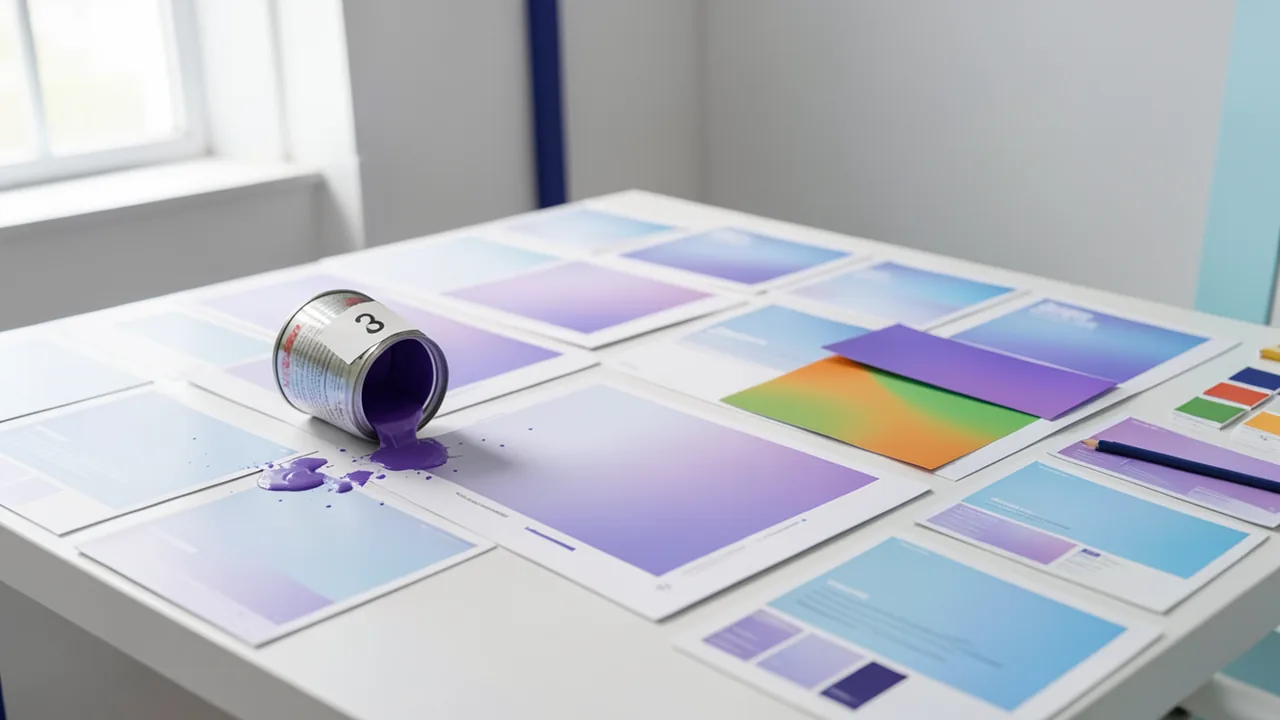
If you've seen a few “vibe-coded” websites over the past year, you know the look. Vibe coding means having an AI build a site from chat instructions instead of writing the code yourself. At the top sits a big intro section, the so-called hero, with white text on a gradient from light blue to violet. Most of the time, it all comes down to a single line of CSS:
linear-gradient(135deg, #667eea 0%, #764ba2 100%)
The usual explanation: blame Tailwind, the most widely used styling framework on the web. A new data-driven analysis by developer NotAFlightRisk on dev.to tells a more precise story, and the raw data is openly available on GitHub. We rechecked the numbers, compared them with other datasets and asked the question that really matters: what can you do about it?
A gradient with a name and a long sleep
The color pairing isn't a Tailwind shade. It's called “Plum Plate” and is gradient number 28 in WebGradients, a free collection of 180 gradients that the studio itmeo released in January 2017. The site itself recommends Plum Plate for “SaaS marketing pages, corporate intranets and productivity tools.” That's exactly where it ended up.
For eight years, though, hardly anyone wanted it. The analysis counts:
| Period / dataset | Plum Plate | For comparison: Flat UI blue #3498db |
|---|---|---|
| Stack Overflow 2017–2022 | 17 posts | 1,314 posts |
| GitHub snapshot 2022 (470,000 HTML files) | 1 file | 121 files |
| WildChat, 838,000 ChatGPT conversations (4/2023–4/2024) | 1 time | – |
| LMArena data 2023 to summer 2024 (incl. Claude 3 and 3.5) | 0 times | – |
LMArena is a public platform where users compare the answers of two anonymous models and pick the better one. The collected answers are regularly released as a dataset.
Then came Claude 4
Claude Sonnet 4 and Opus 4 launched on May 22, 2025. The next LMArena dataset covers 271,000 responses from April to July 2025. The author pulled out every response that writes a CSS gradient:
- Claude 4: 93 of 232 gradients were Plum Plate. That's about 40 percent.
- Models from other companies: 20 of 670, or 3 percent.
- Claude 3.5 and 3.7: around 1 percent, according to the raw data.
By our math, Claude 4 reached for this gradient a good thirteen times as often as the competition. Broken down by model, models.json puts Sonnet 4 at 48 percent and Opus 4 at 30 percent. 83 of the 93 Claude hits are the exact line above, character for character. The timing fits too: in April there were two Plum Plate responses across all models combined; in May there were 29. Why number 28 out of 180, of all things? The author openly admits he doesn't know. Claude 4 had a second favorite as well, the pink gradient “Ripe Malinka” (No. 17). It appeared twelve times for Claude 4 and twice for all other models combined.
After that, the gradient spread through public code. On November 20, 2026, the author queried GitHub's code search for all 123 two-color WebGradients gradients. According to swatches.json, Plum Plate shows up in 1,337,344 files, with Ripe Malinka in second place at 121,856. We did the math: that's 68.6 percent of all hits and almost eleven times as many as the runner-up. The analysis reports 609 hits for the middle gradient on the list (the median). GitHub itself describes these numbers as estimates.
Hit counts don't tell you when the lines were written. So the author checked which commit added the line in the first 100 CSS files. 95 of them date from 2025 or 2026. Because search favors newer files, he checked #3498db for comparison: only 34 out of 100 were that recent. In pure CSS files, Plum Plate now sits at 349,000 hits, close to the old blue at 429,000, which has been around since 2013.
The author himself stresses an important caveat: there's no proof that Claude wrote these files. Only three commits are explicitly marked as agent work, one by Claude Code and two by Copilot. The link rests on the timeline, not on proof of origin.
The apparent contradiction: 98 out of 100 or 0 out of 600?
Things get interesting with the newer models. In the current LMArena WebDev dataset, with 6,390 battles and therefore 12,780 generated websites through July 2026, Plum Plate doesn't appear even once for Claude 4.8 and the Claude 5 models, on none of the 600 pages that contain a gradient at all. Claude 4.5 through 4.7 still use it in 1 to 2 percent of cases.
The “priors” study by centricle, on the other hand, comes to a very different result: Sonnet 5 started 98 out of 100 responses with exactly this color pair, and Haiku 4.5 had it in 90 responses.
Both are true, because they measured different things:
| LMArena WebDev | centricle “priors” | |
|---|---|---|
| Task | build a full website | just “write a CSS gradient” |
| Environment | Arena's own build environment | Claude Code, fresh session, low effort level |
| Claude 5 result | 0 of 600 pages with a gradient | Sonnet 5: 98 of 100 |
So the preference is still there. It just gets suppressed when building full pages, probably through training or system instructions. That's our assessment; it isn't proven. centricle also points to its own limits: it never tested outside the Claude Code environment, and the system prompt changed between two test runs.
The real lesson is in the fine print. In centricle's data, Fable 5.1, Opus 5.5 and Sonnet 5 each answered “Pick a color” with teal 100 out of 100 times. For a button, they almost always chose #2563eb, which is Tailwind's blue-600. The author of the Plum Plate analysis also ran “Write a CSS gradient” six times each through Claude Code. Sonnet 4.5 and Haiku 4.5 returned Plum Plate 6 out of 6 times, Opus 5.5 twice and Haiku 5.5 once. Sonnet 5.5 scored zero, but it wrote the same different gradient all six times: #ff7e5f → #feb47b → #86a8e7. GitHub currently finds that one in 11 files. So the habit hasn't gone away; it's just changed color. The samples are very small, though.
We weren't able to run our own sample test with GPT, Gemini and Qwen for this article, so we rely solely on the published measurements.
What about Tailwind? Partly to blame, but not for the gradient
On August 7, 2025, Tailwind creator Adam Wathan half-jokingly apologized on X: he wanted to “officially apologize” for making every button in Tailwind UI bg-indigo-500 five years earlier. Since then, Tailwind has been the prime suspect. A widely read dev.to post by Alan West traces the uniform look back to classes like from-indigo-500 to-purple-600, but offers no data to back it up.
For indigo in general, that's plausible. Tailwind's indigo-500 (#6366f1) shows up in centricle's data too, and #2563eb is also a Tailwind shade. But it doesn't explain the specific hero gradient. #667eea and #764ba2 aren't Tailwind colors. Indigo buttons have been around since 2020, yet Plum Plate was almost nowhere until May 2025. The order of events is telling as well: Wathan's tweet came eleven weeks after Claude 4.
Why models converge on the same preferences
Anthropic described the problem itself in November 2025 and called it “distributional convergence”: without guidance, Claude draws answers from the “high-probability center.” The Claude Cookbook puts it this way:
Without guidance, Claude often defaults to generic designs with white and purple backgrounds.
Researchers call this mode collapse: a model keeps landing on the same few favorite answers instead of using the full range. The paper “Verbalized Sampling” (ICML 2026) sees a main cause in the preference data used to tune models toward “good” answers after pretraining. People who rate answers prefer what's familiar. The authors call this typicality bias. Earlier work also shows that the training method itself amplifies majority answers.
A paper from the University of Washington and Microsoft Research (Shin et al.) adds a second layer: tools optimized for speed nudge users into accepting the first suggestion. So the sameness doesn't come from training data alone. On top of that, there's a feedback loop: AI-built sites published en masse end up on the web and can feed into future training data. For now, that's a plausible assumption, not a measured result.
What helps, and what doesn't
| Approach | What it does | Limitation |
|---|---|---|
| Impeccable | Agent skill with 24 commands and a slop detector (62 fixed rules, no language model needed), also available as npx impeccable detect for automated checks and as a Chrome extension |
The rule count has changed several times. Purple gradients fall under the “AI color palette” rule. |
| no-slop-ui | Rule set plus acceptance checklist; bans glassmorphism, decorative gradients and monochrome purple-blue palettes | Tiny project (17 stars), modeled on Linear and Stripe. The result is a new default look. |
| Astryx (Meta) | 150+ components, 7 themes, CLI and MCP interface so agents look up real components instead of guessing | Ensures correct code, not originality |
| Anthropic's frontend-design skill | About 400 tokens of design instructions; bans Inter and “purple gradients on white” | According to Anthropic, Claude then converges on new favorites like Space Grotesk |
Astryx deserves a closer look. Meta says it used the system internally for eight years, for more than 13,000 apps according to a report on smzdm, and released it as a beta (v0.0.14) under the MIT license in June 2026. It now has more than 32,000 stars on GitHub. According to smzdm, astryx init writes 35 rules into the project files for AI agents, including bans on hard-coded colors and pixel values. The repo even has a vibe-tests folder, which the README describes as a test harness for how well language models handle the components. In a comparison test with Claude Code summarized by daily.dev, the agent made fewer and more easily fixable mistakes with Astryx than with shadcn/ui, and theme switches applied completely.
Against the purple itself, though, Astryx only helps indirectly: if you define your colors through design tokens, meaning centrally stored color and type values, the AI has no room for Plum Plate. Designer Tommaso Nervegna writes that Astryx brings Meta's taste, not yours. For teams with their own style, it doesn't solve the problem. According to smzdm, a much-liked comment adds that you still have to rework the results heavily by hand.
A better prompt is the cheapest fix, and it's well documented. Anthropic shows clear improvements as soon as you specify typography, color, motion and background. The Verbalized Sampling paper measures 1.6 to 2.1 times more diversity on creative tasks when you ask for several variants with probabilities instead of a single answer. For web design, that means in practice: ask for three clearly different directions, provide a reference site or your own hex colors, then choose deliberately.
Our take
The Plum Plate story is solidly documented as far as frequency and timing go. Whether Claude caused the spread, however, remains a strong chain of circumstantial evidence: proof of origin is missing, and GitHub's hit counts are estimates. The myth that this is purely a Tailwind problem only partly holds up. Tailwind's indigo shapes buttons and accents, but the famous hero gradient is a separate find from 2017.
Our view: the purple is the symptom, not the disease. When models lose one favorite answer, they pick up a new one, as centricle's teal and Sonnet 5.5's sunset gradient show. Detectors and blocklists make the old look disappear, but they can easily create a new uniform look, such as “serious like Linear and Stripe.” What really helps is a deliberate decision before your first prompt: your own colors, your own fonts, your own template. The AI can then implement them reliably, and systems like Astryx help with that. But no tool will make the judgment call on taste for you.
Sources
- dev.to: The AI purple is a 2017 gradient called Plum Plate dev.to
- GitHub: NotAFlightRisk/blog Pull Request #86 github.com
- Rohdaten models.json raw.githubusercontent.com
- Rohdaten swatches.json raw.githubusercontent.com
- Artikeltext index.mdx raw.githubusercontent.com
- centricle: priors – Color centricle.com
- Hugging Face: lmarena-ai/arena-webdev-preferences huggingface.co
- WebGradients: #028 Plum Plate webgradients.com
- dev.to: Why every AI-built website looks the same (Alan West) dev.to
- AIbase: Adam Wathans Entschuldigungs-Tweet news.aibase.com
- Anthropic: Improving frontend design through Skills claude.com
- Claude Cookbook: Prompting for frontend aesthetics platform.claude.com
- arXiv: Verbalized Sampling (2510.01171) arxiv.org
- arXiv: Interrogating Design Homogenization in Web Vibe Coding arxiv.org
- GitHub: meta/astryx github.com
- GitHub: meta/astryx internal (vibe-tests) github.com
- InfoQ: Meta Open-Sources Astryx infoq.com
- smzdm: Meta开源了管工程师8年的那套家规 post.smzdm.com
- daily.dev: Astryx vs. shadcn/ui mit Claude Code daily.dev
- note.com: Astryx und MCP note.com
- Substack (Tommaso Nervegna): Your Storybook is a Museum nervegna.substack.com
- GitHub: pbakaus/impeccable github.com
- Impeccable: The visible tells of AI design impeccable.style
- GitHub: LeoStehlik/no-slop-ui github.com
- prg.sh: Why Your AI Keeps Building the Same Purple Gradient Website prg.sh
Ask the AI assistant
Questions about this article, installation or background? Our assistant knows this page and runs on our own machine, not in someone else's cloud.
The Assistant is an AI (Gemma 4) and can make mistakes – please check important details against the source. Questions are used only to generate an answer and are deleted after one hour. Please don't enter any personal data.


Comments
What do you think? Already tried it? Write it here, no sign-up needed.
Comments are public. Links aren't allowed, and we delete abusive posts. You can delete your own comment at any time in this browser. Learn more in the Privacy Policy.