
The Driving View No Camera Shot: Xiaomi's "Real-Time Rendering" Debunked
A demo video of Xiaomi's new "Auto World Model 2.0" went viral in China. Many viewers took it for a photorealistic live in-car view, like the one Tesla is rolling out with FSD v15. The technical report tells a different story. It describes a cloud tool for generating training data and simulations, and its benchmarks say little about driving safety.
What it's about
On November 27, 2026, Xiaomi presented two things at the Guangzhou auto show. In the morning came HAD 1.20, the new update to its driver-assistance system. In the afternoon came the Xiaomi Auto World Model 2.0. A world model is an AI that learns how a scene evolves and uses that to generate future frames. Shortly after 5 p.m., the official Weibo account "小米技术" (Xiaomi Technology) posted the announcement, along with a technical report and a project page.
The benchmarks weren't what made it trend, though. A demo video was. According to the site smzdm, it shows three stacked layers:
- top: the SR surround view, the schematic display the assistance system already shows on the car's screen today;
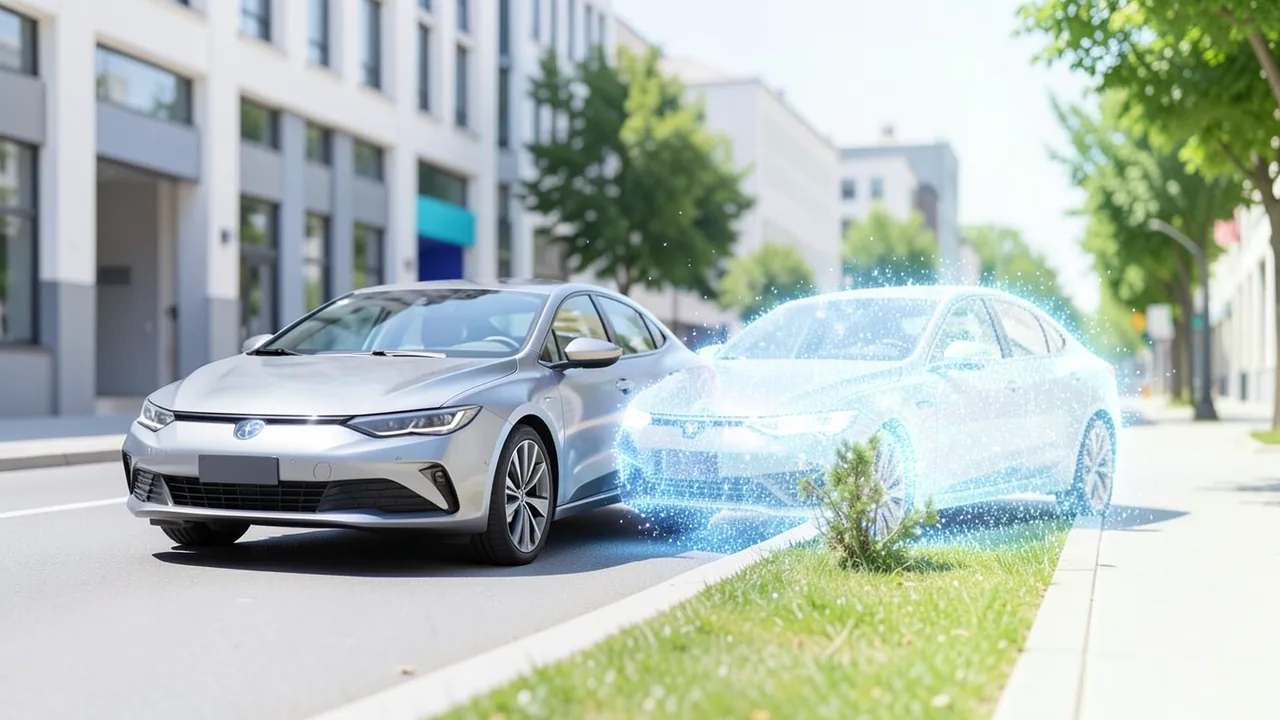
- middle: a photorealistic exterior view that the model generated from a test vehicle's data;
- bottom: the real footage from the front camera.
According to smzdm, the middle layer looks "almost like real footage," and many users read the video as a new live view for the cockpit. Comments like "That's basically V15" show the obvious comparison with Tesla's FSD v15, whose photorealistic "Reality View" Tesla has been rolling out since November 21. That reading is wrong. We'll show you what the demo actually shows, what the numbers support and what really makes it into the car.
What the model is and what Xiaomi uses it for
Technically, World Model 2.0 is a causal Diffusion Transformer (DiT). It generates video piece by piece from noise and only ever sees the past, never the future. According to the report, it takes the architecture, weights and image encoder (VAE) from Alibaba's open video model Wan2.2-5B. It processes one to seven camera views at once and was trained on 12.6 million video clips. These include 5.4 million driving scenes, 3.6 million robot clips, 3.6 million general videos and a few tens of thousands of "physically causal" clips.
Two components are new. Gated Linear Attention replaces the usual attention computation in the temporal layers with a leaner variant. Instead of keeping every previous frame in memory, the model carries a kind of running summary. According to the report, this cuts the cache per layer by more than 97 percent. WorldRec 2.0 builds a 3D scene from the camera images in a single pass using 3D Gaussian Splatting: many small, colored, fuzzy blobs that together form a scene. The model uses this as memory so roads and buildings don't drift over long sequences.
So what's it for? Every official Xiaomi description names two purposes. First, the model generates synthetic training data for the perception models. Xiaomi says that's now more than 200,000 clips, up from over 100,000 in May 2026, according to IT之家 (IT Home). Second, it serves as a closed-loop simulator. A driving policy drives virtually inside it, the world model computes what the cameras would see next, and the policy reacts. That way you can replay rare hazards as often as you like, such as sudden cut-ins, crossing pedestrians, rain or occlusions. That's exactly what the project page shows: about 45 seconds of seven-camera video along a recorded drive, where you can change the route afterward and watch the road and traffic adapt.
smzdm sums it up this way: the "real-time rendering" isn't a new in-car interface. Its main impact is on data generation and simulation. A second smzdm article also makes clear that drivers can't use the "GTA view" in the car. Most of the frames are computed in the cloud.
Running the numbers: how "real-time" is it?
In its comparison table, the report labels the model "real-time." But it defines that narrowly: one generation step has to finish within the time budget of one simulation step so the simulator doesn't have to wait. That has nothing to do with live video in a car.
The hard numbers are in Table 3. They were measured on a single Nvidia H20, a data center chip Nvidia sells for the Chinese market. The test used seven cameras and the final distilled two-step model. Distillation means a large, slow "teacher" model trains a faster "student" to deliver the result in just a few compute steps.
| Attention variant | Time per chunk | Latent frames/s | Image quality (FID, lower = better) |
|---|---|---|---|
| Full softmax attention | 6.481 s | 0.309 | – |
| View-temporal attention | 2.299 s | 0.870 | 37.24 |
| Gated Linear Attention | 1.742 s | 1.148 | 38.08 |
"Latent" frames are compressed intermediate frames. According to its Model Card, the Wan2.2-5B VAE packs every four video frames into one latent frame over time (compression 16×16×4). That's why analyst Huang Yu, in a Zhihu analysis quoted by smzdm, arrives at about 4.6 frames per second. We checked the math: 1.148 × 4 ≈ 4.6. The training clips run at 16 Hz, and the test fleet's raw data at 30 Hz. Huang Yu points out two more things. The numbers cover only the backbone, without VAE encoding and decoding. And the model competing on the leaderboards isn't the distilled model used for simulation. The report itself suggests image quality was evaluated at the "mid-train" stage. For seven-camera operation, the report says Xiaomi spreads inference across eight GPUs in parallel.
Compare that with the predecessor. The JointWM model from May 2026 needed 0.19 seconds per frame with one camera on H20 cards and 0.46 seconds with three cameras, so just over 2 frames per second. Our assessment: going from three to seven cameras at roughly double the speed is real progress, even if the test conditions aren't identical. But it's nowhere near enough for a live view on in-car hardware.
What the benchmarks actually measure
Xiaomi claims first place on PAI-Bench-G, with 78.0 points for driving videos and 77.1 for robot videos. The benchmark comes from researchers at Georgia Tech and CMU, and Nvidia uses it for its Cosmos models, among others. It gives two sub-scores. The Quality Score follows the VBench protocol and measures consistency, motion smoothness, aesthetics and image quality. The Domain Score uses a large vision-language model as a judge to check whether the video is physically plausible. The overall score is the average of the two.
Xiaomi's tables include only the Quality Score. There's no column for the Domain Score. According to the PAI-Bench paper, physics is exactly where video models fail most clearly. The best models come close to the image quality of real videos, but they all score well below them on the Domain Score. In the paper, real source videos average a Quality Score of 78.0, so the top of the scale is tight. That's why the margins are so thin:
| PAI-Bench-G (Quality only) | Xiaomi 2.0 | Best competitor | Margin |
|---|---|---|---|
| Driving (118 videos) | 78.0 | HunyuanVideo 1.5: 77.4 | +0.6 |
| Robotics (174 videos) | 77.1 | LingBot-World: 77.0 | +0.1 |
Xiaomi leads clearly on object consistency with 96.2, while Wan2.2-5B scores 90.4. According to its own table, though, the model trails several competitors on aesthetics and image quality. Nvidia's Cosmos doesn't appear in the comparison. On the multi-camera benchmark TriWorldBench, Xiaomi's 64.79 actually puts it behind CausalWM (66.04).
That leaves the number that sounds most like safety: a collision rate of 0.4 versus 1.2 percent. Xiaomi trained its own driving policy (E2E-WM-RL) with reinforcement learning in the world model simulator and compared it with a baseline (ST-JEPA-E2E). Testing used 1,000 scenes from the NAVSIM benchmark. That works out to 4 collisions versus 12. The scenario completion rate rose from 95.2 to 96.3 percent, and progress per drive dipped slightly from 84.7 to 84.5. All of it happened in simulation. It tells you nothing about crashes on real roads, and with such small absolute numbers the gap isn't very robust. At most, it shows that the world model works as a training environment.
There are visible errors too. According to smzdm, one demo frame renders a car into a grass median, a clear physics error.
What actually makes it into the car
What drivers get is HAD 1.20. It brings two new features. A "causal chain" remembers the traffic situation over the last 20 seconds, and an onboard world model predicts how traffic will develop over about the next 6 seconds. Xiaomi promises smoother maneuvering around stopped cars and better risk prediction for two-wheelers at intersections. According to the car blogger "42号车库" (Garage 42), the cloud model's predictive abilities are transferred to the car through distillation. Xiaomi hasn't disclosed exactly which abilities. The model probably works with abstract states rather than images, but that isn't documented either. Models from the Xiaomi 澎程 brand (N70, N90) get the update right away. The SU7 Pro/Max, SU7 Ultra, the new SU7 and the YU7 will follow "gradually," with no date given.
There are no metrics at all for this onboard model: no compute requirements, chip, intervention rates or test mileage. smzdm explicitly lists these as open questions. So far, generated video reaches the car in only one way. According to IT之家, even the May model produced pre-rendered tutorial videos for the "辅助驾驶学堂" (Driver Assistance School) section of the infotainment system. Nothing there is rendered live.
How it differs from Tesla's Reality View
| Tesla Reality View (FSD v15) | Xiaomi World Model 2.0 (demo middle layer) | Xiaomi HAD 1.20 onboard model | |
|---|---|---|---|
| Where does it run? | In the car (AI4 hardware) | Cloud/data center (H20) | In the car |
| Purpose | Display for the driver | Training data, simulation | Prediction for driving decisions |
| Live? | Yes, "real-time" according to Tesla | No, about 4.6 frames/s per H20 | Yes, according to Xiaomi |
| Input | Live camera images, gaps filled generatively | Recorded drives plus conditions | Unknown |
| Metrics | None independent | Simulator and image quality | None |
According to Not a Tesla App, Tesla projects the pixels from the camera images onto a 3D stage and lets generative AI fill the gaps. In the release notes, Tesla describes a "generative real-time driving visualization" that needs less compute than the old display. Tesla doesn't necessarily show what FSD sees either. Not a Tesla App notes that a clear picture in fog doesn't mean the system sees clearly. So both approaches are generative. But Tesla works with the live signal and for the driver, while Xiaomi's model serves its own development process.
Our take
Xiaomi has built a serious research tool. Seven consistent camera views, a 3D memory that prevents image distortion and a noticeable speedup over the May model are real advances. With more than 200,000 clips delivered, Xiaomi says it's also in practical use. But neither the report nor Xiaomi's own throughput table supports the viral claim that "Xiaomi renders the world live in the car."
On the core question, our view is this: a photorealistic world model says almost nothing about how safely a car drives. The image scores measure consistency and looks, the physics score is missing, and the safety figure comes from a simulation the model generates itself. Researchers see it similarly. According to smzdm, experts at a CoRL 2026 workshop called for physical consistency, rare hazard scenarios and closed-loop safety metrics instead of image quality. CoRL hosted the workshop "Grounded 4D Multimodal World Models for Autonomous Driving Decision Making," which included a paper called "Fidelity Is Not Safety." The WorldLens paper found that almost every driving world model it tested caused collisions or road departures in closed-loop driving. Photorealism alone, it concludes, doesn't add up to functional reliability.
The most important question for SU7 and YU7 drivers is still open: how the onboard model in HAD 1.20 performs in real traffic. So far, there are only manufacturer claims and first impressions from bloggers. Xiaomi hasn't released code or weights for World Model 2.0, so nobody can verify the numbers independently.
Sources
- arXiv: Xiaomi Auto World Model 2.0 (Abstract) arxiv.org
- arXiv: Xiaomi Auto World Model 2.0 (HTML-Volltext) arxiv.org
- Projektseite Xiaomi Auto World Model 2.0 xiaomiautoworldmodel.github.io
- Projektseite JointWM (Vorgänger, Mai 2026) jointwm.github.io
- smzdm: „Echtzeit-Rendering“ in den Trends, Fahrzeug-Kennzahlen fehlen post.smzdm.com
- smzdm: Was bringt das Echtzeit-Rendering für die Sicherheit? post.smzdm.com
- smzdm: Weltmodell für Auto und Roboter – was merken Nutzer? post.smzdm.com
- smzdm: „GTA-Vorschau“ – können Fahrer sie nutzen? post.smzdm.com
- smzdm: HAD 1.20 – 20 Sekunden merken, 6 Sekunden vorhersagen post.smzdm.com
- Sina/42号车库: HAD 1.20 im Test sina.cn
- IT之家: Xiaomi Auto World Model (Mai 2026) ithome.com
- NetEase/Huanqiu: World Model 2.0 veröffentlicht 163.com
- PAI-Bench-Paper (HTML) arxiv.org
- Hugging Face: Wan2.2-TI2V-5B Model Card huggingface.co
- Not a Tesla App: FSD v15 Release Notes notateslaapp.com
- Not a Tesla App: FSD v15 mit Reality View notateslaapp.com
- Not a Tesla App: Beeindruckendste FSD-v15-Visualisierungen notateslaapp.com
- alphaXiv: CoRL-2026-Workshop Grounded 4D World Models alphaxiv.org
- arXiv: WorldLens – Evaluierung von Fahr-Weltmodellen arxiv.org
- arXiv: How Should World Models Be Evaluated for Embodied Decision-Making? arxiv.org
Ask the AI assistant
Questions about this article, installation or background? Our assistant knows this page and runs on our own machine, not in someone else's cloud.
The Assistant is an AI (Gemma 4) and can make mistakes – please check important details against the source. Questions are used only to generate an answer and are deleted after one hour. Please don't enter any personal data.



Comments
What do you think? Already tried it? Write it here, no sign-up needed.
Comments are public. Links aren't allowed, and we delete abusive posts. You can delete your own comment at any time in this browser. Learn more in the Privacy Policy.