
Trillion-dollar rout: Markets fear Democratic sweep will end the AI data center boom
Chip and AI stocks crashed worldwide after Democrats' decisive win in the US midterms. Investors fear a Democratic Congress will slow the construction of new data centers, and several trillion dollars in market value vanished from Wall Street in a single day.
What's going on
Financial markets are going through one of the sharpest sell-offs in tech and chip stocks in years. The trigger: the Democratic Party's clear victory in the US midterm elections on Tuesday, November 3, 2026. Democrats won control of both chambers of Congress, the House of Representatives and the Senate. They also scored wins at the state level, most strikingly in Texas, where according to NPR Democrat Gina Hinojosa won a surprise victory in the governor's race.
On Wednesday, markets initially reacted with relief because the election had produced a clear result. On Thursday, the mood flipped. Investors fear the new majority will put the brakes on the massive build-out of AI data centers. Many Democratic candidates had promised on the campaign trail to slow down or stop such projects. On Friday, the sell-off spread to Asia, and Europe braced for losses too.
The numbers behind the crash
On Wall Street, Thursday ended with the steepest daily losses since President Donald Trump's tariff announcements in April 2025 ("Liberation Day"). Sources put the total damage at different figures, depending on which index they use:
| Metric | Value |
|---|---|
| Nasdaq Composite | −5.5% (biggest daily loss in 18 months) |
| Nasdaq-100 | −6.3%, roughly $2.3 trillion in market value wiped out (Yahoo Finance) |
| S&P 500 | −4.36%, a record $2.9 trillion loss according to Euronews |
| Dow Jones | −1,833 points or −3.44%, closing at 51,868 |
| Philadelphia Semiconductor Index (SOX) | −12.2%, biggest daily loss since 2020 |
| Entire US stock market | more than $3.2 trillion lost (The Guardian) |
According to AP, that leaves the Nasdaq nearly 12 percent below its record high and in a correction, which is what traders call a decline of at least 10 percent from the most recent peak. A drop of 20 percent or more counts as a bear market. The index also slipped below its 200-day moving average, a line that tracks the long-term price trend and that many investors treat as a warning sign. The VIX, Wall Street's so-called "fear gauge" that measures expected price swings, shot up 61 percent according to goodreturns. All eleven sectors in the S&P 500 closed lower, and money flowed into US Treasuries, seen as a safe haven.
Chipmakers hit hardest
The companies that had profited most from the AI boom took the worst beating: makers of memory chips and graphics processors. SanDisk lost 22 percent, while Western Digital, Micron and AMD each fell about 17 percent. Nvidia, at times the world's most valuable company, dropped 9.3 percent and, according to goodreturns, is now down for 2026. Yahoo Finance notes the slide started earlier: Lam Research lost 36 percent over the past month, Applied Materials 30 percent.
Software companies closely tied to AI came under pressure too. Palantir shed about $40 billion in market value, and Crowdstrike, Cloudflare, Oracle and Palo Alto Networks all fell sharply. Notably, Salesforce and Adobe, which are more often seen as AI losers, held largely steady. Tesla and SpaceX, both controlled by Elon Musk, slumped more than 9 percent. According to NPR, Musk had poured hundreds of millions of dollars into an unsuccessful bid to get more Republicans into Congress, and investors now fear closer scrutiny of his companies.
The sell-off continued in Asia on Friday. Japan's Nikkei fell as much as about 7 percent and was down 5.7 percent at midday, its steepest drop since April 2025. Kioxia and SoftBank lost more than 10 percent. In South Korea, the KOSPI plunged more than 8 percent right after the open, prompting the exchange to halt trading for 20 minutes. According to the Yonhap news agency, the index closed 6.02 percent lower at 5,059.69 points, after already losing more than 5 percent on Thursday. SK hynix tumbled 10.44 percent and Samsung Electronics 6.35 percent. Taiwan's Taiex closed down 4.5 percent, and chipmaker TSMC fell as much as 8.5 percent.
Why the election hits the AI industry
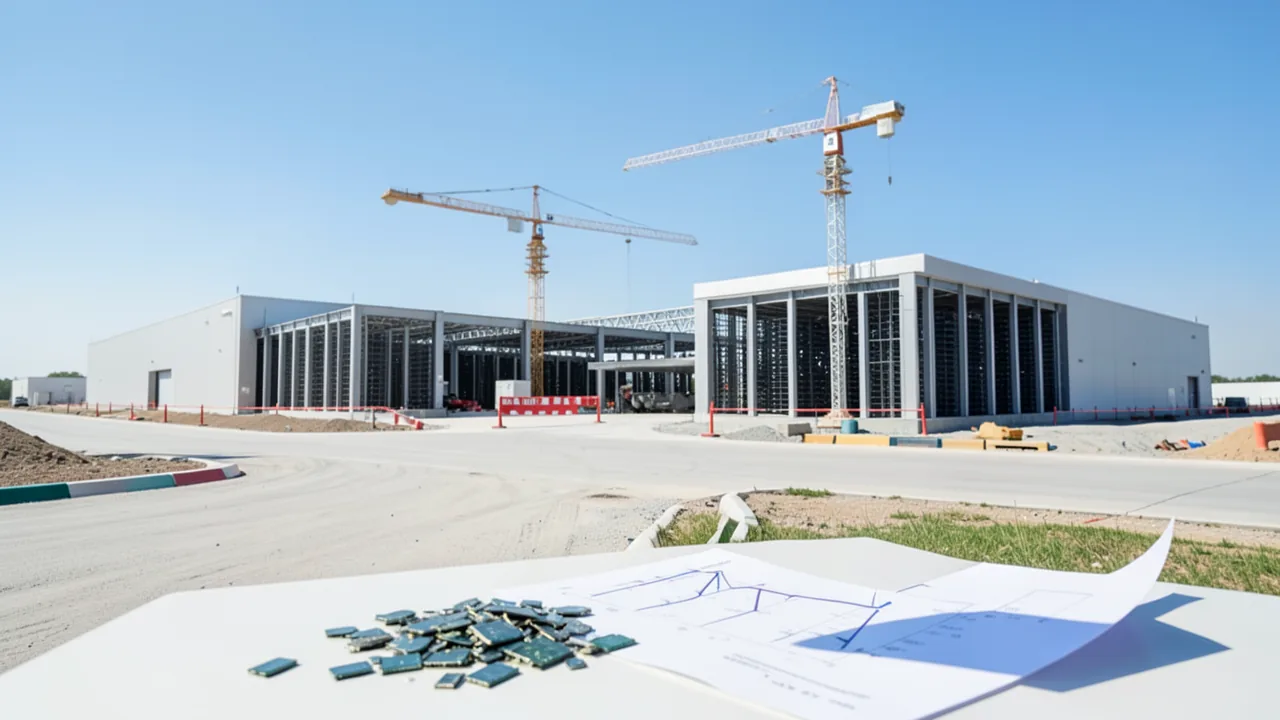
At the center of it all is the construction of data centers: huge halls full of servers where AI models are trained and run. Companies like Meta and Alphabet are investing hundreds of billions of dollars in these facilities. But public resistance is growing. Many people worry the centers consume huge amounts of electricity and water. According to NPR, voters revolted against exactly these projects, and across party lines. Senator Bernie Sanders and Representative Alexandria Ocasio-Cortez had already proposed a nationwide moratorium, a temporary construction freeze, earlier this year.
According to Yonhap, analyst Lee Kyoung-min of Daishin Securities points out that five states that went to the Democrats, including Texas, are among the most important locations for AI data centers. Christopher Forbes of CMC Markets described the mood to Reuters in stark terms:
"This is not just a valuation wobble. It's essentially a political and structural shift over six years that says: we're now taking a pause, we're cooling AI, we're cooling data centers, permits and capital markets."
The politics landed on a mood that was already fragile. For months, experts have warned of an AI bubble, meaning inflated valuations not backed by real profits. According to Kyle Rodda of Capital.com, the current earnings season has disappointed: the "Magnificent Seven," the seven biggest US tech companies, fell short of growth expectations, and there are signs that the pace of AI spending is slowing. Higher interest rates are also making it harder to finance new data centers.
Profit-taking and retail panic
Not everything can be explained by the election. Charlie McElligott, a strategist at Nomura, sees hedge funds at work above all, locking in gains before year-end: "They're shooting the generals," he wrote, meaning the year's top winners. The unwinding of these positions has been running "extremely violently" for more than a month, he said. On top of that came forced selling by automated and leveraged trading strategies.
Unusually, retail investors, who normally like to "buy the dip" when prices fall, also headed for the exits. According to Vanda Research, they had sold a net $358 million in individual stocks by the afternoon, the biggest selling day since March 2020. Vanda strategist Viraj Patel called it "total capitulation." NPR points out that ordinary Americans are also heavily invested in AI stocks through retirement plans such as 401(k) accounts.
Reactions from politics and business
President Trump blamed the Democrats on Truth Social: the market crashed "because the Dumocrats had a big Tuesday." In another post, he wrote that people's 401(k) accounts had fallen as a result. Vice President JD Vance, by contrast, had said on X that Republicans lost the election because of the war against Iran, which sparked hopes in the oil market that the war might end. Brent crude traded just under $100 a barrel on Friday.
AMD CEO Lisa Su pushed back against the pessimism in an interview with Yahoo Finance: the market is "sometimes a little bit short-sighted," she said, and she sees no slowdown in demand for AI chips. Daishin analyst Lee considers a complete halt to data center construction unlikely and called the reaction "excessive." Neil Wilson of Saxo Markets also called the sell-off overdone, though he said investors want to see things stabilize first.
The bigger picture
The crash shows how heavily the US stock market now depends on the AI bet. According to NPR, AI was a major contributor to the 3.4 percent economic growth in the third quarter. For the AI industry, the core of the story isn't the crash itself but the political message: the build-out of computing infrastructure that the plans of OpenAI, Google, Meta and others rely on is facing serious democratic headwinds for the first time. What the new Congress, which convenes in January, will actually do remains open. There are no concrete bills yet. It's also unclear how much of the drop reflects real policy risk and how much is overdue profit-taking after an overheated year. Several experts expect more sharp swings ahead.
Related videos
Sources
- The Guardian – KI theguardian.com
- Merkliste: euronews.com euronews.com
- Bing News (en-US) finance.yahoo.com
- en.yna.co.kr en.yna.co.kr
- goodreturns.in goodreturns.in
- npr.org npr.org
Ask the AI assistant
Questions about this article, installation or background? Our assistant knows this page and runs on our own machine, not in someone else's cloud.
The Assistant is an AI (Gemma 4) and can make mistakes – please check important details against the source. Questions are used only to generate an answer and are deleted after one hour. Please don't enter any personal data.



Comments
What do you think? Already tried it? Write it here, no sign-up needed.
Comments are public. Links aren't allowed, and we delete abusive posts. You can delete your own comment at any time in this browser. Learn more in the Privacy Policy.