
Why every AI gives your startup the same name, and what actually helps
The "Artificial Hivemind" study won an award at NeurIPS 2025. Its claim: language models from different vendors give almost identical answers on creative tasks. Two new papers from this fall partly challenge that picture. We ran the numbers to see what holds up, and whether prompt tricks like the popular "antialgorithm" skill actually help.
What this is about
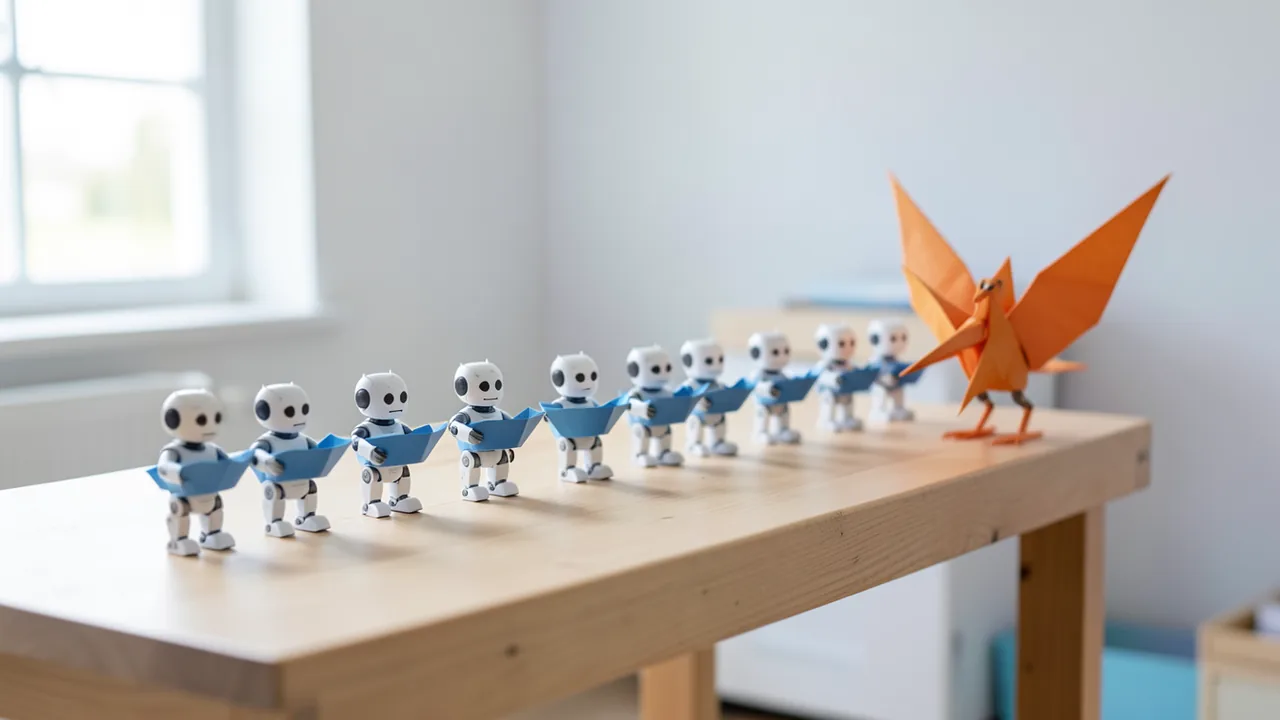
Ask five different chatbots to name your startup, and you'll often get the same name five times, give or take. Ask for a metaphor for time, and nearly every answer ends up at a river. Researchers led by Liwei Jiang (University of Washington, Allen Institute for AI) coined a catchy name for this: the "Artificial Hivemind." Their study won a Best Paper Award in the Datasets and Benchmarks track at NeurIPS 2025, and since then the thesis has often been treated as settled.
This fall, two new papers shifted the picture. Meanwhile, a tool that promises to drive the mediocrity out of AI agents is spreading on GitHub. We care about the question underneath: is AI sameness baked in by training, or can the right prompt fix it? A disclosure up front: we didn't run our own experiments for this piece. We rely on the published data, check the papers against each other, and at the end show you how to run the test yourself.
What the original study measured
The study is built on the Infinity-Chat dataset. It contains 26,000 real, open-ended user questions from the WildChat archive, meaning questions with no single right answer, plus 31,250 human ratings. According to the University of Washington, creative writing (58 percent) and brainstorming (15.2 percent) make up most of the questions. More than 70 models were tested.
The researchers converted answers into embeddings, numerical vectors that capture a text's meaning, and compared them using cosine similarity, which runs from 0 (nothing in common) to 1 (identical). The headline numbers:
- At temperature 1.0 and top-p 0.9, the average similarity of a model's answers to the same question exceeds 0.8 in 79 percent of cases.
- With min-p, a sampling method that dynamically filters out unlikely candidates when picking the next word, it's still 61.2 percent of pairs.
- Answers from different models are on average 71 to 82 percent similar.
- For the time metaphor, the study says answers from 25 models fall into two clusters: "time is a river" and, smaller, "time is a weaver."
The authors conclude that decoding tricks shift the burden onto users, so diversity has to be secured during training. Co-author Yulia Tsvetkov warns of "groupthink in AI systems that could lead to shared blind spots and correlated errors."
The counter-analysis from Stanford
In late September 2026, Rylan Schaeffer, Sanmi Koyejo and three colleagues published "How Strong Is the Evidence for the Artificial Hivemind?". They don't dispute that models lean toward certain answers. Their objection is about the null hypothesis: the baseline that's supposed to tell you what counts as "normally similar."
The original study compared answers to the same question against answers to completely different questions. Those pairs have a similarity of only about 0.11, because they share neither topic nor form. Against that yardstick, almost everything looks similar. Schaeffer and colleagues instead compare answers to the same question that contain clearly different ideas. Those pairs still score around 0.70 to 0.72, simply because they answer the same task in a similar format.
| Finding | Original study (Jiang et al.) | Reanalysis (Schaeffer et al.) |
|---|---|---|
| Baseline | Answers to unrelated questions (≈ 0.11) | Answers to the same question with a different idea (≈ 0.70–0.72) |
| Share above 0.8 threshold for different ideas | not measured | 20–32 % |
| Genuine residual effect | – | 1.9 to 3.1 times as often above 0.8 |
| Time metaphor | two clusters (river, weaver) | one dominant image with a long tail; "weaver" only 3.3 % in the original pool |
| Implication for fixes | training has to solve it | not supported; prompting measurably increases diversity |
The time metaphor doesn't fare well in the reanalysis. In the original authors' answer pool, the river shows up in 90.2 percent of answers, the weaver family in just 3.3 percent. So the result is one clear favorite with lots of outliers, not two camps. On top of that, "time" is among the least diverse of the twelve topics tested. That makes it a convenient showcase, but not a typical one.
The Stanford team also finds the case for training-based fixes shaky. One sampler failing says nothing about other inference-time interventions. The paper doesn't demonstrate a training change that actually helps. And a re-analysis of the min-p authors' own data finds no diversity advantage for min-p, so its failure in the hivemind test doesn't tell you much. Their conclusion:
"The empirical basis for a dangerous Artificial Hivemind is not clear-cut."
Prompt tricks work, just not the way you'd think
The third part of the reanalysis is the one that matters in practice. The team tested five rewrites of the request "Write a metaphor about {topic}," including a poet persona, a nudge toward unusual subject areas, and an explicit instruction to avoid the most obvious answer ("anti_modal"). The runs covered 12 topics, 15 models from Google, Anthropic and OpenAI, and 50 runs per combination. Every rewrite beat the baseline prompt in 79.6 to 91.7 percent of comparisons. The poet persona did best: the effective rank, a measure of how many independent directions the answers span in meaning space, rose from 17.4 to 28.9 within a single model.
The catch is further back in the paper. The researchers used a second model to count which idea each answer actually expresses. The share of the most common idea did drop from 0.48 to about 0.34. But the effective number of distinct ideas only rose from 3.34 to 3.99, which isn't statistically significant (p = 0.39). And across different models, the effect was weaker, and in one of the metrics not detectable at all. Whether quality suffers is something the authors themselves leave open.
Our take: prompting redistributes the answers. The favorite loses share and the wording gets more colorful. Whether that actually produces more new ideas hasn't been shown yet.
A similar but better-studied approach is Verbalized Sampling from Zhang et al. (ICML 2026). Instead of one answer, you ask for several along with estimated probabilities, for example: "Give me five jokes about coffee and their probabilities." The paper also offers an explanation for the hivemind: people who rate answers for training prefer familiar-sounding text (typicality bias). On 6,874 answer pairs from the HelpSteer dataset that were rated equally correct, the authors estimate this effect at α ≈ 0.57 to 0.65. Preference training amplifies it, so when options are tied, the model picks the most typical one. Measured diversity in creative writing rises by a factor of 1.6 to 2.1, and larger models benefit more.
German: well mastered, low diversity?
The second new paper, "The Multilingual Artificial Hivemind" by Davey, Mishra, Adelöw and Liu, is a NeurIPS 2026 workshop submission according to its code repository, not a main-conference paper. It tests 23 open models from the Qwen3, Gemma-3, Mistral, OLMo-2 and Aya Expanse families on 390 open-ended questions in 13 languages, including German. Each model got 50 runs per question at temperature 1.0.
Repeated answers from the same model have an average similarity of 0.857, human answers only 0.657. The gap is +0.18 for German and +0.25 for English, largest for Russian (+0.27) and smallest for Basque (+0.08). The effect also holds with a metric that skips embedding models entirely and only compares character sequences.
The widely quoted finding that diversity is lowest precisely in the best-mastered languages is weaker than it sounds, though. The correlation between translation quality and diversity loss is ρ = 0.27. That's significant but modest, and the authors stress it's a correlation, not proof of causation. There are also only about three human answers per question versus 50 machine ones, and commercial models are missing entirely. One side finding is genuinely useful: two different models land at 0.750 instead of 0.857. So switching models gets you more variety than rerolling the same one.
antialgorithm: good idea, zero data
The skill mankidev/antialgorithm (MIT license) was created on November 14 and, according to Trendshift, gathered around 490 stars within seven days; it's at 555 now. It works with Claude Code, Codex, Cursor and OpenCode. For names, slogans, ideas, posters and interfaces, the agent first has to state the obvious choice ("the default here is X"). Then it's supposed to deviate from it, based on concrete project details rather than simple inversion, and justify each choice in one sentence. For thin requests, seed.py provides a starting point from the operating system's random number generator, meaning randomness from outside the model. moves.py logs which escape moves have already been used, so the way out doesn't become a new default. The skill explicitly names such "new defaults," like cream-colored backgrounds and print-style looks that exist only to seem "not AI."
Conceptually, it resembles the "anti_modal" rewrite from the Stanford reanalysis, plus external randomness and memory across sessions. But the project has no evidence. According to the README, the top row of the demo shows six unfiltered runs without the skill, while the bottom row was picked from about a dozen runs made during development. There are no metrics, no blind comparison, and so far not a single issue reporting user experience.
What about the temperature knob?
Anthropic no longer accepts the temperature parameter as of Claude Opus 4.7. Developers report the error message "temperature is deprecated for this model" on Opus 4.8. But the original hivemind data was already collected at temperature 1.0, and min-p barely helped there either. Our take: the knob was never the big lever for more ideas. Losing it takes away fine control more than real diversity.
Test it yourself
Pick three open-ended tasks, say a startup name for a bakery app, a slogan, and a metaphor for time. Ask each one 20 times in fresh chats, once plain and once with an add-on ("First name the most obvious answer, then deviate from it and explain why" or "Give five variants with probabilities, each below 0.10"). Then count exact duplicates and, more importantly, how many distinct core ideas show up. That's exactly the metric where the Stanford data shows no clear win.
The bottom line
The hivemind isn't a myth, but it's smaller than its reputation. Part of the measured uniformity comes simply from the fact that answers to the same question inevitably look alike. What remains is a real effect that occurs two to three times as often as that baseline would predict. The best explanation so far is typicality bias in preference training. So the sameness has its roots in training, but prompting can partly fix it. Prompt tricks reliably push answers away from the favorite. That they generate more ideas hasn't been proven yet. If you need real diversity, the current data says your best bet is multiple models, Verbalized Sampling, and your own context that no other user has. Whether antialgorithm does more than a good prompt, nobody can say right now, because nobody has measured it. We haven't yet found a response from the original authors to the criticism.
Sources
- arXiv: Artificial Hivemind (Jiang et al.) arxiv.org
- arXiv HTML: Artificial Hivemind Volltext arxiv.org
- arXiv: How Strong Is the Evidence for the Artificial Hivemind? (Schaeffer et al.) arxiv.org
- arXiv HTML: Schaeffer et al. Volltext arxiv.org
- arXiv: The Multilingual Artificial Hivemind (Davey et al.) arxiv.org
- arXiv HTML: Multilingual Artificial Hivemind Volltext arxiv.org
- GitHub: xaverdavey/multilingual-artificial-hivemind github.com
- arXiv: Verbalized Sampling (Zhang et al.) arxiv.org
- arXiv HTML: Verbalized Sampling Volltext arxiv.org
- GitHub: mankidev/antialgorithm github.com
- antialgorithm SKILL.md raw.githubusercontent.com
- Trendshift: antialgorithm trendshift.io
- UW Allen School: Best Paper Award für Artificial Hivemind news.cs.washington.edu
- NeurIPS-Blog: Best Paper Awards 2025 blog.neurips.cc
- The Decoder: Artificial Hivemind the-decoder.com
- Conselara: Opus 4.8 ohne temperature-Parameter conselara.dev
- OpenRouter: Claude 4.7 Migration Guide openrouter.ai
Ask the AI assistant
Questions about this article, installation or background? Our assistant knows this page and runs on our own machine, not in someone else's cloud.
The Assistant is an AI (Gemma 4) and can make mistakes – please check important details against the source. Questions are used only to generate an answer and are deleted after one hour. Please don't enter any personal data.


Comments
What do you think? Already tried it? Write it here, no sign-up needed.
Comments are public. Links aren't allowed, and we delete abusive posts. You can delete your own comment at any time in this browser. Learn more in the Privacy Policy.