
48 AI agents scour NASA lidar data and spot a possibly unknown Maya pyramid
A software engineer with no archaeology training pointed 48 AI agents at public lidar scans of the Mexican jungle. In under 72 hours, he had found what appears to be an unknown Maya site with a pyramid, and Mexico's heritage authority confirms it has no site on record at that location.
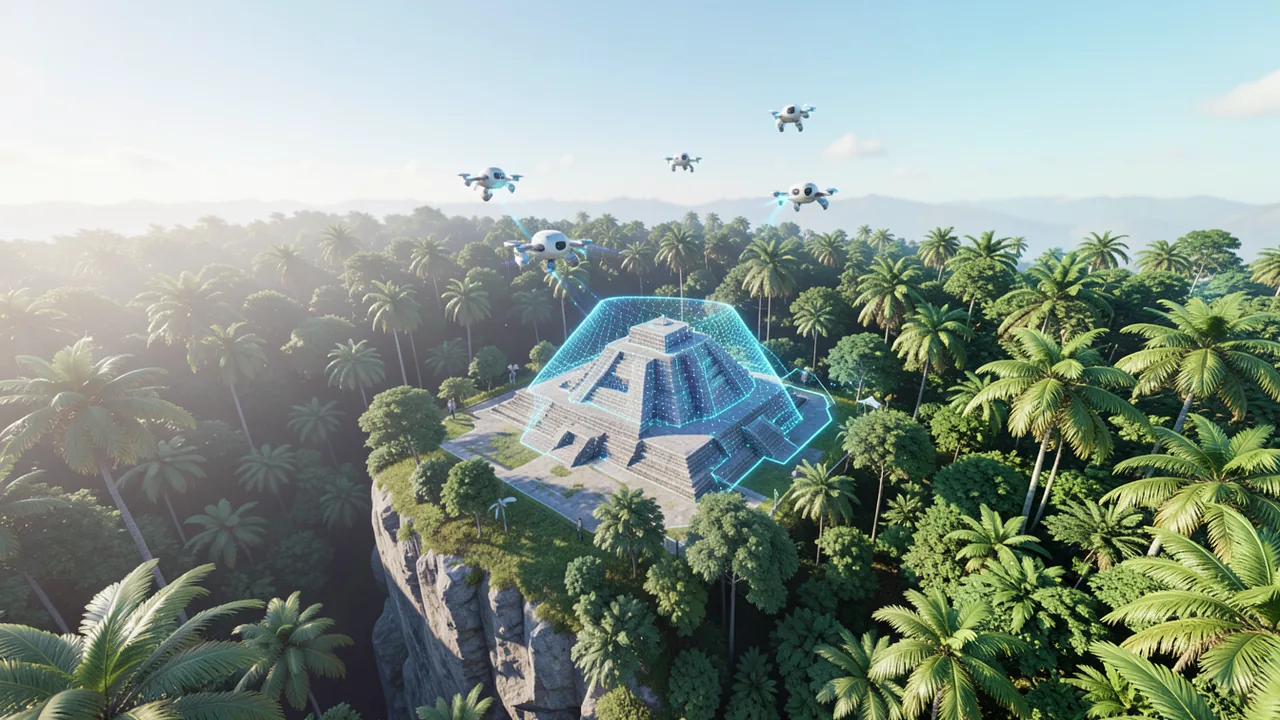
What it's about
Pietro Miotti says he's not an archaeologist. According to the title of the widely read Hacker News thread, he works as a software engineer at Google. On his blog, he describes how he used AI agents to find a Maya site in publicly available laser scans of the Mexican jungle, one that, as far as anyone knows, nobody had mapped before. Miotti says less than 72 hours passed between his first idea and an official reply from the Mexican government. AI agents are AI programs that don't just answer a question but carry out several steps on their own: finding data, analyzing it, doing research, writing reports.
The post, in which Miotti tells the story like a diary, went up on November 11, 2026 and quickly hit the Hacker News front page (with 284 points at the time of the source).
From Machu Picchu to the Maya: the diary
October 18: Miotti was traveling through Peru and having Google's Gemini explain the region's history. Along the way he came across Hiram Bingham, the American explorer who "discovered" Machu Picchu in 1911. Bingham was actually looking for a different city, Vilcabamba, when a farmer led him to the ruins. Miotti wondered what Bingham would have done with today's tools.
He asked several AI systems, namely Gemini, ChatGPT, Claude and Grok, and all of them suggested lidar. Lidar is a measurement technique in which an aircraft fires laser pulses downward. Some of them slip through gaps in the canopy all the way to the ground. The returning signals are used to build a 3D model of the terrain beneath the trees. On regular satellite photos, by contrast, a ruin in the jungle just looks like forest.
Miotti found very little public lidar data for Peru, and commissioning his own survey would have meant permits, costs and red tape. So he switched to the Maya region, which is much better covered by public lidar data. In the evening, he gave the agents their analysis task and went to bed.
October 19: By morning, the reports were in, with numerous villages and regular shapes that looked like buildings. Miotti then had the agents check the academic literature and archives to see which of them weren't yet known. After a few hours, one agent reported that a larger settlement didn't seem to be registered anywhere. The agents also told him whom to contact: INAH (Instituto Nacional de Antropología e Historia), Mexico's national institute of anthropology and history. They supplied instructions and email addresses and drafted the report.
October 20: Miotti revised the report and had it translated into Spanish, because Claude said that would improve the odds of getting a reply. He doesn't speak Spanish himself and had to trust the agents. Before sending it, the agents also checked the raw point cloud, the individual laser measurement points, to make sure the shapes were really in the ground and not an illusion created by trees. Then the report went off to INAH.
October 21: INAH replied that its records show no archaeological site at that location.
How the 48 agents worked
Technically, the approach is surprisingly simple. The agents converted lidar strips covering about 1,200 square kilometers of jungle into images. Then 48 agents went through those images one by one, "like very patient archaeologists," as Miotti puts it. They looked for pyramids, platforms and plazas and weeded out natural hills, sinkholes (collapses in the limestone) and roads. There was no specially trained detection model or classifier, meaning a program trained for one specific sorting task. The agents simply looked at the images while following precise instructions. Miotti doesn't say which models powered the 48 agents, nor does he give any details on cost or compute.
What they found
The site sits on a hilltop at the edge of a cliff, hidden beneath the jungle. What stands out are straight edges and sharp corners, and straight lines are rare in nature. In detail, you can make out:
| Structure | Description | Possible function (speculation) |
|---|---|---|
| Plaza | leveled area | gatherings, ceremonies, maybe a market |
| Pyramid | oval, at least 8–12 m tall | temple |
| Raised courtyard | built directly onto the pyramid | residence of the local ruler |
| Flat-bottomed depression | hollow | aguada (rainwater reservoir) or just a hole |
| Three platforms | around the plaza | houses |
Miotti stresses that the interpretation is speculation, the product of a long conversation with the agents. On that reading, it could be a small administrative and ceremonial center from the Classic Maya period, roughly AD 250 to 900, essentially the "downtown" of a local elite. Maya settlements needed reservoirs like aguadas to get through the dry season. He had Gemini generate a reconstruction of what the place might once have looked like. He doesn't disclose the exact location in the post.
Scientific background
Miotti isn't the first to use lidar for Maya research. He cites the literature himself: NASA's G-LiHT instrument (Cook et al. 2013), the reuse of environmental lidar for archaeology (Golden et al. 2016) and the discovery of an entire Maya city in Mexico in 2024 (Auld-Thomas et al. 2024). There are also studies on population size in the Maya lowlands (Estrada-Belli et al. 2025) and on possible marketplaces (Šprajc 2026).
The 2024 study was covered by outlets including Germany's Bild. In it, researchers led by Luke Auld-Thomas of Northern Arizona University analyzed lidar data originally collected for ecology, construction and forestry. Across roughly 130 square kilometers in the state of Campeche, they found 6,674 previously unknown structures, including a large city with pyramids. Writing in the journal "Antiquity," Auld-Thomas described how things used to be: archaeologists walked every square meter and cleared vegetation with machetes. Because dedicated lidar flights are expensive, existing datasets are often re-analyzed. Miotti took exactly that route, except that he handed the tedious image review off to AI agents.
What happens next
In Mexico, archaeological sites are protected under federal law, and any fieldwork requires a permit from INAH. Miotti has offered to help with a site visit led by the institute. Whether a team goes out is now up to the responsible regional INAH center. Until then, the discovery is explicitly not officially confirmed.
Miotti's conclusion is very optimistic:
"We are on the verge of a revolution in all sciences, and the only remaining bottlenecks will be curiosity and imagination (and compute)."
Our take
The story is a vivid example of how AI agents can do more than write code or crunch numbers: they can also take on painstaking review work in other fields. They sifted through large amounts of data, checked the literature, figured out the reporting process and wrote a report in Spanish. Notably, no specialized model was needed.
There are reasons for caution, though. The fact that INAH has no registered site at this location doesn't mean the structures are actually man-made, or that nobody has ever seen them. Only a visit on the ground can confirm that. All claims about size, age and function come from the author or his agents and haven't been reviewed by an expert. It's also unclear how many false positives the agents produced and how much human cleanup was needed. And as the 2024 study shows, archaeologists now find thousands of structures with lidar, so a single small site isn't a research breakthrough. What's exciting is mainly how quickly, and with how little expertise, it was found. But that's also where the risk lies: if anyone can track down sites with AI, looters could benefit too. Against that backdrop, Miotti's decision not to publish the exact location makes sense.
Sources
- Hacker News Startseite pietromiotti.com
- Merkliste: hn.svelte.dev hn.svelte.dev
- bild.de bild.de
Ask the AI assistant
Questions about this article, installation or background? Our assistant knows this page and runs on our own machine, not in someone else's cloud.
The Assistant is an AI (Gemma 4) and can make mistakes – please check important details against the source. Questions are used only to generate an answer and are deleted after one hour. Please don't enter any personal data.



Comments
What do you think? Already tried it? Write it here, no sign-up needed.
Comments are public. Links aren't allowed, and we delete abusive posts. You can delete your own comment at any time in this browser. Learn more in the Privacy Policy.