
Apple researchers walk a humanoid through unseen rooms using a Mac mini and Qwen
An Apple research team has unveiled HALO, a control system for humanoid robots trained almost entirely on simulated data. A Unitree G1 robot carrying a Mac mini on its back completed 91 percent of its single tasks in six rooms it had never seen before. Multi-step tasks are still a lot harder for it.
What it's about
An Apple research team has unveiled HALO, a control system for humanoid robots, meaning robots built in human form. On November 4 (local time), the researchers submitted the paper "Perceptive Humanoid Motion from Simulation" to arXiv. That platform hosts scientific papers as preprints, before other experts have peer-reviewed them. According to the financial news site BigGo Finance, Apple also released the code for data generation, model training and deployment on the robot. The sources don't say whether the fully trained models are available for download too.
The test platform was the G1 humanoid from Chinese manufacturer Unitree Robotics. The setup stands out: a Mac mini sits on the robot and runs a vision-language model from Alibaba's Qwen family. The main source, a post by Pasquale Pillitteri, is only available as a headline. The technical details in this article come from BigGo Finance's report.
What the robot can do
An Apple robot isn't the news here. The news is that the robot doesn't need to know its surroundings in advance. Many systems like this first scan a room and store it as a map. HALO instead learns its movements in simulation and carries them straight over to real rooms it has never seen. Researchers call this sim-to-real transfer.
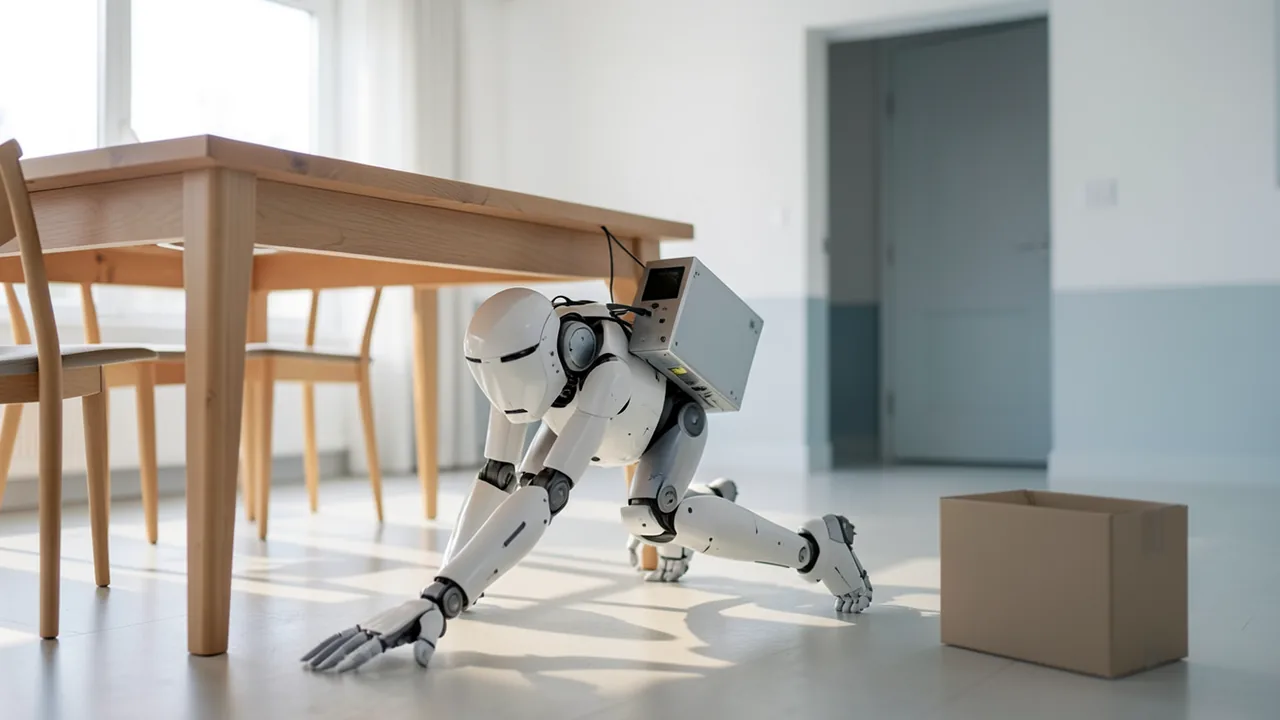
In six real rooms that hadn't been mapped beforehand, the G1 ran a total of 360 single-task trials. Its average success rate was 91 percent. In the team's videos, the robot pushes boxes, follows people and sits down on a chair when told to. It also turns sideways to get through a half-open door, or crouches and crawls under a table. According to the report, these movements aren't hard-coded. The robot keeps adjusting them based on what it sees, how it reads the room and how it's standing at that moment.
How the "brain" works: three layers
HALO splits control into three layers that run at different speeds:
| Layer | Job | Technology | Rate |
|---|---|---|---|
| Task planning | Understand instructions, break them into sub-steps | Qwen3.6-35B-A3B (vision-language model) on a Mac mini, optional cloud model via API | as needed |
| Motion generation | Plan whole-body motion about 5 seconds ahead | Qwen3.5-2B as a frozen encoder plus a DiT decoder | refreshed about 3 times per second |
| Motion tracking | Turn plans into joint commands | trained with reinforcement learning and policy distillation | 50 times per second |
At the top is a vision-language model, an AI that understands images and text at the same time. By default, that's Qwen3.6-35B-A3B. The name tells you how it's built: 35 billion parameters in total, of which only about 3 billion are active per step. Mixture-of-experts models like this use only part of their network for any given task. That's why they run smoothly enough even on a compact computer like the Mac mini. The robot doesn't need an internet connection. If you want more reasoning power, you can also call a stronger cloud model through an API.
In the middle, the small Qwen3.5-2B model works as a "frozen" encoder. It isn't trained any further and just translates camera images and the current sub-step into a representation the system can compute with. A DiT decoder turns that into motion. DiT stands for Diffusion Transformer, the same technique many image generators use. Here, though, it doesn't produce images. It produces whole-body motion sequences.
At the bottom sits the motion tracker. It converts the plans into concrete commands for the joint motors 50 times per second. It was trained with reinforcement learning, which means learning by trial and reward, and with policy distillation. In that process, a large, expensively trained control model passes its skills on to a smaller, faster one.
Lots of compute for synthetic data
Training relies almost entirely on artificially generated data. The team had 1,000 home environments generated automatically and produced around 300 hours of training data in them. That took about 48 hours on 250 Nvidia H100 GPUs. The team trained the motion generator with imitation learning, where the model copies given examples, on 64 Nvidia B200 chips. Four H100s were enough for the motion tracker.
BigGo Finance calls it notable that Apple is publishing the data-generation pipeline. Synthetic training data is becoming standard equipment for robotics research, because collecting real data from real robots is expensive and slow.
Where it still falls short
The success rate is high for single tasks but not for multi-step sequences. The researchers tested three combined tasks ten times each, but only in a single real room. On average, 70 percent worked. The sequence "duck under an obstacle, walk to a target and push a box" succeeded only 50 percent of the time. Chaining several steps together cleanly is still hard.
The team points out two more limits itself:
- New tasks still need manual work. Someone has to write prompts and design keyframes of the motion. Some movements also rely on videos of people or on motion-capture recordings, where real people's movements are recorded with sensors.
- The robot depends almost entirely on its eyes. It can barely sense directly whether it's touching something. Tasks with a lot of physical contact go worse as a result, especially when an object leaves the camera view or is hidden. The researchers name tactile sensors as the next step.
Reactions from the financial world
BigGo Finance puts the paper in a wider context. Several Chinese brokerages see the "physical AI" sector, meaning AI that acts in the physical world, at a turning point. CITIC Securities says global corporations are entering the market. Sinolink Securities notes that large AI models are moving from perceiving and understanding to planning and moving. China Securities expects robots to be controlled in future through "robot-use agents": large models that call control interfaces and fix their own mistakes. On China's stock market, humanoid robot stocks have risen sharply since early November. That's market sentiment, though, not proof that the technology works.
Our take
HALO is a research project, not a product. The sources don't say whether Apple is planning a robot of its own. The work is interesting for three reasons:
- A freely available Chinese open-weight model controls a Chinese production robot, running locally on ordinary Apple hardware. Capable robot control doesn't necessarily need a data center.
- The robot moves through unfamiliar rooms without mapping them first. That's a prerequisite for use in real homes.
- Apple is releasing the code. That's unusual for a company that's usually so secretive, and it lets other teams check the results.
Still, read the numbers with care. 91 percent on single tasks also means almost one in ten attempts fails. That's still too many for a household robot. The combined tasks were tested in just one room with ten attempts each, a very small sample. New skills still need hand-written instructions, and without a sense of touch, the robot remains unreliable at contact tasks. The results haven't been independently verified yet. The paper is a preprint that hasn't been peer-reviewed.
Sources
- Google News (TR) pasqualepillitteri.it
- finance.biggo.com finance.biggo.com
- eu.36kr.com eu.36kr.com
Ask the AI assistant
Questions about this article, installation or background? Our assistant knows this page and runs on our own machine, not in someone else's cloud.
The Assistant is an AI (Gemma 4) and can make mistakes – please check important details against the source. Questions are used only to generate an answer and are deleted after one hour. Please don't enter any personal data.

Comments
What do you think? Already tried it? Write it here, no sign-up needed.
Comments are public. Links aren't allowed, and we delete abusive posts. You can delete your own comment at any time in this browser. Learn more in the Privacy Policy.