
Boston Dynamics puts Atlas on scooter wheels, and it nails a 360-degree spin jump
Boston Dynamics swapped the feet on its Atlas humanoid for kick-scooter wheels. Trained with reinforcement learning in simulation, the robot rolls, balances and spins. Its 360-degree jump worked on the very first real-world attempt.
What's going on
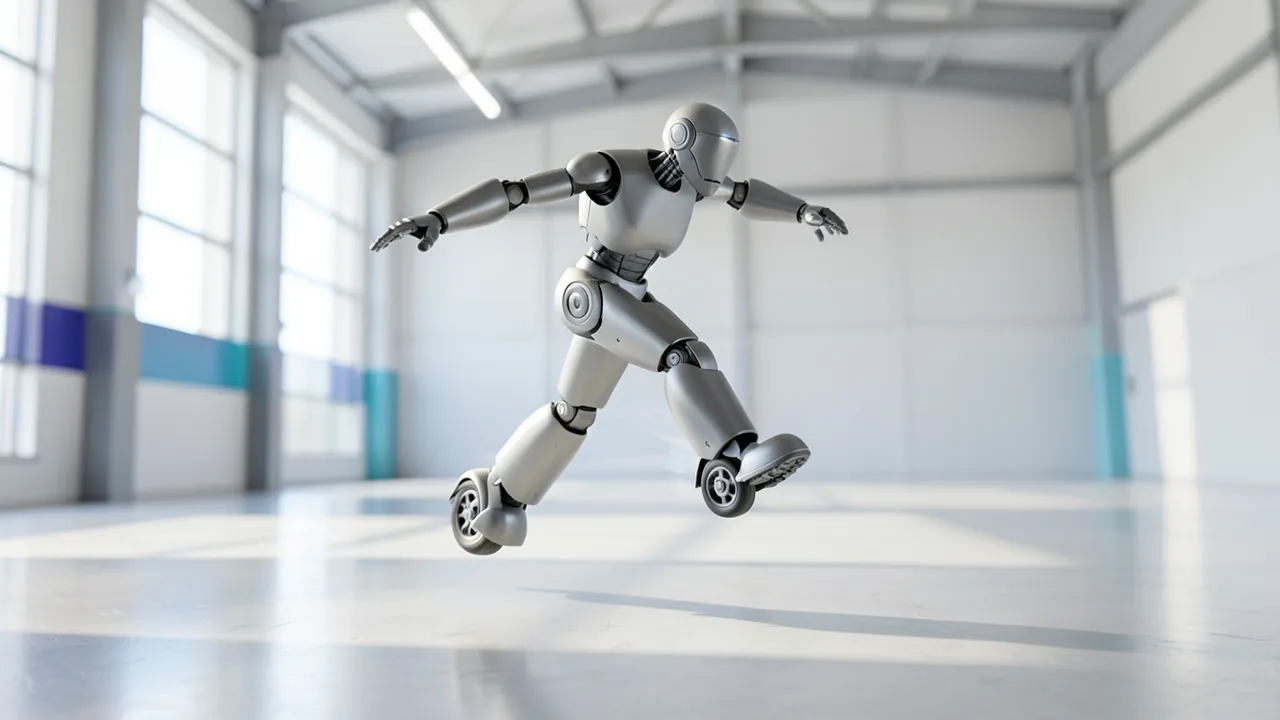
Boston Dynamics, the robotics subsidiary of South Korea's Hyundai Group, released a research video on November 9, 2026 showing its electric humanoid robot Atlas on wheels. In place of feet, each leg ends in a wheel like the ones on a kick scooter. In the video, Atlas drives fast, changes direction abruptly, shoots off sideways, balances on one wheel with the other leg lifted, gets up off the ground and jumps with a full 360-degree spin in the air, a bit like a figure skater.
One thing up front: this isn't a product. Boston Dynamics stresses that the rolling Atlas is a research platform for pushing its motors and whole-body control to their limits. There are no plans to sell it. According to Hyundai, the walking version of Atlas is due to enter "real-world deployment" starting in 2028, in places like factories.
One adapter, one scooter wheel, done
According to the tech blog TechEBlog, the conversion was surprisingly simple. A single custom adapter connects an off-the-shelf kick-scooter wheel directly to the existing ankle actuator, the motor that normally moves the ankle joint. That adapter is the only new part in the whole setup. Atlas was already designed for mass production and easy maintenance, so the swap took about as much effort as changing a bike wheel.
The software barely changed either. The team modeled each wheel as an ankle joint that keeps spinning. Then they trained the same whole-body controller that runs the walking version. That's the control software that coordinates every joint at once. TechEBlog says only a few things needed adjusting for the move to the real robot: the training rewards, the allowed control commands and the body posture.
Why wheels?
The real goal is a stress test for the motors. On wheels, the actuators have to deliver high torque and high speed nonstop while accelerating, turning and braking, and they carry the robot's full weight the whole time. Normal walking gives them constant short breaks. Boston Dynamics says this sustained load is ideal for finding the motors' performance limits. It also shows whether the software can control the robot reliably under extreme conditions, including when ground contact keeps changing.
Training in simulation: reinforcement learning and sim-to-real
Atlas learned its moves through reinforcement learning. Software tries out movements millions of times in a virtual environment and gets "rewarded" for the behavior you want, until it lands on a good strategy. TechEBlog reports that the team simulated millions of different surfaces for this.
The hard part is the so-called sim-to-real gap. Something that works in simulation often fails on the real robot, because the virtual world never reproduces physics exactly. So Boston Dynamics focused on bringing the behavior of the real motors into the simulation as accurately as possible. The team ran parameter checks and characterization tests, which are series of measurements showing how a motor actually behaves under different conditions. That way the learned controller never asks for moves the real actuators can't deliver. Fittingly, the video's subtitle is "Classical Motor Controls and Whole-Body RL": classical motor control combined with whole-body learning.
A pirouette on the first try
Some moves came almost naturally. Take the sideways dash. A human would do it by sliding their feet sideways. The template came from motion-capture recordings of a person, and the controller worked out how to pull off the same move on wheels.
The 360-degree spin jump was considered much harder. It also followed a recorded human motion trajectory, and Boston Dynamics says it worked on the real robot on the very first attempt. Just before takeoff, the controller positions the lower body and uses clever wheel "footwork" to build the upward momentum it needs. The engineers describe the robot as stable and responsive. According to TechEBlog, they even call it "fun to drive."
Atlas controls engineer Andy Wu said:
"What was especially impressive was how the robot dashed sideways while jumping during the learning process. I was amazed and delighted when the robot figured out on its own, through the learning pipeline, how to get around by rolling its wheels."
What the walking Atlas gets out of it
TechEBlog says the lessons are already flowing back into the version with feet. Motor dynamics and whole-body learning are now more tightly linked, so the walking Atlas can push its hardware harder. It also recovers much more smoothly from disturbances like shoves and handles more maneuvers safely. Hyundai frames all of this as part of its push into "physical AI": AI that controls machines in the real world instead of just generating text or images.
Our take
Flashy videos are a Boston Dynamics tradition, but the real news here is under the surface. A robot gets a completely new way of touching the ground, and the existing learning pipeline handles it with minimal changes. A demanding move like the spin jump working on the first try, with no tuning on the real hardware, suggests Boston Dynamics is closing the sim-to-real gap. That gap is one of the central problems in robotics.
Some caveats: every claim comes from Boston Dynamics itself, and there are no independent measurements. We don't know how many attempts failed, how robust the behavior is outside the lab, or how much of it will actually make it into the production Atlas. Wheeled legs aren't a new idea either. Companies like ANYbotics and Unitree have shown robots with wheels on their legs for years. What's new is that a production humanoid was converted with a single adapter part and the same control software.
Related videos
Sources
- Naver News (KR) kukinews.com
- mt.co.kr mt.co.kr
- techeblog.com techeblog.com
- en.fnnews.com en.fnnews.com
- Merkliste: interestingengineering.com interestingengineering.com
- Merkliste: businesskorea.co.kr businesskorea.co.kr
- Slashdot hardware.slashdot.org
- Naver News (KR) aitimes.com
- Habr KI (RU) habr.com
- Merkliste: gadgetreview.com gadgetreview.com
- Bing News (pt-BR) tekimobile.com
- NewsData (ukraine) gagadget.com
Ask the AI assistant
Questions about this article, installation or background? Our assistant knows this page and runs on our own machine, not in someone else's cloud.
The Assistant is an AI (Gemma 4) and can make mistakes – please check important details against the source. Questions are used only to generate an answer and are deleted after one hour. Please don't enter any personal data.



Comments
What do you think? Already tried it? Write it here, no sign-up needed.
Comments are public. Links aren't allowed, and we delete abusive posts. You can delete your own comment at any time in this browser. Learn more in the Privacy Policy.