
Canva Craft: first in-house image AI model plans layouts before it draws
With Craft, Canva has released its first in-house image model. It plans composition and text placement first, then draws, trained on millions of Canva templates. It debuted at No. 4 on the DesignArena leaderboard and is also available via API.
What this is about
Canva, the design platform with more than 250 million users according to Betanews, unveiled Canva Craft on October 22, 2026. It is the company's first fully in-house AI image model, and it competes with models from OpenAI, Google and others. According to The Verge, Craft is available to all users worldwide. In Canva, you'll find it in Dream Lab (in the left-hand menu under the three dots). Developers can also build it into their own apps through an API.
How Craft works: plan first, then draw
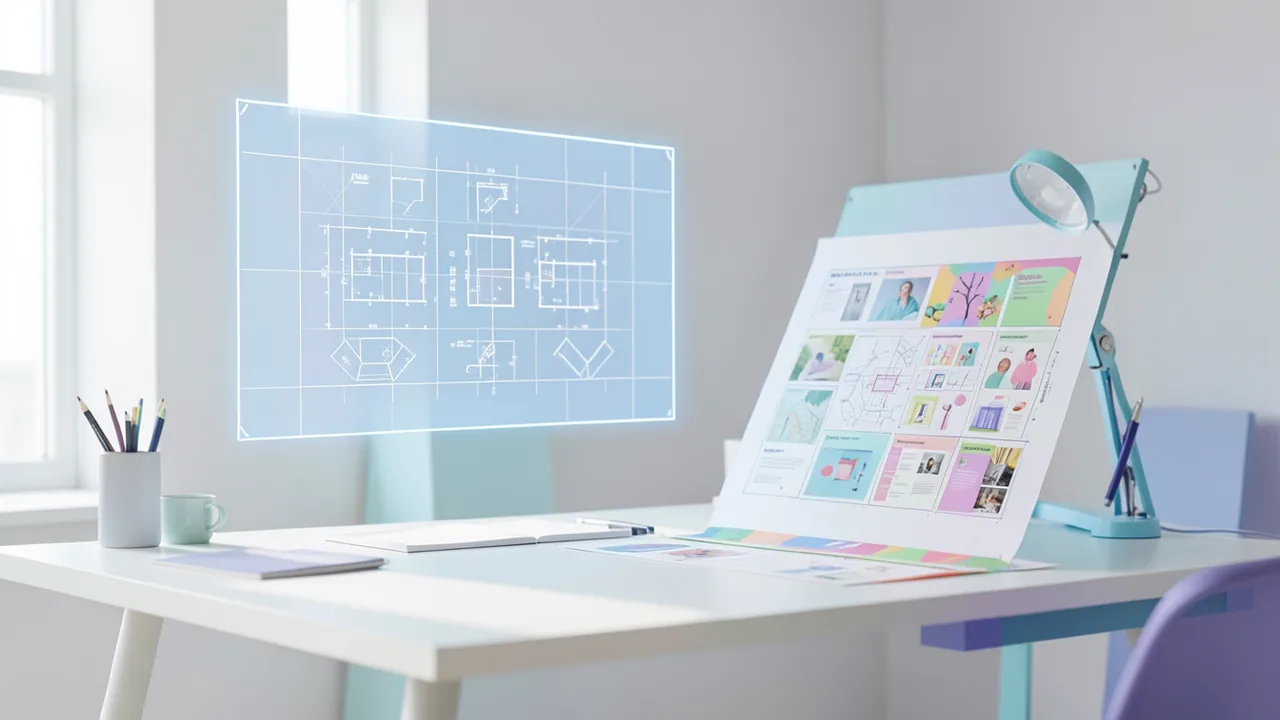
Most image AIs go straight from text prompt to pixels. Craft splits this into two steps:
- Planner: Reads the request and decides which objects appear where and at what size, what matters most, and which words must appear in the image.
- Image model: Draws the finished image from that plan, in over 30 aspect ratios and up to 2K resolution.
This is meant to keep text legible and place objects precisely. Canva says that's an advantage for posters, social media graphics and marketing material. You can also change one part of an image without touching the rest. More editing tools and support for working with reference images are planned for later. Prompts work in any language, and in-image text is supported in 55 languages, according to Betanews. Craft falls under Canva Shield, which checks inputs and outputs and lets users report harmful content.
Trained on templates, not just photos
The biggest difference from rivals: according to Canva, Craft was trained on millions of human-made templates from the Canva library, including menus, infographics, slides, social media graphics, posters and text-heavy layouts. Other models mostly learn from photos. The model was then refined with reinforcement learning (learning through rewards) and supervised fine-tuning (further training on curated examples), guided by in-house designers.
Designers and researchers compared more than 25,000 image pairs against competing models. When automated scores and human judgment disagreed, the rule was: "We sided with the designer."
Numbers and leaderboard
On DesignArena, a leaderboard where users rate images by voting, Craft debuted at No. 4. According to The Verge, GPT-Image-2.5 Sunburst, GPT-Image-2.5 Flare and GPT-Image-2 rank ahead of it. TechRadar names models below it such as Nano Banana 2.1.
| Category | Rank |
|---|---|
| Overall | 4 |
| People & Portraits (87 models) | 1 |
| Landscapes & Nature (85) | 1 |
| Abstract & Patterns (85) | 2 |
| Products | 4 |
Canva sees itself as the second-best image lab on this list. According to Betanews, the Elo score (calculated from votes) was 1330 on October 23, down from 1340 at launch. Such values shift as new models arrive.
Speed, cost, API
With more than 400 new designs created per second, speed and cost matter a lot. Through distillation (a small model learns to imitate a large one), the number of processing steps was cut sharply. Together with a dedicated engine for the planner, Craft runs about ten times faster than the earliest internal version. Two cheaper variants, Craft-fast and Craft-ultrafast, have been announced, with no prices or dates. Partner models remain in use alongside it.
Through the Connect API, you select the model name craft_v1_2k. Each request uses AI credits and takes "about 50 to 60 seconds", according to the developer forum. Support for Canva's MCP server (which connects AI assistants) is due soon.
Hands-on impressions
A user on note.com who hadn't touched Dream Lab in a year was surprised: four images appeared in about a minute, all different and of good quality. He found it especially useful for re-laying out his own designs and creating thumbnails from photos. One oddity: when a reference image is attached, the "Canva Craft" label disappears and "Use of attached image" (adopt the style or edit the image) appears instead. It's unclear which model is working then. After 14 generations, his usage showed 14%, so there seems to be a monthly limit that depends on your plan. Dream Lab launched in October 2024, initially with Leonardo.Ai's "Phoenix" model.
Our take
Craft matters strategically for Canva: in-house models give it more control over costs. Training on templates and planning ahead addresses the weakness many image AIs have with text and layout. No. 4 overall and top scores for portraits and landscapes are strong, but they rest on a single voting-based leaderboard that changes quickly, and OpenAI is still ahead. "Second-best lab" is Canva's own reading. Independent tests of text quality and reference-image features are still to come.
Related videos
Sources
- Bing News (en-US) note.com
- betanews.com betanews.com
- theverge.com theverge.com
- techradar.com techradar.com
Ask the AI assistant
Questions about this article, installation or background? Our assistant knows this page and runs on our own machine, not in someone else's cloud.
The Assistant is an AI (Gemma 4) and can make mistakes – please check important details against the source. Questions are used only to generate an answer and are deleted after one hour. Please don't enter any personal data.

Comments
What do you think? Already tried it? Write it here, no sign-up needed.
Comments are public. Links aren't allowed, and we delete abusive posts. You can delete your own comment at any time in this browser. Learn more in the Privacy Policy.