
ChatGPT now types as you talk: live dictation drops the 10-minute limit
OpenAI has reworked dictation in ChatGPT. Your words now appear on screen while you're still speaking, and the old ten-minute cap per recording is gone. The update is coming to every plan, free accounts included. Privacy advocates and tech outlets are pointing out what can happen to all those long recordings.
What's going on
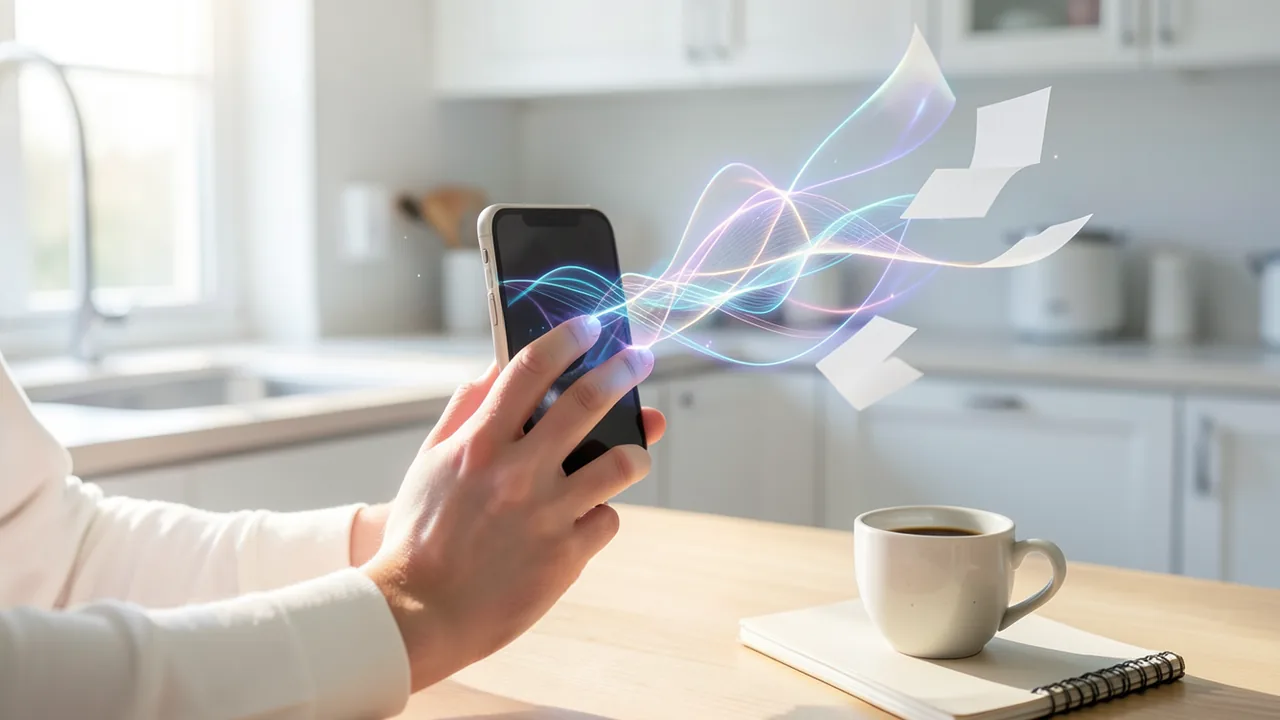
OpenAI has rebuilt ChatGPT's dictation feature. Since November 18, 2026, the company has been gradually rolling out "Live Dictation" worldwide. It's available on every plan, including free accounts, on iOS, Android, the web and the desktop app. Because the rollout is staggered, some users won't see it yet, Notebookcheck notes.
Two things change. First, your words show up on screen right away, word by word, while you're still talking. That's called real-time transcription. Until now, the text arrived as one big block after you stopped recording. Second, the ten-minute limit per recording is gone. OpenAI also says the feature is faster and more reliable than the old version.
Dictation isn't Voice Mode
Don't mix them up. This is about the microphone icon in the input field, not Voice Mode, where ChatGPT talks back in its own voice. Dictation only turns speech into text. According to Notebookcheck, the finished transcript lands in the message field as soon as you stop speaking. You can edit it there before you hit send.
There's also a small new toggle. Tap or click the waveform while you're dictating to show or hide the live text. Digital Trends says this is meant for people who don't want the screen distracting them while they talk.
Digital Trends names the biggest practical benefit: when you can read along live, you catch misheard words right away. You can also rephrase mid-thought or talk at length, say for brainstorming, drafting or multi-step instructions. Windows, macOS, iOS and Android all have their own dictation that turns speech into text. Live Dictation, though, is built right into ChatGPT, so speaking, checking and sending flow together without a detour. According to 9to5Mac (quoted by Notebookcheck), the old limit was a real nuisance for notes, long prompts or emails, because longer recordings simply got cut off.
What OpenAI isn't saying
There are no hard numbers. Digital Trends points out that OpenAI hasn't published any latency figures (the delay between speaking and seeing the text), any recognition accuracy data or a new maximum recording length. All it says is that the feature is "faster and more reliable". Whether there's still an internal limit, say for extremely long recordings, is unclear.
In a short demo video on X, OpenAI has an actor talk at length about his long friendship with a close friend. ChatGPT then sorts it all into bullet points as the basis for a best man's speech.
Part of a bigger voice strategy
The update fits OpenAI's plan to make talking to AI feel as natural as talking to another person. In July 2026, the company introduced the voice model GPT-Live-1, which is meant to mimic the subtleties of human speech, like spontaneous laughter or pausing to think mid-sentence. According to Gizmodo, an OpenAI researcher described GPT-Live-1 during the livestream as:
"a step closer to truly accessible AGI, a world where talking to AI actually feels like a real conversation"
Gizmodo dryly notes that the model still thinks "seventeen" has two E's. The outlet also brings up start-ups like Friend, which sell voice-driven AI companions and whose New York subway ads were widely defaced. Gizmodo sees a business angle too: OpenAI needs to win over a broad audience before it follows Anthropic to the stock market.
The flip side: talk more, reveal more
Gizmodo raises the sharpest objection. When you speak instead of typing, you often share more than you meant to. The outlet cites a 2025 study of 171 knowledge workers by Danish audio maker Jabra and the London School of Economics. Participants' trust in AI rose by an average of 33 percent with voice commands compared to typed input. The author writes that typing forces her into a careful weighing of words that often gets lost when you just start talking. For people who use ChatGPT as a stand-in for therapy, she argues, dropping the ten-minute limit could make it "dangerously easy" to share deeply personal things unfiltered. That's why Gizmodo calls the feature a potential "goldmine of training data" for OpenAI.
OpenAI's help pages spell out what happens to your data. Notebookcheck and TechNews went through them:
- Processing: The recording goes to OpenAI and is transcribed on its servers, not on your device.
- Retention: The audio file is kept as long as the chat stays in your history. If you delete the chat, OpenAI removes the recording within 30 days. Exceptions apply to recordings that have to be kept for security or legal reasons, and to clips you previously shared for training that have already been disconnected from your account.
- Training on audio: OpenAI says it only trains on dictation audio if you've turned on audio sharing yourself: "If you're a consumer user and have chosen to share audio to improve our models, we may train on audio from dictation."
- Training on text: This is the catch, according to Notebookcheck. The transcript is sent like a normal message, so the general "Improve the model for everyone" setting applies. That setting is on by default for personal Free, Plus and Pro accounts. If you dictate a lot and don't change anything, you may be handing over a lot of dictated text as training material.
- Business accounts: On ChatGPT Team, Enterprise and other business plans, OpenAI doesn't use your data for training by default.
How to turn off training
You'll find both toggles in ChatGPT under Settings → Data Controls:
| Toggle | What it does |
|---|---|
| "Include your audio recordings" | Only stops audio sharing, for both dictation and voice chat |
| "Improve the model for everyone" | Keeps your chats, including dictated text, out of training. Your chat history stays intact |
If you want to play it safe, turn off both and delete sensitive chats. The matching recordings then disappear within 30 days too. Notebookcheck also mentions that Google separated Gemini's history from AI training this week, but now keeps chats there for longer.
The bigger picture
Technically, Live Dictation isn't a revolution. Operating systems and plenty of apps have offered real-time transcription for years. Still, you'll notice the change in everyday ChatGPT use. You can now dictate long trains of thought, email drafts or detailed task descriptions in one go, without getting cut off after ten minutes and without waiting blind for the result. And because it's coming to the free plan, a huge number of people can use it right away.
Two concerns remain. OpenAI offers no verifiable numbers on speed or accuracy, so "faster and more reliable" is just the company's claim for now. And the privacy question is fair. The feature itself isn't the problem. The problem is that training on chat content is switched on out of the box for personal accounts. If you dictate a lot, and freely, check your Data Controls first.
Sources
- Google News (TH) techsauce.co
- Google News (TW) infosecu.technews.tw
- digitaltrends.com digitaltrends.com
- gizmodo.com gizmodo.com
- notebookcheck.net notebookcheck.net
- Google News (UA) news.google.com
- Google News (TR) news.google.com
Ask the AI assistant
Questions about this article, installation or background? Our assistant knows this page and runs on our own machine, not in someone else's cloud.
The Assistant is an AI (Gemma 4) and can make mistakes – please check important details against the source. Questions are used only to generate an answer and are deleted after one hour. Please don't enter any personal data.
Comments
What do you think? Already tried it? Write it here, no sign-up needed.
Comments are public. Links aren't allowed, and we delete abusive posts. You can delete your own comment at any time in this browser. Learn more in the Privacy Policy.