
Claude Fable 5.2 paints in Python: 700,000 brushstrokes for one photoreal image
Anthropic's new Claude Fable 5.2 doesn't use an image generator. It writes programs that paint a virtual canvas one brushstroke at a time, then paints over its own mistakes the way a human artist would. The community is also sharing 3D animations built entirely in code.
What's going on
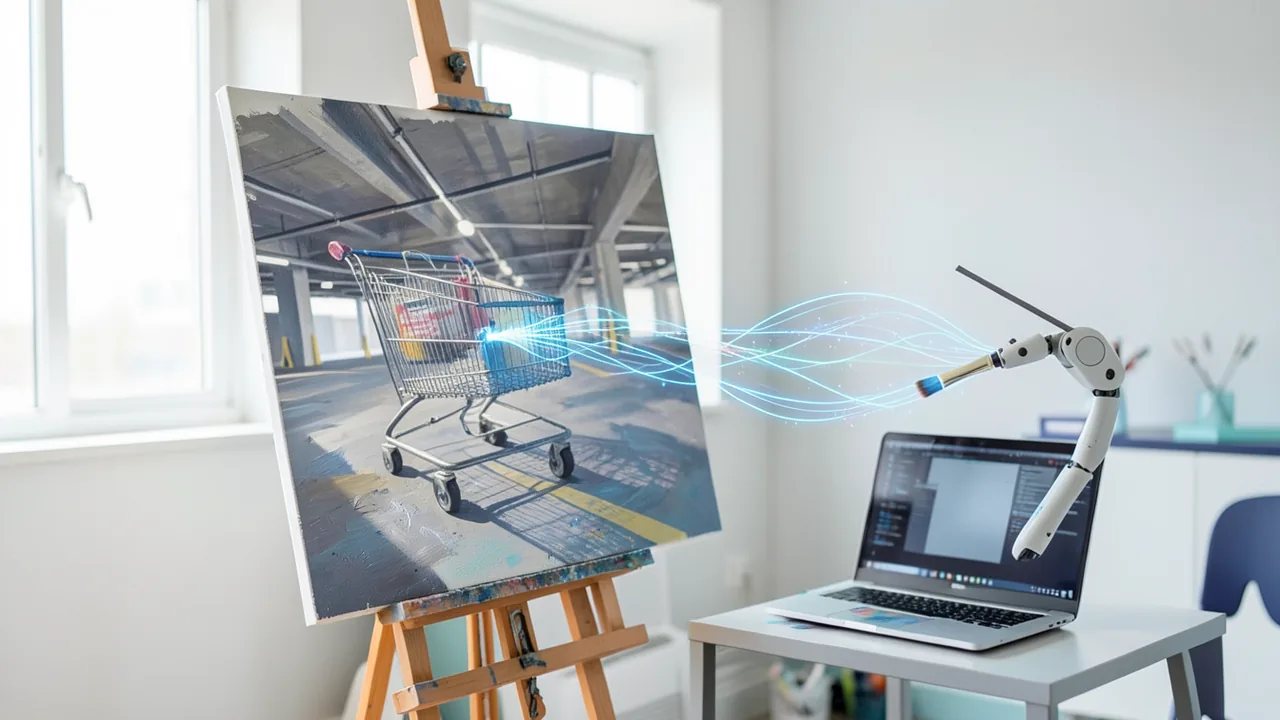
Anthropic has released Claude Fable 5.2, a new large language model. Just a day after launch, one ability that isn't on the spec sheet was already making the rounds on social media: the model can paint pictures without using an image generator. Instead, it writes Python programs that paint a virtual canvas one brushstroke at a time. The results range from deliberately painterly pieces to one image you'd struggle to tell apart from a photo.
Most of the examples came from Anthropic employees on X, including Jake Eaton and Michael Graczyk. The German tech publication The Decoder rounded them up. Other reports, on vocal.media and BigGo Finance, describe more experiments from the community, including 3D animations made entirely in code.
Painting, not generating: how it works
Well-known image models like Midjourney mostly rely on diffusion. The model starts with an image of pure noise, a bit like TV static, and refines it step by step into a clear picture. Fable 5.2 does something completely different: it imitates the act of painting.
According to Eaton, every artwork is a Python program of 1,000 to 2,000 lines. The program drives a simulated paint engine, essentially a small physics simulation of brushes, bristles, paint application and canvas. Every single stroke runs through this simulation before it lands on the canvas. Eaton says Claude doesn't use any external image model, and no pre-rendered or traced templates either. It's reminiscent of agentic image editing: the language model picks its own tools, applies them and judges the result.
The most striking example: Eaton asked the model for a painting that would be as hard as possible to tell apart from a photo. Fable 5.2 painted a shopping cart in a parking garage out of roughly 700,000 simulated brushstrokes. Zoom in, says the author on vocal.media, and you can see the details of individual strokes.
There's some backstory here. Earlier attempts with the sibling model Opus 5.5 drew criticism for merely imitating existing art. So Eaton had Fable 5.2 develop its own artist personas: invented painters with fictional life stories and a consistent style. A typical painting takes the model a few thousand strokes. Eaton nudges it in new directions with comments along the way.
The bird experiment: 111 strokes, no undo button
Even more revealing is an experiment by Anthropic engineer Michael Graczyk, who published the chat log and a video. The task was to paint a bird at sunrise. The rules were strict. The model could only use code for the physics simulation of bristles, wet paint and canvas texture. It had to output every brushstroke by hand as its own line with coordinates, and strokes couldn't be undone once placed.
The 21-second video uses a counter to show the image coming together from exactly 111 strokes. For the first stroke, the model chose the color code #30346a, a width of 90 pixels and five slightly wobbly waypoints. It said it built in the roughly seven-pixel wobble on purpose, because a human arm can't draw a perfectly straight line either.
Between passes, the model looked at the canvas and reacted to its own mistakes like a painter. When the bird's back came out too thin and scratchy, it laid a bolder stroke over it. The stray bristle lines ended up looking like ruffled feathers. In a second, 280-stroke painting of two people painting at dusk, a late lighting effect accidentally smeared some paint tubes and a cup. Claude then repainted those objects. It also had both figures paint with their outer hands so their inner shoulders could touch, as the prompt required.
The Decoder contrasts this with AI video models like Flux 3. Those generate image sequences, temporal consistency included, directly, rather than planning a process step by step.
What the community is building
Beyond the paintings, more examples are circulating, described by vocal.media and BigGo Finance:
- Pelican on a bicycle in 3D: The motif is a well-known test for AI models. A user called Tech Friend AJ had Fable 5.2 build a 3D animation of it. It's based on around 4,800 lines of Python that talk to the API of the 3D software Blender. Modeling, rigging (the digital skeleton used to move characters), animation and rendering all happened without a GUI.
- Video in pure code: Jeremy Berman also had the model drive Blender via Python, without "computer use", meaning the AI never controlled a mouse and keyboard itself.
- Games and animations: In one case, the model built a game prototype in eight hours. Another user made an animated film with the web 3D library Three.js in 83 minutes and 2,000 lines of code.
- Music: The model generates music through code, too. But the vocal.media author admits it can't currently match the dedicated music generator Suno.
The vocal.media author, a former 3D designer by his own account, compared the results with Google's Gemini 4 Carbon, released the same day. Technically, he says, Gemini isn't bad. The difference is "taste": rhythm, lighting and composition. According to BigGo, several testers feel the same way. These are subjective impressions, though, not measurements.
Robots and benchmarks: strong on paper, limits in practice
Anthropic is pitching Fable 5.2 at very demanding, long-running technical tasks. There's also a variant called Mythos 5.2, reserved for verified researchers in security and biology. Anthropic says Fable 5.2 solved two open problems in black hole physics during internal testing. Working with circuit board maker Diode, it reportedly designed three working electronic devices. And using more than 1,000 sub-agents, subordinate AI instances that handle subtasks, it supposedly wrote its own laptop operating system in eight days. These are the company's claims, and nobody has independently verified them yet.
A model that can plan steps and correct itself under physical constraints also has an edge in robotics. On the internal benchmark RoboDojo Sim, Anthropic reports these numbers:
| Model | RoboDojo Sim |
|---|---|
| Claude Fable 5.2 | 64.9 % |
| GPT-6 Astra (OpenAI) | 29.8 % |
AI researcher Aris Zhu compared the two models in the real world. Their task was to paint Van Gogh's "The Starry Night" with a physical robot arm. That's where Fable 5.2 showed its limits: GPT-6 Astra painted faster. And so far, only the OpenAI model has managed to stand a domino upright. It did so by slowly loosening its gripper and using gravity as a pivot.
The tools industry follows suit
BigGo Finance places the demos in a bigger trend. At Adobe MAX, which kicked off in Miami on November 10, Adobe announced that Photoshop, Illustrator, InDesign, Lightroom, Premiere and After Effects will support the Model Context Protocol (MCP). Through this interface, AI assistants like Claude, ChatGPT or Gemini can control the apps directly, for example to edit long videos or generate subtitles. Observers see it as a response to fears that AI will make software subscriptions obsolete.
Anil Chakravarthy, who becomes Adobe's CEO in December, put it this way:
"Adobe believes that creativity is uniquely human."
He stressed that Adobe also respects creatives who want nothing to do with AI. Deepa Subramaniam, VP of Creative Cloud product marketing, said experience, skill and above all taste will become the key differentiators for creative professionals.
The bigger picture
The approach is interesting for two reasons. First, the images are transparent: every stroke lives in the code and can be changed, unlike a diffusion image that comes out as a finished grid of pixels. Second, the experiments show something that goes beyond art. The model plans across many steps, evaluates its intermediate results and fixes mistakes without being able to start over. That ability matters for robots and long-running agent tasks too.
There are some caveats. The most impressive examples come from Anthropic employees, so they're hand-picked showcases. The robotics benchmark is internal, and in the only independent hands-on test, the competition came out ahead on speed and fine motor control. How long the paintings take to compute and what they cost via the API is unclear. The "taste" verdict against Gemini 4 Carbon rests on personal impressions. Even the enthusiastic vocal.media author concedes that simulated brushstrokes aren't the same as human painting, with its physicality and happy accidents. In his view, the model won't replace artists. It shortens the path from idea to finished work: if you can write good instructions and judge quality, you'll need less specialist knowledge and no full team to get there.
Sources
- The Decoder (DE) the-decoder.de
- vocal.media vocal.media
- finance.biggo.com finance.biggo.com
Ask the AI assistant
Questions about this article, installation or background? Our assistant knows this page and runs on our own machine, not in someone else's cloud.
The Assistant is an AI (Gemma 4) and can make mistakes – please check important details against the source. Questions are used only to generate an answer and are deleted after one hour. Please don't enter any personal data.
Comments
What do you think? Already tried it? Write it here, no sign-up needed.
Comments are public. Links aren't allowed, and we delete abusive posts. You can delete your own comment at any time in this browser. Learn more in the Privacy Policy.