
Claude Opus 5.5 designs a 200-part analog synth from scratch, and it actually works
An electronics blogger had Claude Opus 5.5 design, simulate, lay out and program a complete analog synthesizer with a Moog-style filter. It took 19 hours to get from the first prompt to the order files, and the finished board behaved almost exactly like the simulation.
What it's about
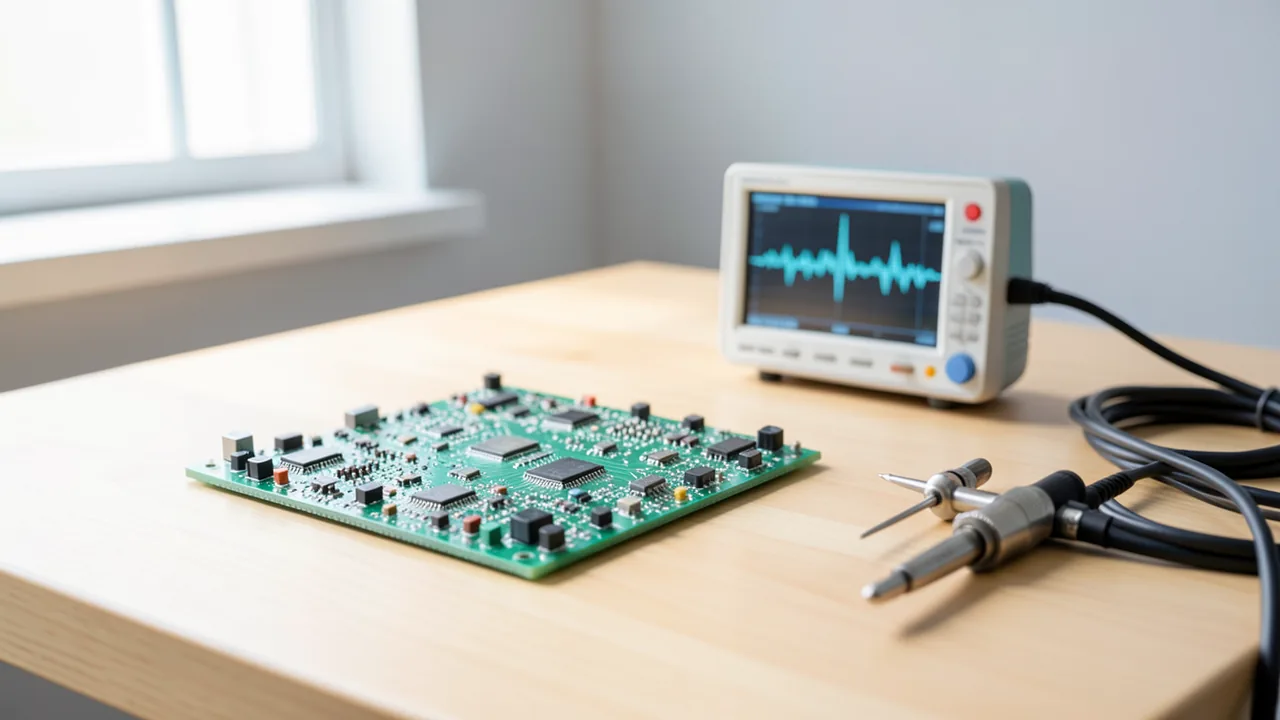
Can you just "vibe-engineer" analog electronics? In other words, can you let an AI design a real circuit without calculating every component yourself? Electronics blogger cpldcpu set out to find out. On his blog (cpldcpu.github.io) he explains how he used Claude Code with Anthropic's Claude Opus 5.5 to build a complete analog synthesizer. The board has around 200 discrete components: individual transistors, resistors, capacitors and op-amps instead of off-the-shelf synth chips. The AI designed and simulated the circuit, laid out the PCB, wrote the firmware and generated the order files. Once the boards arrived, it also handled most of the bring-up on its own.
The author says the trigger was the release of GPT-6 Astra and Claude Opus 5.5 in September 2026. Since then, he says, it's been clear that the models have gotten much better at spatial reasoning and engineering. OpenAI even showed a PCB designed by the model when it launched Astra. The author wanted to test these skills himself and writes that he was "pretty amazed" by the results. The project is documented with a repository, a design report written by the AI and an AI-generated web page with sound samples.
The method: plan everything first, then build
The author says he runs projects like this strictly top-down, following the V-model, a classic systems engineering process. Requirements come first, then the concept, then the details, and at the end every level gets verified. He deliberately avoids going back to tinker with earlier levels. His observation: the models are much better at producing the next level of abstraction in one pass from a complete spec than at working step by step. He suspects a full spec gives the model a more compact context, so there's less material it has to keep in view at once. Alongside the work, he had the AI write a design report. Trial and error is tempting with AI, he says, but it works much worse.
The tool was Claude Code in VSCode, started in an empty project folder with a fresh Git repository. The agent got access to KiCad 10, a free schematic and PCB layout program, on Windows. Through WSL it also had Linux tools: ngspice for circuit simulation, pdflatex for documents, the RISC-V toolchain for firmware, and Python. Almost everything was done as Python scripts.
The starting point was strikingly open. The author pointed the AI to PCB maker JLCPCB's list of free basic parts and asked what could be built from them. After a few boring suggestions, he came up with the idea himself: a microcontroller-controlled analog synthesizer with touch keys on the board. The only part he specified was the microcontroller, a CH32V00x with a RISC-V core. The AI then proposed a subtractive synthesizer. This kind of synth first generates a tone rich in harmonics and then filters parts of it away, a bit like a sculptor cutting material from a block.
The circuit: '70s classics in a new combination
The signal chain has three stages:
- Roland Juno-style DCO (digitally controlled oscillator): An integrator with a 10 nF capacitor, a current sink and a reset switch generates a sawtooth wave. The microcontroller resets the capacitor through a pin, which sets the pitch. A filtered PWM signal sets the slope. PWM is a digital signal switched on and off very quickly, and once smoothed it acts like a voltage. The author praises the component choices: the AI used an op-amp with low input leakage (TL072) and a capacitor with a high voltage rating (X7R, 50 V) to reduce distortion. Noise and square waves come straight from the microcontroller's digital pins.
- Moog-style voltage-controlled filter (VCF): The heart of the synth is a transistor ladder filter. It's a 24 dB per octave low-pass, so it cuts high frequencies very steeply. Feedback provides resonance, the typical "whistle" at the cutoff frequency. It's built from matched NPN transistors that happened to be in the free parts list. To sweep the cutoff across the whole audible range, the control current has to vary by a ratio of 1:1400, from a few hundred nanoamps up into the milliamp range. The AI used an exponential voltage-to-current converter for this.
- Voltage-controlled amplifier (VCA): A differential amplifier with adjustable gain, plus a small trim DAC to compensate for voltage offsets. Since no PWM outputs were left, the DAC is an R-2R resistor ladder driven by a 74HC595 shift register.
The microcontroller ran out of pins, so the touch keys and LEDs connect through analog multiplexers (CD4051) and shift registers. At the author's request, the AI also added a feedback path from the audio output to one of the microcontroller's analog inputs. That made it possible to measure the circuit automatically later on.
The author says he reviewed the design in detail but changed nothing. He does admit to some weaknesses. He calls the resonance amplifier "pretty overkill", since the original Moog just used a potentiometer. The exponential converter could probably have been simpler too. He puts part of this down to the limited parts selection, which had no OTAs and no JFETs. Overall, though, he's "extremely impressed". Designing and tuning a circuit like this by hand would have taken a long time.
Simulation and layout: where the human had to step in
The AI simulated the circuit in ngspice with seven test benches and built its own component library from models it found online. Based on the results, it corrected parts of its first design. A full SPICE simulation of the whole synthesizer would have been too heavy, so it also built a behavioral model in Python. This simplified replica was checked against the detailed simulation and produced the first simulated sound samples.
PCB layout was where the author had to step in most. At first the analog components were scattered all over the board. Things only improved once he asked for a floorplan organized by functional blocks. The AI wrote Python programs to place the components and used Freerouting, a tool that routes the traces automatically. It couldn't fully route the board on two layers. That only worked after switching to four layers and getting more hints about moving blocks around. The author suspects a board larger than 10 × 10 cm would have helped.
| Time | Step | Result |
|---|---|---|
| Sat 20:59 | First prompt | Basic KiCad/JLCPCB workflow |
| 21:09 | Parts lists | JSON API found, 1,586 parts saved as CSV |
| 21:18–21:28 | Concept | Juno DCO, ladder filter, written spec |
| 21:53–22:59 | Simulation | Seven ngspice test benches |
| 23:00 | Model | Behavioral model validated against SPICE, sound samples |
| 23:24–23:39 | Schematic | KiCad sheets generated |
| 00:01–10:48 | PCB, 2 layers | Never fully routed |
| 10:48–15:18 | PCB, 4 layers | New layout, fully routed, design rule check clean |
| 16:04 | Order | Gerber files, BOM, placement file |
The whole thing took 19 hours. Most of that was routing runs that nobody had to babysit.
Bring-up: the AI at the oscilloscope
The assembled boards arrived two weeks later. After some initial hand tests, the author connected the board to a lab PC through the programming adapter and hooked an oscilloscope (MSO5074, over Ethernet) up to the audio output. Claude Code controlled the lab PC over SSH. From there, bring-up ran fully automatically using the audio feedback path and the oscilloscope.
The author says the SPICE simulations matched the real hardware "excellently". That surprised him, partly because simulation models for second-source replacement parts often aren't very accurate. Using the feedback path, the AI calibrated trim and control parameters automatically. The only hardware fix needed was a solder bridge on the microcontroller, and the author had caused that one himself while soldering by hand.
Not everything worked out. The touch keys were too sensitive at first and had to be recalibrated. Because they're so small, they stayed hard to use. So the author controls the synthesizer directly from programs running on the microcontroller. The sound samples were generated automatically from sheet music and other sources and recorded with the oscilloscope. The synth itself is monophonic, so for polyphonic pieces each voice was recorded separately and then mixed together.
The bigger picture
The project shows that a current language model, running as an agent, can handle the entire hardware development chain: concept, simulation, schematic, layout, firmware, manufacturing data and bring-up. The result is a working mixed-signal circuit that combines analog and digital parts. Analog design is considered hard because small mistakes in component choice or layout can quickly lead to hum, distortion or a dead board. So it's remarkable that the hardware worked almost exactly as simulated on the first try.
There are caveats, though. This is a single hands-on report from an experienced electronics engineer, not a systematic test. The author structured the workflow on purpose, reviewed the design and stepped in several times during layout with expert knowledge. Without that know-how, the result would probably have been worse. He also says some parts of the circuit are more complicated than they need to be, and the touch keys aren't usable in practice. How other models such as GPT-6 Astra would do under the same conditions is still an open question.
His verdict is still clear. Asked whether generative AI can design PCBs with complex mixed-signal circuits, he answers:
Absolutely. What do we make of that? It will surely require rethinking development workflows soon, much like what is happening in software right now. I hope it doesn't make electronics less interesting …
Sources
- Reddit rising: KI-Szene cpldcpu.github.io
Ask the AI assistant
Questions about this article, installation or background? Our assistant knows this page and runs on our own machine, not in someone else's cloud.
The Assistant is an AI (Gemma 4) and can make mistakes – please check important details against the source. Questions are used only to generate an answer and are deleted after one hour. Please don't enter any personal data.



Comments
What do you think? Already tried it? Write it here, no sign-up needed.
Comments are public. Links aren't allowed, and we delete abusive posts. You can delete your own comment at any time in this browser. Learn more in the Privacy Policy.