
GPT-6 Astra helps physicist put the Standard Model on a lattice
Physicist Nathaniel Craig worked with OpenAI's GPT-6 Astra to propose a candidate for a mathematically rigorous lattice definition of the Standard Model, a problem that has been open for more than 25 years. Craig says the AI worked out most of the detailed proof.
What's this about?
OpenAI has published the first guest post on its science blog. The author is Nathaniel Craig, a particle physicist at the University of California, Santa Barbara, and a permanent member of the Kavli Institute for Theoretical Physics there. He's currently a visiting scientist at OpenAI. In the post, he describes how he and GPT-6 Astra, OpenAI's most capable widely available model, came up with a candidate definition of the Standard Model of particle physics on a lattice. Here, the lattice is a grid of points that represents spacetime. The work came out in October as a preprint, meaning a paper that hasn't been through formal peer review yet.
That sounds very niche, but it touches a fundamental problem in physics. For more than 50 years, nobody has been able to write down the full Standard Model in a mathematically rigorous way without relying on approximations.
The problem: a theory that's only defined approximately
The Standard Model describes all known elementary particles and three of the four fundamental forces: the strong force, the weak force and electromagnetism. Craig says its predictions match experiments across eighteen orders of magnitude, from hydrogen's 21-centimeter radio emission to particle collisions at the Large Hadron Collider.
Most of these calculations rely on perturbation theory. You start by imagining that the particles don't interact at all, solve that simple problem exactly, then add the interactions back step by step as small corrections. That's how you can predict the strength of the electron's magnetism to within a few parts per trillion.
But plenty of phenomena don't fit this approach. Take the mass of the proton. Most of it comes from the motion and interactions of the quarks and gluons inside it. Switch off the strong force and the proton falls apart, so small corrections won't get you very far. What you need is a nonperturbative description that includes the full interactions from the start. No such definition exists for the complete Standard Model in continuous space. Nobody even knows for sure whether the theory is mathematically well-defined.
Why the lattice wasn't enough until now
A proven workaround is lattice field theory. You replace spacetime with a fine grid of points. The spacing between the points sets the smallest distance the theory can still resolve. On a finite lattice like this, you can define a theory rigorously and compute it on a computer. For the strong force, this has paid off hugely over the past few decades, including a first-principles calculation of the proton's mass.
The full Standard Model has one obstacle in the way: it's a chiral theory, meaning it looks different in a mirror. Craig compares it to gloves. The mirror image of a left glove is a right glove. The weak force treats left-handed and right-handed fermions (the matter particles such as quarks and electrons) differently. If you put a left-handed fermion on a lattice the naive way, a right-handed partner shows up uninvited. This is called doubling. It would leave the weak force with the wrong particles.
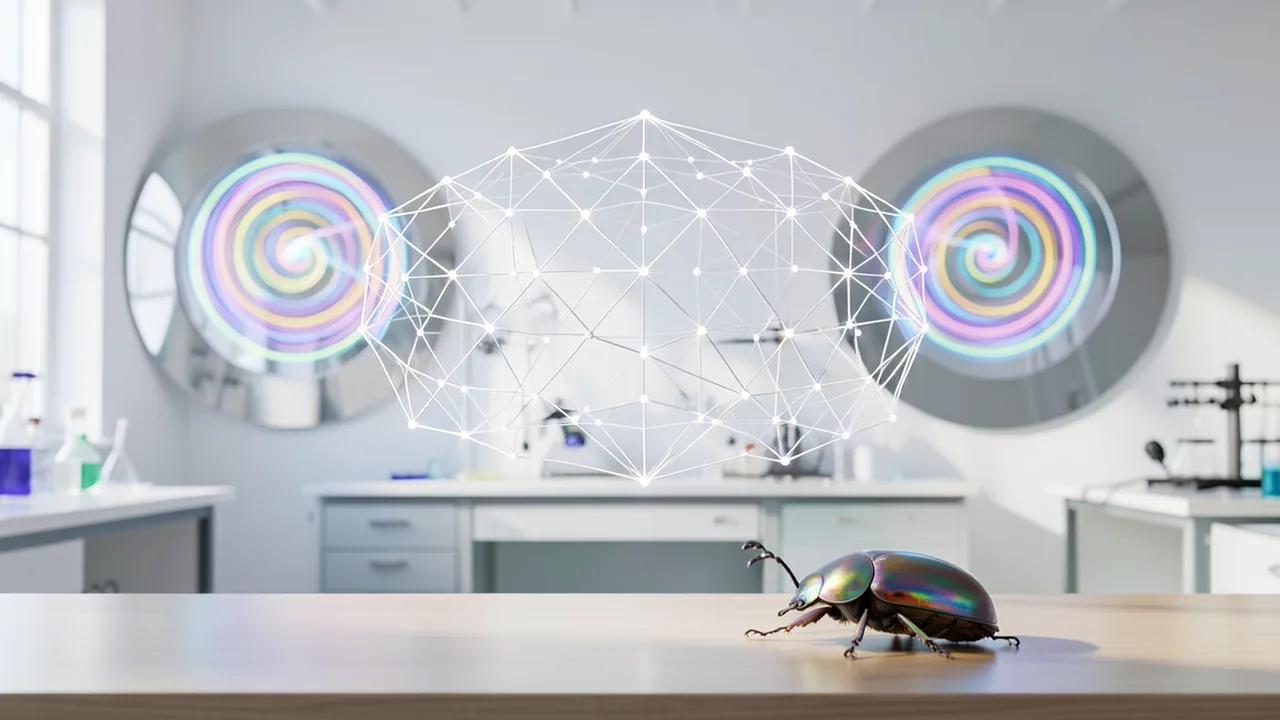
Craig explains this with light in a box between two mirrors. Send left circularly polarized light in, and an ordinary mirror turns it into right-polarized light when it reflects, so suddenly the box contains both kinds. The fix is chiral mirrors made from special films with molecules arranged in spirals. They reflect left-handed light as left-handed and let right-handed light pass through. Some scarab beetles have a similar spiral structure in their iridescent shells.
The lattice equivalent of these mirrors has been around for a while. Paul Ginsparg and Nobel laureate Ken Wilson set out the rules. Rajamani Narayanan and Herbert Neuberger developed overlap fermions, a way of defining fermions on the lattice so the unwanted doubles disappear. Martin Lüscher showed how to tell left-handed and right-handed overlap fermions apart, and Yoshio Kikukawa and colleagues studied how to use them to describe the weak force.
The missing piece: getting the phase right
According to Craig, one piece was still missing. In the light-box picture, it's the phase. For light to build up in the box, every returning wave has to arrive in step with fresh light from the laser. Otherwise the waves partly cancel out. In the lab, you fix that by tilting one mirror slightly relative to the other.
On the lattice it's much harder, because the phase depends on what the forces are doing at every single lattice point. If you change the force fields in small steps and end up back where you started, you can get a different phase than you began with. So you need a rule that corrects the phase properly for every round trip like this. Lüscher found that rule for simpler theories such as a chiral version of electromagnetism. For the full Standard Model, it stayed out of reach for more than 25 years.
Craig's idea: take the force fields on the lattice you want and map those same fields onto a sequence of ever finer lattices. Comparing the allowed fermion states on each pair of neighboring lattices gives you one piece of the phase correction, and adding up the pieces gives you the phase rule on the original lattice. Craig says the proof shows three things. The rule gives the right correction for every allowed round trip. The correction at any one spot depends mainly on the fields nearby. And different mathematical descriptions of the same fields lead to the same result. That gives you what's called the measure for the Standard Model at finite lattice spacing. One limitation remains: field strengths at the scale of the lattice have to be bounded.
What the AI contributed
Craig says he had a strategy but couldn't prove it worked in every case that mattered. He writes about GPT-6 Astra:
GPT-6 Astra was crucial in turning the refinement idea into a working construction. It suggested the right way to carry the force fields over to finer lattices, showed that the comparisons on finer lattices converge to a definite result, and took the lead in working out the detailed proof.
Getting there took several rounds of work with the model and conversations with outside experts. Lattice field theorists Maarten Golterman, Andreas Kronfeld and Yigal Shamir looked over Astra's proof and asked tough questions. Craig says that was important for him to trust the result.
Some background: OpenAI officially launched GPT-6 Astra in September. According to The Journal and Campus Technology, it's the first model OpenAI has rated "critical" for cybersecurity under its own Preparedness Framework. Given the right tools, the model can apparently find and exploit unknown security vulnerabilities on its own. For now, its most advanced cyber capabilities are only available to selected testing partners. Mashable reports that Astra made headlines even before launch: OpenAI said an internal model by that name had solved ten open problems in mathematics and theoretical computer science.
What's still open
Craig is keeping expectations in check himself. He calls the result "much more a beginning than an end." Experts still need to work out whether the construction has all the properties it should. It's more of an answer in principle than a practical one, he says, and there's a lot of work left before anyone can run realistic lattice simulations with it. He's currently checking whether the construction satisfies reflection positivity at finite lattice spacing. That condition ties lattice calculations to a quantum theory in which probabilities are conserved.
There's also the question of how the interacting theory is defined in continuous space, meaning the limit of an infinitely fine lattice. Here Craig points to what he describes as a recent OpenAI proof of the existence of Yang-Mills theory, the kind of theory the strong and weak forces belong to. Building on that, he says, the existence of the simplest unified Yang-Mills theory with the Standard Model's gauge fields and fermions has been proven, starting from overlap fermions on the lattice. The post alone doesn't let you judge how far that claim goes or whether the wider field will accept it.
Analysis
The post shows a new kind of collaboration. A physicist supplies the core idea, and a language model works out the technically demanding proof. Earlier AI wins in mathematics were often about counterexamples and disproofs. This one is a positive construction for a long-standing open problem in theoretical physics.
There are some caveats. The post appears on OpenAI's own blog, and Craig works for the company as a visiting scientist. So far the work is a preprint without formal peer review. Three respected experts did go through the proof, but that's no substitute for scrutiny by the wider field. Craig himself only calls it a "candidate," and one key property, reflection positivity, is still unresolved. There's no practical payoff for simulations yet. But if the result holds up, AI will have made a measurable contribution to a foundational question that experts have struggled with for decades.
Sources
- OpenAI openai.com
- thejournal.com thejournal.com
- campustechnology.com campustechnology.com
- mashable.com mashable.com
- Merkliste: superpowerdaily.com superpowerdaily.com
- Merkliste: blockchain.news blockchain.news
- dev.to #ai dev.to
- Merkliste: explainx.ai explainx.ai
Ask the AI assistant
Questions about this article, installation or background? Our assistant knows this page and runs on our own machine, not in someone else's cloud.
The Assistant is an AI (Gemma 4) and can make mistakes – please check important details against the source. Questions are used only to generate an answer and are deleted after one hour. Please don't enter any personal data.


Comments
What do you think? Already tried it? Write it here, no sign-up needed.
Comments are public. Links aren't allowed, and we delete abusive posts. You can delete your own comment at any time in this browser. Learn more in the Privacy Policy.