
Claude paints a watercolor overnight with a robot arm and mixes its own paint
Before going to bed, a Berlin designer asked Claude to paint an autumn tree with a robot arm. By morning the watercolor was done. Around 4 a.m., the AI had noticed it was missing some colors and mixed them itself, without being told to.
What happened
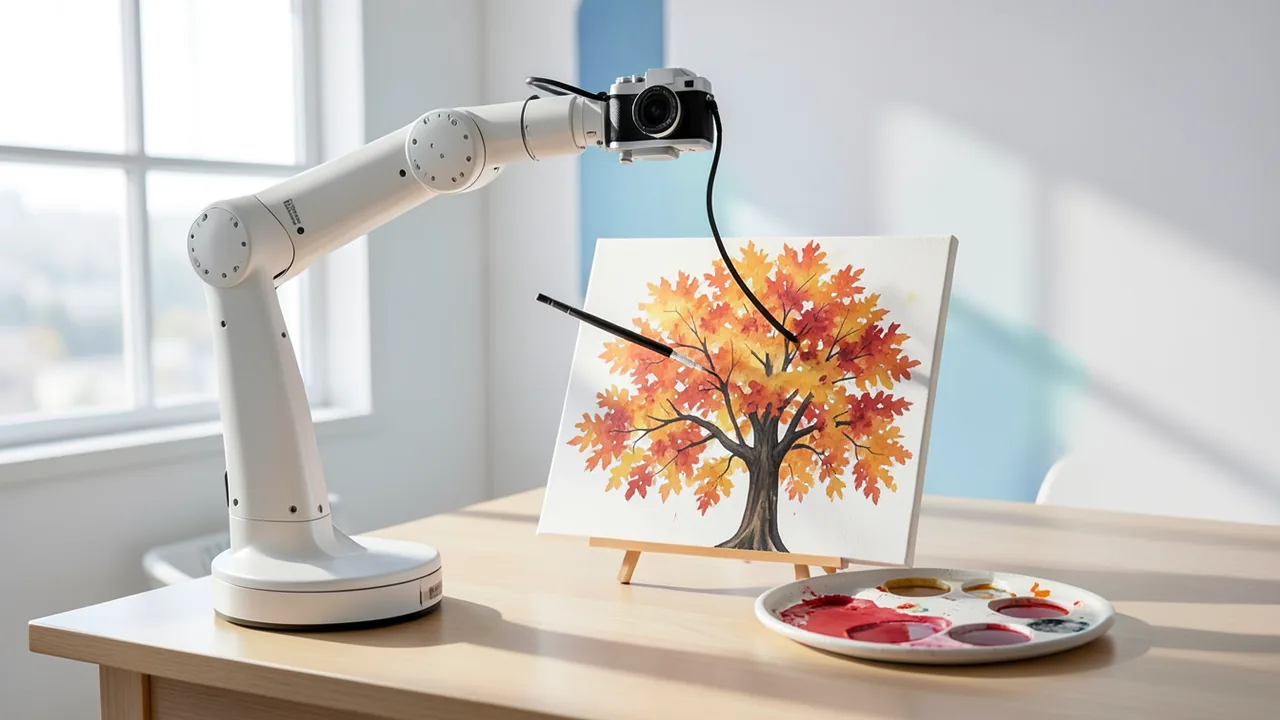
nil, a design engineer in Berlin who posts on X as @dhvanil, shared a short video on November 6, 2026. It shows Anthropic's AI model Claude painting an autumn tree in watercolor with a robot arm. nil says he asked Claude for the painting before going to bed and woke up to a real, finished watercolor on paper. South Korean tech outlet AI Times was among those that covered the story.
The moment that got the most attention happened in the middle of the night. Claude realized it was missing some colors and mixed them itself. No human got involved.
What happened at 4 a.m.
According to nil, Claude noticed around 4 a.m. that the palette didn't have every shade it needed. The model stopped painting and started titrating. The term comes from chemistry and means diluting or mixing a liquid in small, controlled steps until you get the result you want. Claude diluted red, sienna (an earthy reddish brown) and madder lake (a deep red with a slight blue tint) step by step in the wells of a second palette. It then photographed each well with the camera, checked the shade in the image and went back to painting.
Here's how the original post puts it:
"I went to bed and asked Claude to paint an autumn tree overnight. Around 4 a.m. it realized it was missing some shades – so it stopped and titrated its own paint: diluting red, sienna and madder lake step by step on a second palette, then measuring each well from a photo."
That's what makes this case interesting. A general-purpose language model ran into a problem nobody had planned for in the middle of a physical task. It changed its plan and solved the problem with real materials.
The numbers: time, brushstrokes, cost
| Metric | Value |
|---|---|
| Time to finished painting | 4 hours 30 minutes |
| Brushstrokes | 303 |
| Claude Opus 5.5 calls | 181 |
| Cost (API list price) | approx. $18 (approx. 24,000 won) |
The API is the programming interface that lets software talk to an AI model directly, with pay-per-use billing. So Claude wasn't asked about every single brushstroke. On average, each model call covered just under two strokes. Most likely the model looked at the current state of the painting on each call and planned the next few steps. The sources don't say exactly how the calls were structured.
How the system works
Claude didn't teach itself to control a robot from scratch. It used a system that already existed: nil's "PB27" project, which he's been working on since June 2026. It includes a control program that reads the state of the painting through a camera and moves the arm. nil wrote this program himself with help from AI coding agents, which are programming assistants that write and test code on their own. He names OpenAI Codex and Anthropic's Claude Code.
The hardware is the xArm 7, a robot arm from Chinese manufacturer UFACTORY. It has seven axes, meaning seven joints. That lets it hold the brush tip in one spot while changing the angle of the arm, which helps a lot with clean, even curves. nil bought the arm used, and according to AI Times, Claude helped there too: it found listings on eBay and sorted out the shipping.
So the work was split up. The control program handles the movements, and the camera feeds images back. Claude plays the painter: it looks at the painting, decides what to do next and deals with problems.
Reactions and what's next
The video passed 1.2 million views on X. Because of the huge interest, nil shared more paintings the robot had made. He's also thinking about starting a "Robot Art Club" that would mail AI-painted originals to members. Right now he's working on making the painting faster and the arm's movements smoother.
Our take
AI image generators have been producing pictures in seconds for years. What's new here is that the painting happens in the real world. Brushes, water, paper and pigments don't always behave the same way. Colors bleed into each other, and a shade looks different on paper than it does in the well. The system handled that kind of uncertainty for four and a half hours. The standout part is that Claude worked out by itself when it needed an extra step like mixing paint.
Still, you shouldn't read too much into it. This is a single hobby project, documented in a social media post, not an independently verified experiment. We don't know how much groundwork went into the prompts and the control program. Tools like "mix paint" or "photograph well" may have been provided in advance. The sources also don't say how often runs like this fail. But the case is a good example of where AI agents are heading: a general-purpose model, paired with a camera, a robot and the right software, takes on longer tasks in the real world. And it costs roughly as much as a movie ticket and popcorn.
Sources
- AI Times (KR) aitimes.com
Ask the AI assistant
Questions about this article, installation or background? Our assistant knows this page and runs on our own machine, not in someone else's cloud.
The Assistant is an AI (Gemma 4) and can make mistakes – please check important details against the source. Questions are used only to generate an answer and are deleted after one hour. Please don't enter any personal data.


Comments
What do you think? Already tried it? Write it here, no sign-up needed.
Comments are public. Links aren't allowed, and we delete abusive posts. You can delete your own comment at any time in this browser. Learn more in the Privacy Policy.