
Ex-OpenAI exec Kevin Weil launches Warp Sciences to automate drug-discovery labs
Kevin Weil, who used to head OpenAI's science division, has started Warp Sciences. The startup wants to use AI and robots to automate chemistry lab work for drug development, and it has raised $215 million to do it.
What's going on
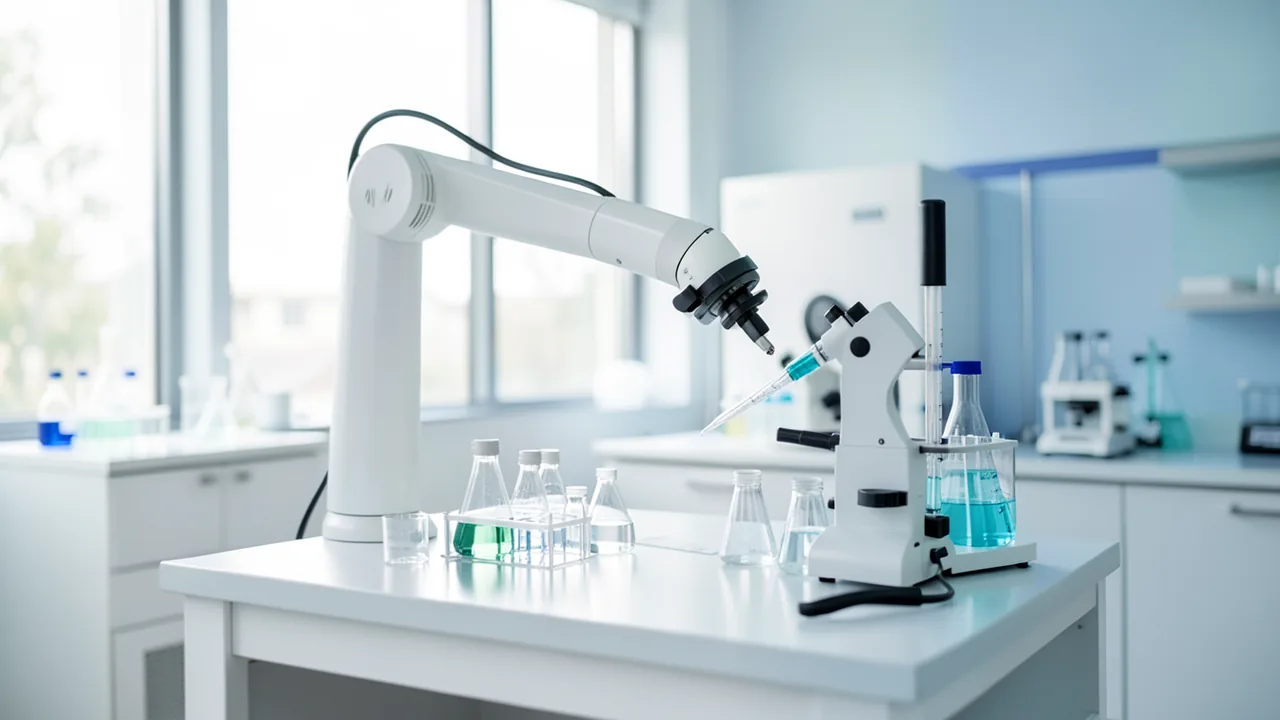
Kevin Weil, formerly OpenAI's Chief Product Officer and head of its science division, has founded the startup Warp Sciences. According to Bloomberg (October 22, local time), the company has closed a $215 million Series A round (about 280 billion won) at a valuation of $865 million. The goal is a largely automated drug-development lab where AI and robots run the experiments.
Backers and founding team
Lightspeed Venture Partners led the round. Other investors include IVP, Mayfield, Lux Capital, Premji Invest and Menlo Ventures. The angel investors include OpenAI CFO Sarah Friar and former OpenAI executive Fidji Simo, as well as Brian Armstrong (Coinbase), Shyam Sankar (Palantir) and Reid Hoffman (LinkedIn). The co-founders include Manohar Paluri, previously a vice president in Meta's superintelligence research; DJ Patil, the White House's first Chief Data Scientist; and Solomon Reisberg, a former manager at Teremoto Biosciences.
The business model: lead optimization
Warp isn't developing its own drugs. Instead, it sells research services to pharma and biotech companies: synthesizing and testing compounds. The first service is lead optimization. Once a promising molecule has been found, hundreds to thousands of variants are made and tested to boost its effect and reduce side effects.
Pharma companies have often outsourced this work to Chinese contract research organizations such as WuXi AppTec, which dominate the market with low costs and high speed. The US–China conflict makes that dependence risky, and some companies are reluctant to share sensitive data and intellectual property with Chinese partners. Weil wants to bring this work back to the US. To do that, he says, Warp has to match Chinese providers on efficiency, hence the automated lab.
How the lab is supposed to work
The team of about 20 has already acquired robotic arms and AI chips. During experiments, researchers wear body cameras and gloves with pressure sensors. The idea is to capture how experienced chemists work, then use that data to train Warp's own AI models and teach robots to handle different lab tasks. In the long run, the robots are meant to work around the clock and cut the time and cost of synthesis and testing.
At first, though, it's still mostly chemists doing the work. The AI helps with synthesis routes and with choosing the next experiment. Repetitive steps such as reaction setup and sample purification will be automated first.
Weil sees a flywheel: more automated experiments produce data, the AI learns from it, plans better experiments and automates more. He says: "The lab drives the AI forward, and the AI drives the lab forward." AI has achieved a lot in software development and math, he argues, but not yet in the experimental sciences, because models need real-world experimental data.
Warp plans to combine current frontier models with its own customized open-weight models (models whose weights are freely available). Weil says the company is still at the beginning and wants to use open-weight models developed in the US.
Background
Weil joined OpenAI as CPO in June 2024 and was responsible for products such as ChatGPT. He later led "OpenAI for Science" and pushed "Prism," an AI workspace for researchers and paper writing. Even there, he promoted combining AI with robotic labs: AI drafts hypotheses and experiments, robots run them, and the results flow back. In a podcast in February, he named the goal of pulling forward discoveries expected in 2050 to 2030. Lightspeed partner Guru Chahal plans to connect Warp with life-science portfolio companies and mentions a possible later expansion into other research fields.
Our take
The sum shows how much capital is flowing into "AI for science," especially where real experiments are required. The geopolitical angle is interesting: countering China's cost advantage through automation. What's still open is whether robots can really match established contract researchers on price and speed. So far there are no results, only plans and company claims. The launch starts with a lot of human labor.
Sources
- AI Times (KR) aitimes.com
Ask the AI assistant
Questions about this article, installation or background? Our assistant knows this page and runs on our own machine, not in someone else's cloud.
The Assistant is an AI (Gemma 4) and can make mistakes – please check important details against the source. Questions are used only to generate an answer and are deleted after one hour. Please don't enter any personal data.


Comments
What do you think? Already tried it? Write it here, no sign-up needed.
Comments are public. Links aren't allowed, and we delete abusive posts. You can delete your own comment at any time in this browser. Learn more in the Privacy Policy.